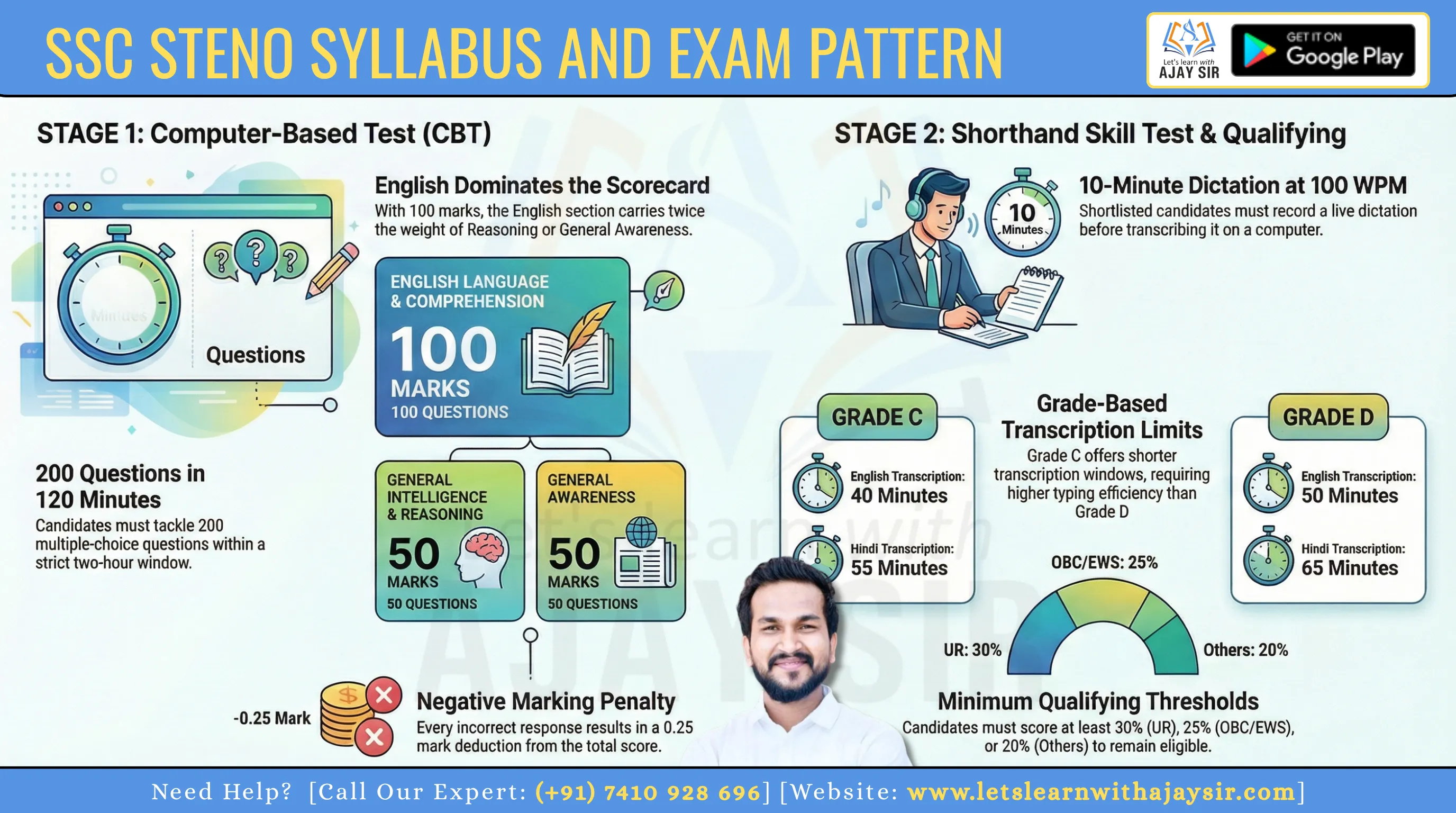
This concise guide gives you a clear, future-facing view of the SSC Stenographer Syllabus and Exam Pattern 2026 so you can plan with purpose. You’ll see how the three-section CBT of 200 questions and 200 marks runs for two hours, with a 0.25 negative mark for each wrong answer.
You will learn who may apply, the Grade C and Grade D age limits, the 12th-pass requirement, and nationality categories that qualify. The skill test is short but strict: 10 minutes of dictation at 100 wpm, with fixed transcription times by grade and language.
Use the official website and the SSC Annual Calendar to catch the notification, application window, admit card, answer key and results without delay. This introduction sets up a practical roadmap: map topics, schedule mocks, and target the qualifying marks for your category.
Read on to convert the syllabus into a weekly plan that builds speed, accuracy and confidence for the selection process.
Quick Overview
SSC Stenographer Syllabus and Exam Pattern 2026: at a glance
Get a clear brief on the posts available, the online delivery and the milestones you must track. The recruitment fills Grade C and Grade D roles across ministries, departments and national bodies. Each post follows the same pathway even if duties vary by organisation.
The selection is a fully online CBT with bilingual delivery in English Hindi for most sections. Note that the English language section is in English only. The CBT tests core skills: general intelligence, reasoning, general awareness and language ability. Use the heavier weight of English to shape a focused study plan.
Frequency: once a year at national level.
Key portal: ssc.gov.in for notifications and schedule.
Timeline: notification + application release together; admit card about a week before the CBT; then answer key, skill test and final result with document verification.
Item | Detail | Who it affects |
Posts | Grade C, Grade D across central departments | Fresh 12th-pass candidates and working applicants |
Mode | Online objective CBT; bilingual except English section | All registered candidates |
Schedule flow | Notification & application → admit card → CBT → answer key → skill test → result + DV | Shortlisted and selected applicants |
Syllabus & Exam Pattern
SSC Stenographer Syllabus and Exam Pattern 2026
This section breaks down the full CBT blueprint so you know where every question and mark sits. The objective test totals 200 multiple‑choice items. Time is fixed at two hours.
CBT structure: sections, marks, duration and negative marking
The CBT splits like this:
Section | Questions | Marks |
General Intelligence & Reasoning | 50 | 50 |
General Awareness | 50 | 50 |
English Language & Comprehension | 100 | 100 |
Negative marking: you lose 0.25 for each wrong response. Use elimination to make smart guesses.
Language options: English and Hindi in the CBT
The interface is bilingual—English Hindi—except the english language section, which appears in English only. Choose the language that matches your schooling to boost speed and accuracy.
Plan a two‑hour time grid that plays to your strengths.
Mirror this exam pattern in mocks to reduce surprise on test day.
Shortlisted candidates face a skill test: 10 minutes dictation at 100 wpm with set transcription times by grade and language.
SSC Stenographer Syllabus 2026: General Intelligence & Reasoning
This part covers the core reasoning topics you must master. You will see how verbal and non‑verbal items appear and which drills raise your speed. Keep practice short and focused.
Verbal and non‑verbal topics
The list includes analogies, similarities and differences, coding‑decoding, number series and figure classification. It also covers Venn diagrams, blood relations, directions and order‑ranking.
Space visualisation, non‑verbal series and visual memory form the image‑based set. Puzzles and arithmetical reasoning test multi‑step thinking under time pressure.
Higher‑order skills and drills
Work on judgement and decision‑making by solving mixed clues sets. Use step‑by‑step diagramming for relationship concepts to avoid common traps.
Timed sectional tests that mirror the 50‑mark load are vital. Review errors to spot concept gaps versus careless slips, then apply micro‑practice to fix them.
Topic group | Sample items | Practice drill |
Verbal reasoning | Analogies, classification, coding | Daily 15‑minute sets; accuracy focus |
Numerical & arithmetical | Number series, arithmetical reasoning | Timed series practice; short calculation checks |
Non‑verbal & spatial | Figure series, space visualisation | Image drills; visual memory flashcards |
Logical relations | Venn, puzzles, blood relations, directions | Diagramming; mixed‑clue puzzles under time |
Tip: follow the ssc steno syllabus list and rotate topics so every session hits both verbal and visual skills. This balances your preparation for the test and helps candidates build reliable speed.
SSC Stenographer Syllabus 2026: General Awareness
This section checks both fixed facts about India and its neighbours and your awareness of recent national developments. General awareness measures how well you link background knowledge with current events, practical science and civic issues.
Static topics to cover
Focus on History, Polity, Geography, Economy and the Constitution. Build concise notes that list key dates, landmark judgments, physical features, major economic terms and constitutional articles.
Current affairs and science
Daily current affairs should include government schemes, appointments, reports, sports results and science & technology updates. Relate each item to policy or constitutional context to answer application-style questions with confidence.
Special note for VH candidates
Visual handicap (≥40%) candidates will not face maps, graphs, diagrams or statistical displays in the reasoning or general awareness sections. Use this to tailor practice and focus more on textual facts and concepts.
Use weekly mini-quizzes to lock facts into memory.
Prioritise India and neighbouring countries; culture and sports appear often.
Monthly revisions with short recall notes boost retention before the test.
Area | What to learn | Study tip |
History & Culture | Freedom movement highlights, art, heritage sites | Flashcards of dates and personalities |
Polity & Constitution | Fundamental rights, key amendments, important articles | Link current events to articles for context |
Economy & Science | Budget basics, schemes, everyday science concepts | Short summaries and practical examples |
SSC Stenographer Syllabus 2026: English Language & Comprehension
The english language section tests comprehension, usage and structure; clear practice makes it predictable. It covers reading passages, grammar items, vocabulary, sentence formation and editing for accuracy.
Grammar and usage: error spotting, voice, speech
Focus areas include subject–verb agreement, tenses, articles and prepositions. You will practise active/passive and direct/indirect conversions to reduce time lost on transforms.
Tip: do short timed drills on error spotting to build reflexes for common traps with pronouns and tense shifts.
Vocabulary and reading: RC, synonyms/antonyms, idioms
Expand daily with synonym‑antonym sets, idioms in context and spelling pattern work. For reading comprehension, learn to skim for the main idea and scan for detail.
Work on inference questions and vocabulary‑in‑context to lift accuracy on tougher passages.
Sentence skills: jumbles and corrections
Para jumbles and sentence rearrangement demand logical connectors, chronology and pronoun links. Use connector lists and practise short reconstructions under time.
Combine grammar, vocabulary and RC in mixed timed sets to mirror the real test and boost section speed for the 100 marks available here.
Topic | What to practise | Result expected |
Grammar & Usage | Subject‑verb, tenses, voice/speech | Fewer errors in transformations |
Vocabulary & RC | Synonyms, antonyms, idioms, skimming | Faster correct answers on inference |
Sentence Skills | Para jumbles, sentence correction | Quicker logical assembly and edits |
SSC Stenographer Syllabus 2026: Skill Test in Stenography
This part explains how the final practical stage measures your shorthand speed, accuracy and computer transcription skills. You face a continuous 10‑minute dictation at 100 words per minute, then you transcribe on a computer within fixed time limits.
Quick facts: the skill test uses live dictation. Transcription times differ by grade and language. Practise both capture and digital transcription to avoid surprises.
Grade C versus Grade D time limits
Grade D candidates transcribe English in 50 minutes and Hindi in 65 minutes. Grade C candidates have 40 minutes for English and 55 minutes for Hindi.
Shorthand notes and computer transcription best practices
Keep abbreviations consistent, leave clear spacing and mark paragraph breaks. That reduces expansion time during typing.
Decide early between english hindi to focus drills on one language.
Pair daily dictation speedwork with timed transcription sessions.
Set up your screen and keyboard so you edit without losing time.
Element | Detail | Practice tip |
Dictation | 10 minutes at 100 wpm | Weekly full runs under silence |
Transcription - Grade C | English 40 min, Hindi 55 min | Type expansion drills; track accuracy |
Transcription - Grade D | English 50 min, Hindi 65 min | Longer typing stamina sessions |
Workflow | Computer-based submission | Familiarise with layout and shortcuts |
Simulate the full skill test weekly. Track WPM and accuracy metrics so you meet the official standards for shortlisted candidates in the ssc stenographer exam.
SSC Stenographer Syllabus 2026: Marking scheme, qualifying marks and cut‑off trends
Start by seeing how marks and negative marking interact so you choose where to take calculated risks. The CBT totals 200 marks: General Intelligence & Reasoning 50, General Awareness 50 and English Language & Comprehension 100. Each wrong answer carries a 0.25 penalty, which changes the value of guessing on easy versus hard items.
Sectional composition and the 0.25 penalty
Keep section-wise balance in mind. Over-relying on one area raises your vulnerability if that section proves tougher than expected. Use this simple rule: prefer accuracy over volume when negative marking can erode small gains.
Strategy: attempt safe, high-confidence items first to protect aggregate marks.
Mocks: track marks per section and adjust attempts based on accuracy trends.
Post-test: use the answer key to estimate raw score and likely cut-offs before results are published.
Minimum qualifying marks and cut‑off drivers
Minimum qualifying thresholds are: UR 30%, OBC/EWS 25% and other categories 20%. Aim higher than these floors to remain competitive against typical cut-off movement.
Item | Value | Why it matters |
Sectional split | 50 | 50 | 100 | Guides time allocation and practice focus |
Negative mark | -0.25 per wrong | Reduces benefit of blind guessing |
Qualifying marks | UR 30%, OBC/EWS 25%, Others 20% | Set minimum targets; plan to exceed them |
Final selection depends on clearing the CBT, qualifying the skill test and then document verification. Track your mock scores, use the provisional answer key for quick estimates, and set targets that place you comfortably above likely cut-offs.
All Details
Conclusion
Finish strong: set precise targets for marks, speed and deadlines so you enter the test room calm and ready.
You now have the end‑to‑end pathway: check eligibility, submit the application, master the 200‑mark CBT (two hours, -0.25 per wrong) and clear the skill test before document verification.
Note the weight on English, the Grade C versus Grade D transcription times, and the category qualifying marks so you can plan attempts to protect safe marks.
Track ssc stenographer notices, answer keys and results on ssc.gov.in. Use mocks, focused shorthand drills and timed transcriptions to turn this ssc stenographer syllabus into reliable performance.
Disclaimer:
All eligible and interested candidates are advised to read the official notification carefully before applying online.
Disclaimer: The examination results and marks published on this website are provided solely for immediate information to candidates and do not constitute a legal document. While every effort has been made to ensure the accuracy and authenticity of the information available on this website, we are not responsible for any inadvertent errors that may occur in the publication of examination results or marks. We shall not be liable for any loss or damage to any individual or entity arising from any deficiency, defect, or inaccuracy in the information provided on this website.

![EMRS PGT [Tier-2] ENGLISH - 2025](https://letslearnwithajaysir.s3.ap-south-1.amazonaws.com/courses/FsnKxIFpiLxbRD418g6vo7AsLy0ge7IP7Iu2fsJY.webp)
![EMRS TGT [Tier-2] ENGLISH - 2025](https://letslearnwithajaysir.s3.ap-south-1.amazonaws.com/courses/BjLXVqVV1SeZKnhYjmPZpz2jQ7r02kS73pGGOLrL.webp)
![KVS/NVS PGT ENGLISH [Tier-2] - 2025](https://letslearnwithajaysir.s3.ap-south-1.amazonaws.com/courses/vqli598KWrKnm4txcsZh5qjMN9UMAX8LvFk9IiF0.webp)
![KVS/NVS TGT ENGLISH [Tier-2] - 2025](https://letslearnwithajaysir.s3.ap-south-1.amazonaws.com/courses/pxC2WhfYKuyaoGqvcTvhTBL2Y44o3TNA0z8NYRB5.webp)