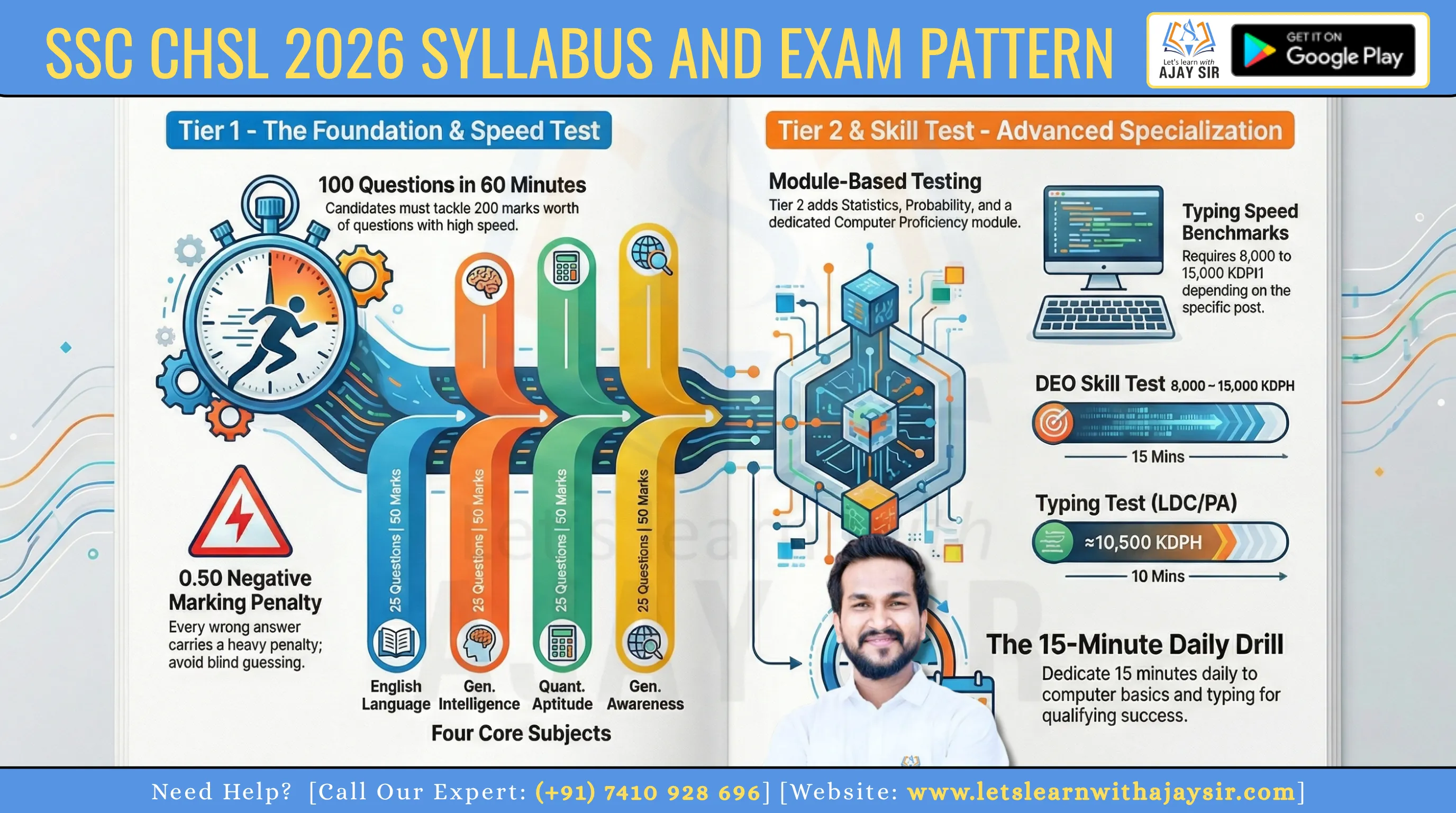
That single fact alone shows how much structure matters. The exam you’re tackling runs in two objective tiers, then a qualifying skill or typing test. Tier 1 packs 100 questions into 60 minutes for 200 marks with a half-mark penalty for wrong answers.
You’ll get a clear, up‑to‑date map of the ssc chsl syllabus and tiers so you can plan with confidence and avoid last‑minute confusion. Tier 2 shifts to module-based testing — mathematical abilities, reasoning and intelligence, English comprehension, general awareness and computer proficiency — and now includes statistics and probability.
This introduction will help you align daily study blocks to the exam pattern, turn topics into weekly goals and focus on mock tests and past papers that reveal previous year trends. It also flags how the Skill/Typing Test and prescribed speeds affect final selection, so you can schedule targeted practice well before the test window.
Quick Overview
SSC CHSL Syllabus and Exam Pattern 2026: Overview
Get a compact roadmap to the chsl tier exam that links topics, timings and scoring to practical study slots.
You’ll find the full ssc chsl journey here: what each tier checks, how it’s scored and where time pressure bites. This makes planning simple and reduces wasted effort.
Tier snapshot: Tier 1 has 100 questions for 200 marks in 60 minutes with a 0.50 negative mark for wrong answers. Core subjects are English language, general intelligence, quantitative aptitude and general awareness.
Tier 2 covers Mathematical Abilities, Reasoning & General Intelligence, English & Comprehension, General Awareness and Computer Proficiency. The computer module includes MS Office, internet, networking and cyber security.
You’ll learn how negative marking alters guessing strategy and which topics give fastest gains.
We turn broad topics into short, weekly blocks so candidates can track progress.
The guide links past year trends to practical drills, saving time for busy candidates.
Section | Questions | Marks | Time | Negative |
Tier 1 (Overall) | 100 | 200 | 60 minutes | 0.50 per wrong |
Tier 1 Subjects | English, Reasoning, Quant, GA | 200 (combined) | 60 minutes | 0.50 per wrong |
Tier 2 Modules | Module-based | Varies by post | As per notification | No negative (depends) |
Syllabus & Exam Pattern
SSC CHSL Syllabus 2026
Know which topics stay constant and which modules expand so you can shape a reliable study plan.
Tier-wise scope: what changes and what stays consistent
You keep four objective subjects in Tier 1: English, general intelligence, quantitative aptitude and general awareness. These core areas appear year after year and form the foundation of your prep.
Tier 2 widens the focus. It adds statistics and probability to mathematical abilities and includes a separate computer proficiency module. The skill/typing test remains a qualifying hurdle.
How to use the official syllabus PDF effectively
Turn the PDF into a checklist. Map each line item to chapters, assign practice sets and mark completion weekly. Use previous year data to prioritise high‑frequency topics first.
Log the number of questions solved per topic to spot weak areas.
Pair quant drills with reasoning practice to build speed and accuracy.
Allocate short sessions for computer basics and cyber security.
Tier | Core focus | Key additions | Prep tip |
Tier 1 | English, Reasoning, Quant, GA | Consistent topics: arithmetic, algebra, geometry | Cover high‑frequency topics first; track questions solved |
Tier 2 | Mathematical Abilities, Reasoning, English, GA, Computer | Statistics, probability, computer proficiency | Plan module‑wise sessions and simulate timed tests |
Skill/Typing | Qualifying test | Typing speed and accuracy | Practice regularly under exam conditions |
SSC CHSL Syllabus 2026: Tier 1 syllabus
Tier 1 is compact but fast‑paced; here’s a clear breakdown of its four core papers.
English Language focuses on reading comprehension, error detection, filling in the blanks and vocabulary items like synonyms, antonyms and one‑word substitution.
Practice close tests, passages and sentence improvement daily. Use pattern drills for active/passive voice and direct/indirect speech to build confidence quickly.
English essentials
Reading comprehension and closing passages for speed.
Grammar control: error detection and sentence correction.
Vocabulary: daily synonyms/antonyms and idioms.
Reasoning and visual sets
General Intelligence blends verbal and non‑verbal reasoning: series, semantic classification, coding‑decoding, syllogism and puzzles.
Add mirror/water images, paper folding and Venn diagrams to switch between figural and verbal items comfortably.
Number sense and problem solving
Quantitative Aptitude covers number system basics, arithmetic, algebra, geometry, mensuration, trigonometry and data interpretation.
Start with relationship numbers, percentages and ratios, then layer TSD and DI practice. Learn shortcuts to save seconds per question.
Static and current topics
General Awareness mixes history, polity, geography, economy and science with current affairs, awards and environment questions.
Balance weekly static revision with a short daily current affairs passage to lock in easy marks.
Section | Core focus | High‑yield topics | Quick prep tip |
English Language | Comprehension, grammar, vocab | Passages, cloze, active/passive voice | Daily passage + 10 vocab items |
General Intelligence | Verbal & non‑verbal reasoning | Series, classification, puzzles, Venns | Mixed sets under timed conditions |
Quantitative Aptitude | Arithmetic to DI | Percent, ratio, algebra, geometry, DI | Short drills, then full timed sets |
General Awareness | Static + current events | Polity, science, economy, current affairs | Weekly static + daily 10‑minute news review |
SSC CHSL Exam Pattern 2026: Tier 1
Know the precise timing and question split so every minute of the test counts for marks.
Pattern snapshot: Tier 1 contains 100 objective questions for 200 marks to be completed in 60 minutes. Each wrong answer carries a 0.50 mark penalty, so guessing must be selective.
Exact section split and pacing
There are four sections with 25 questions and 50 marks each: General Intelligence, Quantitative Aptitude, English Language and General Awareness.
Plan micro‑targets: aim for a fixed number of questions per 10 minutes, leaving a five‑minute buffer to review flagged items. Use mark‑and‑move tactics to protect overall accuracy.
Strategy and candidate considerations
Start with your strengths (for many, GI and English) to secure quick marks.
Adjust your guessing threshold: a 0.50 negative changes risk–reward for each question.
Track section accuracy across mocks so you can reallocate time to the highest‑return areas before the exam.
PwD candidates entitled to a scribe receive extra minutes as per rules; prepare documentation and logistics well in advance.
Metric | Value | Prep tip |
Questions | 100 total (25 per section) | Set 10‑minute targets and practise speed |
Marks | 200 total (50 per section) | Prioritise high‑accuracy attempts |
Time | 60 minutes | Keep a five‑minute final review buffer |
Negative | 0.50 per wrong | Use mark‑and‑move; avoid blind guessing |
SSC CHSL Syllabus 2026: Tier 2 syllabus
This stage asks you to balance depth with speed across five focused modules. You will build on quantitative foundations and add statistics, shift between semantic and figural reasoning, handle multi-paragraph English passages, cover India-first general awareness, and complete a compact computer module.
Mathematical Abilities
Topics: number systems, arithmetic, algebra (identities, surds, graphs), geometry, mensuration, trigonometry and basic statistics & probability.
Reasoning & General Intelligence
Practice semantic and symbolic analogies, series, classification, spatial orientation, folding/unfolding, Venn diagrams and coding/decoding. Mix verbal and figural sets to build flexible pattern recognition.
English & Comprehension
Work on vocabulary, grammar and sentence structure. Do multi‑paragraph practice: one narrative for inference and one editorial for argument and detail tracking.
General Awareness
Focus on India-centric history, polity, geography, economy, science and policy, plus current events and neighbours. Weekly recaps keep static and recent facts fresh.
Computer Proficiency
Cover PC basics (CPU, I/O, memory), MS Word/Excel/PowerPoint essentials, web browsing, email, e-banking, networking basics and common threats with simple preventive measures.
Scaffold quantitative study from arithmetic speed to algebra and geometry accuracy, then add statistics and probability.
Combine reasoning types in timed sets so you can shift patterns quickly during the test.
Map module weight to your schedule and add short recall sessions for formulas, vocab and keyboard shortcuts.
Module | High-yield topics | Quick prep tip |
Mathematical Abilities | Arithmetic, algebra, statistics | Daily timed drills + formula flashcards |
Reasoning | Series, Venns, spatial | Mixed sets under time pressure |
Computer | MS Office, networking, cyber safety | Short practical tasks and shortcuts |
SSC CHSL Exam Pattern 2026: Tier 2
Understand the flow of Tier 2 and the separate skill and typing tests to shape focused practice.
Session layout, modules, marks, and time allocation
Session 1 runs three sections: Section 1 (Mathematical Abilities + Reasoning), Section 2 (English + General Awareness) and Section 3 (Computer Knowledge).
Sections 1 and 2 usually carry 180 marks each and allow one hour per section. The Computer Knowledge module carries 45 marks for 15 minutes. Plan micro‑breaks between sections to reset focus.
Skill/Typing Test specifics for DEO, LDC/JSA, PA/SA
Session 2 is the practical round. Part A tests data entry skill; Part B tests typing speed and accuracy.
DEO skill test: aim for 8,000 KDPH standard, while some posts (C&AG DEO) require 15,000 KDPH; typical attempt length ≈15 minutes.
Typing test (LDC/JSA, PA/SA): target ~10,500 KDPH in a 10‑minute test; scribe candidates receive extra minutes.
Bring documentation for scribe eligibility and practise full passage drills to match exam pace.
Test | KDPH / Speed | Minutes |
DEO Skill | 8,000–15,000 KDPH | 15 |
Typing (LDC/PA) | ≈10,500 KDPH | 10 (scribe extra time) |
Practice tip: Simulate Session 1 back‑to‑back, then add a separate daily slot for skill and typing drills. This mirrors the exact ssc chsl pattern and builds stamina for exam day.
SSC CHSL Syllabus and Exam Pattern 2026: Syllabus PDF, previous year trends
Convert the downloadable syllabus PDF into a living roadmap for focused weekly work. Download the official file, print or save it, and mark each topic with a realistic due date. This turns broad goals into short, repeatable sprints you can measure every Sunday.
Download and organise the PDF for weekly sprints
Keep one master tracker. Colour-code topics: green = mastered, amber = partial, red = pending. Tag mocks by whether they follow the chsl exam pattern so every practice gives reliable feedback.
Leverage previous year patterns to optimise study hours
Use previous year trends to front-load high-yield topics. Prioritise arithmetic in quantitative work and analogue/series/coding items in reasoning. Allocate two short reasoning blocks on weekdays and a longer mixed set at the weekend.
Reserve 15 minutes daily for computer skills and keyboard practice.
Build a weekly current-affairs note and a monthly consolidation review.
Track progress each Sunday and reshuffle the next week based on mock performance.
Action | Focus | Frequency | Benefit |
Master tracker (PDF) | All topics listed by tier | Weekly review | Clear deadlines and progress visibility |
Mock tagging | Pattern alignment | After every full mock | Reliable feedback on weak sections |
Daily computer slot | MS Office, shortcuts, typing | 15 minutes/day | Prevents last-minute scrambling for test modules |
Current affairs consolidation | India-centric facts, schemes | Weekly notes; monthly recap | Long-term retention without cramming |
All Details
Conclusion
Use the final weeks to convert practice data into a tight, personalised revision plan.
Your clear blueprint: align daily work to the tier pattern, mix timed sets with quick topic drills and protect marks by avoiding low‑confidence guesses. Keep the ssc chsl syllabus checklist close and use previous year trends to set priorities.
Maintain short daily touchpoints for english language, reasoning and quantitative aptitude. Add brief computer practice and a few typing test drills so skill test pace is steady.
Track questions, minutes, correct answers and marks in mocks. Iterate weekly and enter the chsl tier stages calm, focused and exam‑ready.


![EMRS PGT [Tier-2] ENGLISH - 2025](https://letslearnwithajaysir.s3.ap-south-1.amazonaws.com/courses/FsnKxIFpiLxbRD418g6vo7AsLy0ge7IP7Iu2fsJY.webp)
![EMRS TGT [Tier-2] ENGLISH - 2025](https://letslearnwithajaysir.s3.ap-south-1.amazonaws.com/courses/BjLXVqVV1SeZKnhYjmPZpz2jQ7r02kS73pGGOLrL.webp)
![KVS/NVS PGT ENGLISH [Tier-2] - 2025](https://letslearnwithajaysir.s3.ap-south-1.amazonaws.com/courses/vqli598KWrKnm4txcsZh5qjMN9UMAX8LvFk9IiF0.webp)
![KVS/NVS TGT ENGLISH [Tier-2] - 2025](https://letslearnwithajaysir.s3.ap-south-1.amazonaws.com/courses/pxC2WhfYKuyaoGqvcTvhTBL2Y44o3TNA0z8NYRB5.webp)