The Madhya Pradesh Employee Selection Board opened recruitment for 10,758 teacher posts, a scale that reshaped vacancy trends overnight.
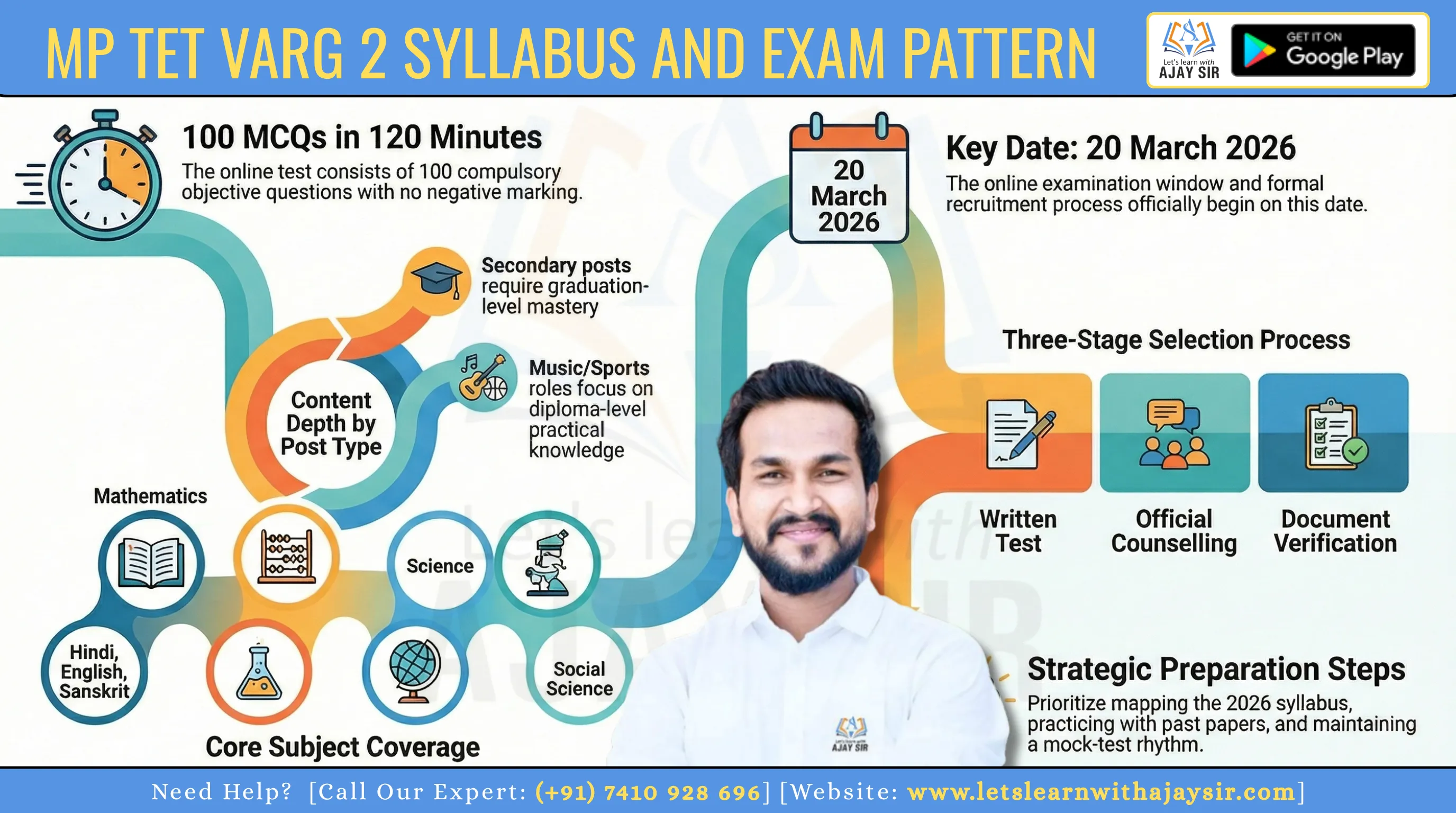
You will get a clear, friendly walkthrough of the full syllabus and exam pattern so you can plan your preparation with confidence. The written test is online, with 100 compulsory objective questions worth one mark each, a two-hour duration and no negative marking.
The test covers Hindi, English, Sanskrit, Mathematics, Science and Social Science. You will learn how subject emphasis varies for Secondary posts and for Primary Music/Sports roles, which follow diploma-level content.
This introduction points you to key dates and the conducting body. The online window starts on 20 March 2026 and formal PDFs are published at esb.mp.gov.in. Use this guide to benchmark study material, manage time and approach each question strategically.
Syllabus & Exam Pattern
MP TET Varg 2 Syllabus and Exam Pattern 2026
Below you will find a clear summary of what each paper contains, how long it runs and how each question is scored.
Exam structure at a glance
The test covers Hindi, English, Sanskrit, Mathematics, Science and Social Science. Each subject paper has 100 compulsory MCQs, worth 100 marks in total.
The total duration is two hours for every paper, held online from 20 March 2026 so you must practise on a screen interface to save time.
Difficulty level and content source
Questions draw mainly from Classes 9–12 of the state board, but items for Secondary posts reach graduation-level depth. Primary Music and Sports follow diploma-level content.
Marking scheme and attempts
Each correct response gives one mark; there is no negative marking. Attempt every question after ruling out unlikely choices.
Timing and pacing advice
Aim for about 72 seconds per question. Use a quick first pass to answer easy items and flag longer ones for review.
Practice on mock online tests to build speed with navigation.
Set a revision calendar that covers all six subjects before the March window.
Tune resources if you are preparing for Music or Sports posts; difficulty differs.
Subject | Number of questions | Marks | Duration |
Hindi, English, Sanskrit, Mathematics, Science, Social Science | 100 MCQs | 100 | 2 hours (online) |
Secondary (subject papers) | 100 | 100 | 2 hours |
Primary Music / Sports (diploma level) | 100 | 100 | 2 hours |
MP TET Varg 2 Syllabus and Exam Pattern 2026: Post-wise scope
Here you will see how each post’s scope differs: deep content for secondary roles, practical focus for primary music and sports. This helps you pick the right varg teacher paper and plan study time.
Secondary teacher framework
Secondary posts test graduation-level content. You choose a subject that matches your highest degree — Hindi, English, Sanskrit, Mathematics, Science or Social Science.
Choosing the correct varg teacher paper strengthens your eligibility and improves clarity during the exam. Study graduation texts for content mastery.
Primary, music and sports variants
Primary roles in Music and Sports follow diploma-level content with practical emphasis. Specialised singing, instrumental or dance categories assess repertoire, technique and related theory.
Special categories: Singing, Instrumental and Dance are judged through subject-specific MCQs at the prescribed level.
Documentation: Match your degree or diploma carefully to avoid eligibility issues with the selection board.
Post type | Level | Focus |
Secondary teacher | Graduation | Subject mastery |
Primary Music/Sports | Diploma | Technique & repertoire |
Specialised roles | Diploma/Performance | Practical knowledge |
Tip: As a tet varg teacher candidate, align resources to your post — graduation books for secondary, diploma materials for music and sports — so your preparation maps tightly to the official syllabus and supports selection board checks.
MP TET Varg 2 Syllabus 2026: Hindi syllabus outline
This section maps the Hindi paper so you can link historical roots to modern usage and answer questions with context. It shows which topics recur in objective items and how to focus on quick revision sessions.
Language evolution and dialects
Trace Hindi from Pali, Prakrit and Apabhramsa to regional varieties such as Eastern Hindi, Rajasthani and Pahari. Note features of Khadi Boli, Braj and Awadhi that influence modern usage.
Script and standard norms
Revise Devanagari basics: alphabet order, vowels, consonants and common orthographic rules. These points often form straightforward objective items in the tet varg syllabus.
Periods, authors and genres
Cover Adikal, Bhakti Kal, Reetikal and the Modern period. Link authors like Premchand, Surdas, Kabir and Mahadevi Verma to their themes and notable works so you answer literature prompts fast.
Poetics, grammar and vocabulary
Study rasa theory, chhandas such as Doha and Chaupai, and common alankar. Strengthen grammar: parts of speech, syntax and word formation. Build idioms, proverbs and inflections for contextual questions.
Practice tip: match author to work, revise Devanagari rules, and time short quizzes for steady gains.
Focus: this map aligns the varg teacher syllabus with likely question types so your study stays efficient.
Area | Core topics | Why it matters | Study task |
Language history | Pali, Prakrit, Apabhramsa, dialects | Explains word origins and regional features | Make a timeline and flashcards |
Script & grammar | Devanagari rules, syntax, morphology | Common source of objective items | Do short drills daily |
Literature & poetics | Periods, major authors, chhandas, alankar | Frequently tested in literature questions | Associate authors with themes |
MP TET Varg 2 Syllabus 2026: English syllabus outline
Sharpen reading, grammar and literature skills so you can answer objective questions with speed and confidence.
Reading practice centres on unseen prose and poetry. You will work on inference, tone, vocabulary in context and quick summarising. Short timed sets build the habit of spotting the main idea and implied meaning.
Reading comprehension
Focus on passage structure, author intent and word choice. Practice questions that test interpretation, inference and vocabulary use. Include SCERT Class IX–X extracts for familiar reference points.
Core grammar
Systematise nouns, pronouns, prepositions, tenses, subject‑verb agreement, voice, speech and clause types. Drill sentence transformation, punctuation and error spotting to reduce slips in objective items.
Vocabulary and figures of speech
Build synonyms, antonyms, one‑word substitutions, idioms and prefixes. Learn figures of speech—metaphor, irony, hyperbole, alliteration—so you can identify stylistic devices quickly.
Literature and authors
Cover key poets, dramatists, prose writers and novelists. Include Keats, Yeats, Toru Dutt, Sarojini Naidu, Shakespeare, Dickens, Woolf, Galsworthy, Hazlitt, Gardiner, Tagore, Narayan and Ruskin Bond.
Time reading sets to match the two‑hour test pace.
Use short revision cards for grammar rules and device definitions.
Apply SCERT texts to link themes and vocabulary to likely questions.
Area | Core topics | Study task | Why it matters |
Reading | Unseen prose, poetry, inference | Timed passage practice | Improves speed and accuracy for objective questions |
Grammar | Tenses, SVA, voice, clauses, punctuation | Daily drills and sentence transformation | Reduces careless errors in MCQs |
Literature & Vocab | Poets, dramatists, synonyms, idioms | Make flashcards and short summaries | Anchors context and helps spot authorial tone |
MP TET Varg 2 Syllabus 2026: Sanskrit syllabus outline
This section gives a compact plan to cover core grammar, selected literature and translation practice so you build reliable speed and accuracy for the paper.
Start with grammar drills. Focus on sandhi rules and main samasa types; these appear often as identification or application items. Work short daily sets to make rule use automatic.
Grammar essentials
Consolidate karaka analysis and vibhakti endings so you can parse sentence roles quickly under time pressure. Use sentence-level parsing exercises that require one‑minute responses.
Classical texts and forms
Survey key genres—kavya, nataka, mahakavya—and a few representative passages. Link meters, themes and author signatures to speed recognition in objective items.
Comprehension and translation skills
Practise unseen‑passage work both Sanskrit→Hindi/English and back. Short translation drills reduce hesitation and help you avoid distractors in look‑alike options.
Pair grammar drills with brief sahitya readings to reinforce memory.
Use mixed-format practice sets that mirror official multiple‑choice style.
Maintain a revision grid that alternates topics each week for retention.
Area | Core focus | Quick task |
Vyakaran | Sandhi, Samasa, Karaka, Vibhakti | Daily 10‑item drills with answers |
Sahitya | Classical forms, meters, representative passages | Read 2 short excerpts weekly |
Comprehension | Unseen passages, translation accuracy | Timed translation sets (15–20 mins) |
MP TET Varg 2 Syllabus 2026: Mathematics Syllabus Outline
This maths outline shows which concepts carry weight and how to practise problem types efficiently.
Number systems, polynomials, and equations
You will solidify number sense from real numbers through Euclid’s Division Lemma to the Fundamental Theorem of Arithmetic. These ideas speed up divisibility and factor checks.
Master polynomials, zeros, linear and quadratic equations so you can factor and solve quickly during timed questions.
Geometry, mensuration, and trigonometry
Revise triangle, quadrilateral and circle properties and common theorems for quick recognition. Convert word problems to diagrams to cut errors.
Memorise surface area and volume formulae for cubes, cylinders and spheres. Sharpen trigonometric ratios, identities and height–distance methods for angle problems.
Sequences, coordinate geometry, and vectors
Cover AP and GP techniques, 2D and basic 3D coordinate questions, and vector algebra. Practice section formula, distance and position vectors for rapid answers.
Statistics, probability, and calculus foundations
Focus on mean, median, mode, variance and standard deviation, plus classical probability types that recur in objective items.
Build a light calculus toolkit: limits, simple derivatives, integrals and basic maxima/minima applications you can use in problem solving.
Topic | Core concepts | Practice focus | Why it matters |
Number theory | Real numbers, Euclid’s lemma, FTA | Speedy divisibility checks | Reduces computation time |
Algebra | Polynomials, linear/quadratic equations | Factorisation, root interpretation | Essential for many questions |
Geometry & Trigonometry | Triangles, circles, mensuration, identities | Diagram practice, height–distance | High frequency in objective papers |
Data & Calculus | Statistics, probability, limits, derivatives | Quick formula recall, simple optimisation | Supports interpretation and application |
MP TET Varg 2 Syllabus 2026: Science syllabus outline
Covering biology, physics and chemistry, this section maps high-yield topics to practical study moves. You will get a compact plan to turn facts into fast answers for the online tet exam.
Biology focus areas
Biology covers classification (five kingdoms), plant form and reproduction, animal groups, cell structure, tissues, heredity and evolution. Revise human systems, reproduction, health, conservation and basic biotechnology so you handle applied questions with ease.
Physics and chemistry essentials
Physics groups kinematics, Newton’s laws, energy, electricity, magnetism, optics, waves and modern topics like semiconductors. Keep a formula compendium for quick substitution.
Chemistry revises states of matter, periodic trends, bonding, equilibrium, acids–bases (pH), organic fundamentals and thermodynamics. Practice numerical and concept items side by side.
Tip: Use diagrams, circuit sketches and concise bioscience charts. Align mock tests with the weightage in the tet varg syllabus so you convert strong areas into reliable marks for the exam.
Science branch | Core topics | Study task | Why it matters |
Biology | Classification, cells, genetics, human health | Draw diagrams; 10-min recall drills | Improves applied and factual recall |
Physics | Motion, forces, electricity, optics | Formula sheet; problem sets | Speeds numerical solving |
Chemistry | States, bonding, equilibrium, organics | Equation practice; concept maps | Balances conceptual and numeric items |
MP TET Varg 2 Syllabus 2026: Social Science syllabus outline
This section breaks down social studies so you can link institutions, places and timelines into sharp, testable facts. Use thematic revision to group related concepts and make recall reliable during the test.
Polity and economy
Learn core ideas: political theory, rights, duties, and the working of the Indian Constitution. Focus on amendments, Parliament, the executive and judiciary so you can answer institution-based questions swiftly.
Revise Election Commission roles, local government, party systems, pressure groups and planning bodies such as five-year plans and NITI Aayog. These topics often appear as short objective items.
Geography
Map India's major physical regions—Himalayas, plains, plateaus, deserts and islands. Link drainage systems and the monsoon to climate patterns for application questions.
Cover resources (land, soil, water, minerals), energy and manufacturing. Relate conservation issues to industry and environment for higher‑order items.
History
Travel from prehistoric cultures and the Harappan civilisation through Vedic, Buddhist and Jain developments. Memorise dynastic sequences—Delhi Sultanate, Mughals, Marathas—and the Bhakti, Sufi and Sikh movements.
Study British rule, the national movement and key world events such as the French and Russian Revolutions, the unifications of Germany and Italy, and the World Wars to build comparative answers.
Study tip: practise map drills and timelines to boost speed on fact-heavy items.
Study tip: use thematic sets (institutions, environment, movements) to shorten revision time and reduce overload.
Area | Core focus | Quick task |
Polity | Constitution, Parliament, elections, planning | Make one‑page summaries of each institution |
Geography | Physical regions, climate, resources, industry | Label maps and revise resource links |
History | Timelines, movements, world events | Create chronological flashcards |
MP TET Varg 2 Exam Pattern 2026: Detailed exam pattern by subject
Here is a clear subject-level breakdown so you can plan pacing, practice and revision for each paper. Each subject is a separate test with identical structure, which keeps your strategy consistent across papers.
Section-wise weightage
Each subject contains 100 compulsory MCQs. Every correct response gives one mark. The total duration is two hours per subject, and there is no negative marking. Questions have four options with a single correct choice.
Answering approach
Start with quick, low‑time items to build momentum. Mark longer or calculation-heavy questions for review and return to them after the first pass.
Use elimination to make educated guesses—since there is no penalty, it is profitable to attempt flagged items after narrowing options.
Keep a compact formula sheet and a short rules list for each subject so you cut lookup time during revision sprints.
No sectional time limits — you control allocation within the 120 minutes.
Secondary-level papers test Class 9–12 topics at greater depth; expect graduate-level flavour in some items.
Practise on a test-like interface to normalise scrolling, marking and review actions before the real test.
Subject | Number of questions | Marks | Duration |
Hindi | 100 MCQs (compulsory) | 100 | 2 hours |
English | 100 MCQs (compulsory) | 100 | 2 hours |
Sanskrit, Mathematics, Science, Social Science | Each: 100 MCQs (compulsory) | Each: 100 | Each: 2 hours |
MP TET Varg 2 Syllabus and Exam Pattern 2026: Selection process and result 2026
Follow this clear roadmap to move from the online written test to final appointment with fewer surprises. The Madhya Pradesh Employee Selection Board runs the full process: written examination, counselling and document verification.
Stages explained
Written test: clear this first to be shortlisted. After the online paper held from 20 March, shortlisted candidates appear on the published 2026 list.
Counselling: you will receive a notification with dates and venue. Attend with originals and attested copies of marksheets, degree/diploma, caste or category certificates (if applicable), domicile and photo ID.
Result and next steps
After you see the result, download the PDF, confirm your slot and prepare for document checks. The selection board uses the score to form panels and waiting lists during recruitment.
Keep originals and photocopies ready to avoid delays.
Set reminders for counselling windows and contingency fixes for name or DoB mismatches.
Track official updates on the notification page so you never miss a call.
Stage | Action | When |
Written test | Score, download result | Immediately after publication |
Counselling | Attend with documents | As per notification |
Verification | Finalise appointment | After document check |
MP TET Varg 2 Syllabus and Exam Pattern 2026: Download resources, official links, and preparation planning
Gather official documents first. These files anchor your study plan and keep preparation focused on the exact structure of the test.
Start by downloading subject PDFs and previous year question papers from the official site: esb.mp.gov.in. Save admit‑card and notification alerts so you never miss updates.
MP TET Varg 2 syllabus PDF and previous papers
Get the subject-wise PDF for every paper and a set of past papers. Practise on those to learn common stems, typical distractors and time demands for a 100‑question paper in two hours.
Official website, notification updates, and important dates
Check the site daily for notifications and city intimation. Candidates must note admit‑card windows, centre instructions and any change to dates.
Download PDFs per subject and store organised folders.
Compile three years of previous papers and simulate online tests.
Create a weekly revision table that sets daily targets and mock frequency.
Keep a compact summary book mirroring the test structure for last‑week review.
Resource | Purpose | Action |
Subject PDF | Authoritative syllabus blueprint | Download, print key pages, mark high‑weight topics |
Previous papers | Familiarity with question style | Do timed mocks; log errors for review |
Official notifications | Dates, admit card, centre info | Subscribe to site alerts; save PDFs |
Revision table | Daily targets and progress tracking | Set weekly checkpoints; adjust by weak areas |

![EMRS PGT [Tier-2] ENGLISH - 2025](https://letslearnwithajaysir.s3.ap-south-1.amazonaws.com/courses/FsnKxIFpiLxbRD418g6vo7AsLy0ge7IP7Iu2fsJY.webp)
![EMRS TGT [Tier-2] ENGLISH - 2025](https://letslearnwithajaysir.s3.ap-south-1.amazonaws.com/courses/BjLXVqVV1SeZKnhYjmPZpz2jQ7r02kS73pGGOLrL.webp)
![KVS/NVS PGT ENGLISH [Tier-2] - 2025](https://letslearnwithajaysir.s3.ap-south-1.amazonaws.com/courses/vqli598KWrKnm4txcsZh5qjMN9UMAX8LvFk9IiF0.webp)
![KVS/NVS TGT ENGLISH [Tier-2] - 2025](https://letslearnwithajaysir.s3.ap-south-1.amazonaws.com/courses/pxC2WhfYKuyaoGqvcTvhTBL2Y44o3TNA0z8NYRB5.webp)