A massive 18,650 vacancies were announced for primary teaching posts, which changes the scale of opportunity for many aspirants,
You will get a clear, friendly walkthrough of the new blueprint so you know what to study and how to schedule your time. The Madhya Pradesh Employees Selection Board issued the official notice on its esb.mp.gov.in website, with a downloadable PDF for quick reference.
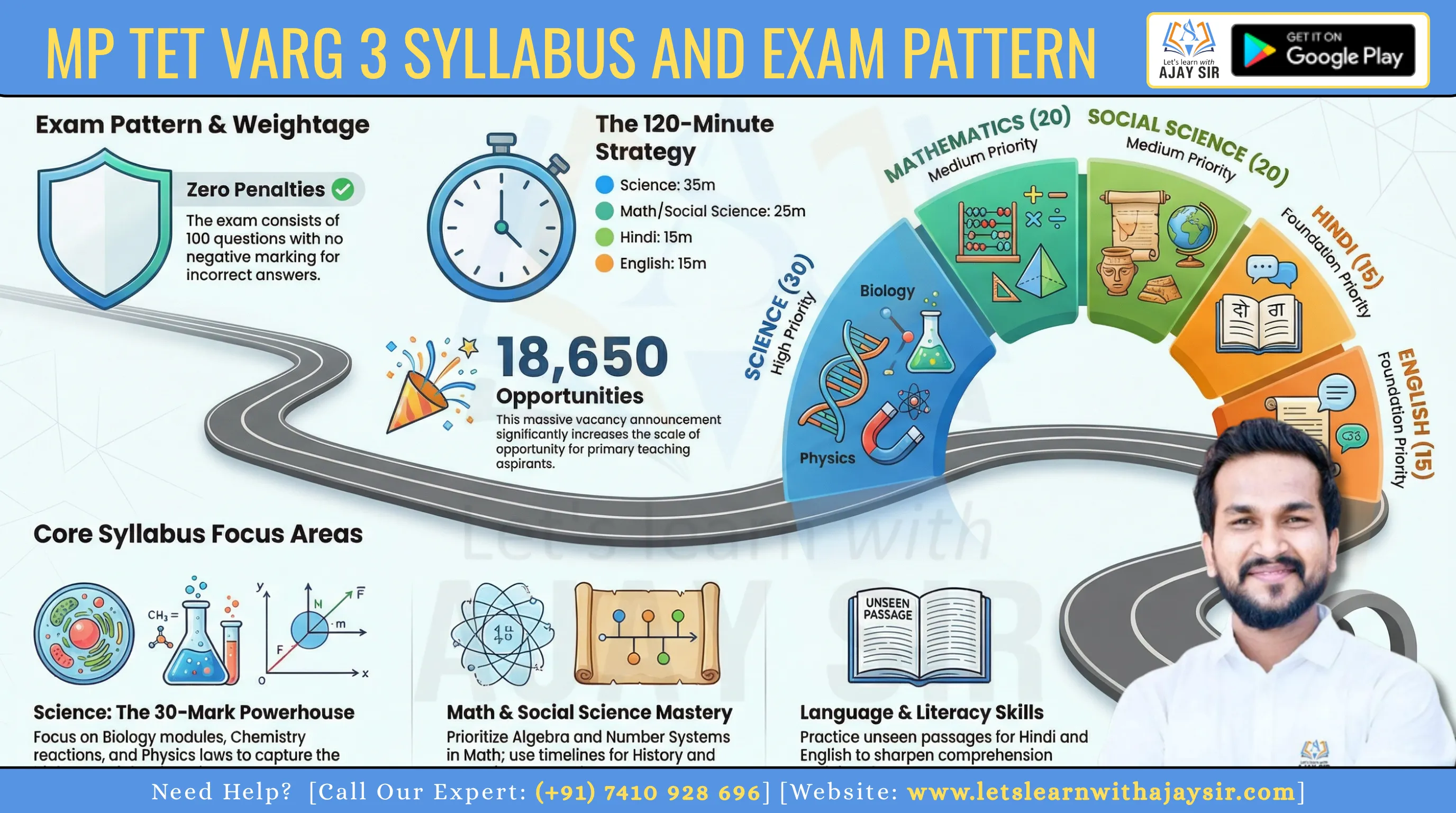
The recruitment covers five core subjects — Hindi, English, Mathematics, Science and Social Science — with 100 questions for 100 marks. There is no negative marking and the total duration is two hours, so you can attempt boldly while managing time smartly.
This introduction sets out how the TET paper is split, what each section tests and how teachers and aspiring primary teacher applicants should prioritise study. Use this guide to map strengths, fill gaps and follow a practical revision plan that mirrors the official syllabus and exam pattern.
Syllabus & Exam Pattern
MP TET Varg 3 Exam Pattern 2026: subjects, questions, marks and timing
Quick view: the paper contains a total of 100 questions for 100 marks. Each question carries one mark and there is no negative marking, so you can attempt boldly while staying accurate.
Paper structure at a glance
The exam follows a simple structure: 100 multiple-choice questions, +1 per question, two hours to complete. The mode is reported as offline by a secondary source; the official table lists these core parameters.
Section-wise weightage
Use the weightage below to apportion revision time and prioritise topics.
Science: 30 questions — highest share, so focus here first.
Mathematics: 20 questions — practice problem sets and speed.
Social Science: 20 questions — fact-based recall and timelines.
Hindi: 15 questions — grammar and comprehension.
English: 15 questions — reading and sentence skills.
Duration and mode: managing the two-hour window effectively
Plan a timed approach to cover all sections. A suggested micro-plan is: 15 minutes for Hindi, 15 for English, 25 for Maths, 35 for Science, 25 for Social Science. This builds a steady question-by-question rhythm and leaves brief buffers to revisit flagged items.
Item | Detail | Why it matters |
Total questions | 100 | Defines pacing for the full paper |
Total marks | 100 | One mark per question; no negative marking |
Duration | 2 hours | Use timed mocks to mirror real time pressure |
Top tips: prioritise high-weight subjects first, take reasoned shots since there is no penalty for wrong answers, and practise filling the OMR accurately if the paper is offline. Align your mocks to this exact pattern so your test-day routine feels familiar.
MP TET Varg 3 Syllabus 2026: Language I - Hindi
Treat Hindi as both subject matter and a tool for teaching. You will practise unseen passages — prose and poetry — to sharpen comprehension, inference and interpretation under timed conditions. These exercises boost quick-mark gains on the paper.
Core grammar covers the alphabet, pronunciation and parts of speech: noun, pronoun, verb, adjective, adverb and indeclinables. Work in short drills so your basics become instinctive for classroom use.
Vocabulary and word formation
Expand vocabulary with tatsam, tadbhav, deshaj and loan words. Focus on synonyms, antonyms and one-word substitution items that recur in the paper.
Sentence skills and practical tasks
Master sentence types, transformation, error spotting and synthesis. Study sandhi, samas, prefixes and suffixes to handle word-formation questions that test both rule knowledge and application.
Train with teacher-oriented examples to mirror real school language use.
Build a short revision roster that cycles grammar rules, idioms and proverbs daily.
Attempt mixed exercises combining passage-based questions with grammar and vocabulary.
Area | What to practise | Benefit for candidates |
Unseen passages | Prose and poetry; inference | Faster comprehension and better accuracy in reading sections |
Grammar basics | Alphabet, pronunciation, parts of speech | Solid foundation for classroom instruction and error detection |
Vocabulary & word formation | Tatsam/tadbhav, deshaj, sandhi, samas | Higher score on lexical and rule-based questions |
MP TET Varg 3 Syllabus 2026: Language II - English
Focus here on practical English tasks that build confident reading, accurate grammar and fluent sentence use. Use the official syllabus headings to guide daily practice so each session stays on target.
Reading comprehension
You will practise unseen passages from prose and poetry to extract meaning, tone and inference quickly. Train with short timed passages so you learn to spot key ideas and implied intent under pressure.
Vocabulary and word formation
Build synonym and antonym sets, one-word substitutions, prefixes and suffixes. These drills help you form new words on the fly and recall lexical items during the paper.
Grammar focus
Revise parts of speech, determiners, articles and degrees with targeted exercises. Clear rules cut common slips and save easy marks for the actual test.
Sentence control
Work on tenses, subject-verb agreement and quick transformations between affirmative, negative and interrogative forms. Learn to write and recognise simple, compound and complex sentences for classroom use.
Integrate comprehension and grammar practice to mirror mixed questions often seen in the TET section.
Collect tricky examples and teacher-focused phrasing to make explanations simpler in class.
Keep short daily bursts of study so you progress without neglecting heavier subjects.
Area | What to practise | Benefit |
Reading | Unseen prose & poetry | Faster inference and accuracy |
Vocabulary | Synonyms, antonyms, affixes | Better word recall |
Grammar | Parts of speech, articles | Fewer basic errors |
Tip: schedule mixed practice to build exam familiarity and classroom readiness for teachers and candidates aiming to perform well in the tet paper.
MP TET Varg 3 Syllabus 2026: Mathematics syllabus
Explore the core maths subjects that give steady marks and build classroom confidence. This overview helps candidates convert ideas into quick methods for timed tests.
Number systems cover whole to real numbers, HCF/LCM and exponents. Solid basics make many questions simple and fast to solve.
Number systems and ratio-proportion
Ratio and proportion problems recur in papers. Translate word sums into neat setups to avoid time loss.
Algebra
Work on expressions, factorisation, polynomials, linear and quadratic equations. Practice graphs for visual clarity.
Geometry, mensuration and coordinate geometry
Focus on triangles, quadrilaterals, circles and distance/section formula. For mensuration, include frustum and composite solids. Check units each time.
Statistics, probability and trigonometry
Handle data presentation, mean/median/mode, cumulative frequency and basic probability. Revise trig ratios, standard angles, identities and heights-and-distances.
Topic | Focus | Practice tip |
Algebra | Equations & graphs | Daily 20-minute drills |
Mensuration | Surface & volume (frustum) | Unit checks in every sum |
Statistics | Central tendency | Graph reading exercises |
Align this plan with the official syllabus 2026 and keep steady study to grow your knowledge and exam readiness.
MP TET Varg 3 Syllabus 2026: Science Syllabus
A solid command of biology, chemistry and physics will convert theory into easy scoring questions. In this section you get a compact plan to cover core subjects, map topics and speed up revision for the TET test.
Biology focus
Group classification, human systems, endocrine control and genetics into weekly modules. Add a short bio-health mini-guide that covers immunity, vaccines, STDs and common diseases.
Plants and environment
Study plant morphology, anatomy and physiology together. Use labelled diagrams for photosynthesis, respiration and transport. Keep conservation and agriculture notes concise for quick recall.
Chemistry essentials
Start from atomic models and isotopes, then move to hydrocarbons. Give special attention to ethanol, ethanoic acid and benzene. Learn key reactions and uses of soaps and detergents.
Physics core
Split practice into mechanics/heat and electricity/magnetism/light/sound. Master laws, formulae and a few numerical problem types before timed practice.
Create high-yield summary sheets for formulas, laws and key reactions.
Pair concept notes with chapter-end MCQs to turn knowledge into marks.
Teach back difficult points to yourself or peers to improve comprehension and teaching readiness.
Study flow | What to do | Benefit |
Biology | Weekly modules + health guide | Better recall for direct questions |
Chemistry | Concept → reactions → practice | Faster problem solving |
Physics | Concept checks + numericals | Higher accuracy in calculations |
MP TET Varg 3 Syllabus 2026: Social Science syllabus
Tackle Social Science by breaking content into geography, history, polity and economics so you build steady recall for maps, timelines and institutions. This approach helps you cover each part in short, high-yield sessions.
Geography focus
Map India’s size, physiography, drainage systems, climate zones, vegetation and resources. Learn Earth–Sun basics, atmosphere and hydrosphere concepts, maps and agricultural soils to answer map-based questions quickly.
History focus
Trace sources, ancient civilisations, key dynasties, medieval transitions and modern reform movements. Build concise timelines for world events like the French and Russian revolutions, the world wars and the UN to retain cause and effect.
Political Science focus
Master the Constitution: Preamble, fundamental rights and duties, DPSPs, federal features and local self-government. Study elections, commissions and major world organisations for institutional questions.
Economics focus
Cover utility, demand–supply, cost and revenue, sectors, money and banking, national income and LPG policy. Relate concepts to classroom examples to aid teaching at primary school level.
Plan revision in short sections that mirror the official structure and past papers.
Check marking norms and the selection board notice for madhya pradesh before finalising your plan.
Note some sources mention a Mains variant (150 questions, 2.5 hours) including child development and Environmental Studies; use this as situational awareness.
Area | Focus | Quick tip |
Geography | Maps, rivers, resources | Use labelled charts |
History | Timelines, reforms | Flashcards for dates |
Polity & Econ | Constitution, money | Summaries of articles & terms |
All Details
Conclusion
This final note ties the official table to a simple, action-focused plan so you can move from reading to doing. The MPESB pattern gives one clear fact set: 100 questions, 100 marks, no negative marking, two hours and five subjects.
You now hold a tested method to prioritise topics, manage time and convert practice into marks. Many teachers use this blueprint to prepare with calm and control.
Keep a short checklist: download the PDF, plan weekly sprints, practise past questions, and check documents for madhya pradesh vacancies (18,650 for primary teacher roles). These steps help candidates stay organised before the exam.
Trust your process, teach tricky points to others to deepen recall, and enter the tet with accuracy, steady attempts and calm execution.


![EMRS PGT [Tier-2] ENGLISH - 2025](https://letslearnwithajaysir.s3.ap-south-1.amazonaws.com/courses/FsnKxIFpiLxbRD418g6vo7AsLy0ge7IP7Iu2fsJY.webp)
![EMRS TGT [Tier-2] ENGLISH - 2025](https://letslearnwithajaysir.s3.ap-south-1.amazonaws.com/courses/BjLXVqVV1SeZKnhYjmPZpz2jQ7r02kS73pGGOLrL.webp)
![KVS/NVS PGT ENGLISH [Tier-2] - 2025](https://letslearnwithajaysir.s3.ap-south-1.amazonaws.com/courses/vqli598KWrKnm4txcsZh5qjMN9UMAX8LvFk9IiF0.webp)
![KVS/NVS TGT ENGLISH [Tier-2] - 2025](https://letslearnwithajaysir.s3.ap-south-1.amazonaws.com/courses/pxC2WhfYKuyaoGqvcTvhTBL2Y44o3TNA0z8NYRB5.webp)