Here you will find details: eligibility, vacancies, posts, how to apply online at upsc.gov.in, exam pattern, syllabus, admit card, centres, results and likely cut-offs. Treat the official notification as final while using this guide to stay organised.
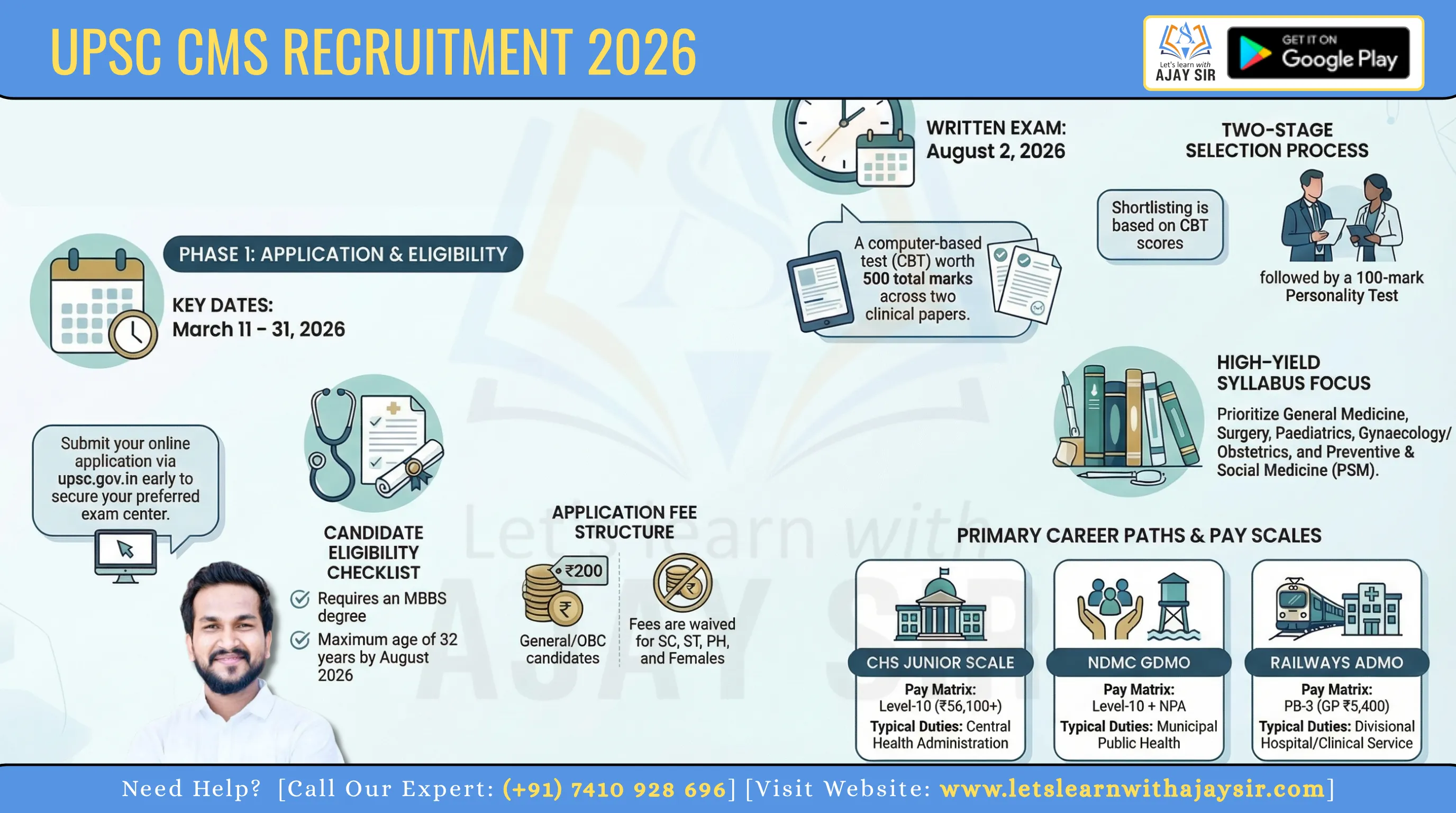
Focus your study on General Medicine, Paediatrics, Surgery, Gynaecology & Obstetrics and Preventive & Social Medicine. With clear dates and topics, you can plan documents and preparation without last-minute rush.
UPSC Combined Medical Service CMS Recruitment 2026: key highlights at a glance
This snapshot helps you confirm the essentials quickly so you can act without delay.
Notification release date and application window
The official notification and online application opened on 11 March 2026 and close on 31 March 2026. Apply early if you want a better chance of getting your preferred exam centre.
Exam date and selection stages
The written exam is scheduled for 2 August 2026.
Selection happens in two stages: a computer-based test first, then a Personality Test for those shortlisted. Shortlisting depends heavily on your written score.
Total marks and paper-wise weightage
The total is 600 marks: CBT = 500 (two papers of 250 marks each; 2 hours per paper) and the Personality Test = 100.
Negative marking applies in objective papers, so build accuracy into your approach from day one.
Official website for updates and forms
Check the official website at upsc.gov.in for the notification PDF and use the “Apply Online” portal to submit your form. Bookmark the site and check for corrigenda or schedule updates regularly.
Item
Key detail
Why it matters
Where to act
Notification & Application
11 March – 31 March 2026
Apply early to choose centre and avoid last‑minute issues
upsc.gov.in → Apply Online
Exam Date
2 August 2026
Plan revision and travel in advance
Admit card on official website
Marks & Stages
CBT 500 + Personality Test 100 = 600
Written score vital for shortlisting and final rank
CBT: objective papers with negative marking
Updates & Forms
upsc.gov.in and Apply Online portal
Download PDF, submit form, track notices
Official website home / recruitment section
Important Dates
Online Apply Start Date
11 March 2026
Online Apply Last Date
31 March 2026
Last Date For Fee Payment
31 March 2026
Exam Date
02 August 2026
Admit Card
Will Be Updated Here Soon
Result Date
Will Be Updated Here Soon
Note:
Candidates Are Advised To Confirm From The UPSC Official Website.
UPSC Combined Medical Service CMS Recruitment 2026: eligibility criteria
Before you apply, confirm you meet every eligibility point so you avoid wasted fees and delays.
Nationality and acceptable categories
You must be an Indian citizen to apply. Other eligible categories include subjects of Nepal or Bhutan, persons of Indian origin from specified countries, and Tibetan refugees who settled in India before 1 January 1962, subject to Government of India certification.
Candidates must be ready to upload and produce documentary proof of their nationality status at verification.
Age limit and cut‑off date
The upper age limit is 32 years as on 1 August 2026. Calculate your age on that exact date to check whether you fall within the limit.
Remember: the cut‑off is fixed. If you are even one day over, you will not meet the eligibility criteria.
Age relaxation for reserved categories
Category
Relaxation (years)
Document note
OBC
3
OBC certificate in required format
SC / ST
5
Valid caste certificate
PwBD
10
Disability certificate as specified
Ex‑servicemen / ECOs / SSCOs / J&K domicile
3–5 (as applicable)
Service or domicile proof
Verify the exact certificate formats given by the service commission before you submit your form. Missing or incorrect documents can cost you your place.
Educational qualification: MBBS and final‑year rules
You need an MBBS degree and must have passed the written and practical parts of the final examination. In practice, this means your university must have declared you eligible for the MBBS award in both theory and clinical components.
Final‑year candidates may apply provisionally, but you must produce passing certificates at the stage specified in the notification. Keep your college records and marksheets ready for verification.
This checklist helps you confirm cms eligibility quickly so you can decide whether to complete the form. If any item is unclear, obtain the required certificate before paying the fee.
Vacancy Details
UPSC Combined Medical Service CMS Recruitment 2026: vacancy and posts
You can apply to three main groups of posts; each links to a specific government employer. Below is a brief guide so you know which post matches your career aims and where to check official numbers.
Assistant Divisional Medical Officer (Railways)
The ADMO role places you inside the railways health system. You will work in stations, divisional hospitals and related clinics to provide routine care and emergency response.
Expect hands‑on clinical work as a divisional medical officer with administrative duties tied to railway health policies and staff welfare.
Junior Scale posts in the central health service
Junior Scale CHS posts give broad exposure to central health administration and postings across India.
This pathway is popular if you want a career within central health structures and rotational clinical experience.
General Duty Medical Officer (NDMC)
GDMO posts are municipal government medical officer positions. They typically include outpatient clinics, public‑health duties and pay/allowances as per rules.
These roles suit candidates aiming for stable city postings with defined clinical responsibilities.
How to track post‑wise and category‑wise vacancy updates
The official notification publishes the vacancy distribution and any corrections. Some outlets report 1358 vacancies; you must confirm the final figure in the PDF.
Do not rely on social media. Check the official PDF and the upsc cms noticeboard for post‑wise and category‑wise tables and addenda.
Syllabus & Exam Pattern
UPSC Combined Medical Service CMS Recruitment 2026: exam pattern
Knowing the test format helps you plan time, accuracy and revision for each subject area.
Computer-based test structure: two papers, two hours each
The exam pattern places two independent objective papers back-to-back. Each paper runs for two hours and carries 250 marks, giving a written total of 500.
Both papers use single-best-answer MCQs and feature negative marking. Your written score is decisive for shortlisting in the upsc cms exam.
Paper I: general medicine and paediatrics question split
Paper I contains 120 questions: 96 on general medicine (including allied topics) and 24 on paediatrics.
Allocate study time roughly in that ratio so you cover high-yield medicine topics first and consolidate child‑health programmes afterwards.
Paper II: surgery, gynaecology & obstetrics, and preventive & social medicine
Paper II balances roughly 40 questions each from Surgery (with ENT, Ophthalmology, Orthopaedics, Anaesthesia), gynaecology obstetrics, and preventive social medicine.
The breadth means you must refresh clinical procedures, maternal health and public‑health topics equally to score well in the upsc cms exam.
Negative marking and accuracy strategy for MCQs
Negative marking rewards accuracy. Attempt questions you can answer confidently and skip doubtful options to avoid avoidable loss.
Practice timed tests to improve speed without sacrificing precision. A calm, methodical approach reduces silly errors on the 2026 exam.
Personality Test: what the 100 marks are assessing
The interview carries 100 marks and assesses mental alertness, integrity, leadership, communication and situational judgement.
Be ready to discuss clinical decisions, public‑health priorities and ethical choices clearly. The panel looks for safe judgement and practical awareness in a government medical officer role.
Stage
Duration
Marks
Paper I (MCQ)
2 hours
250
Paper II (MCQ)
2 hours
250
Personality Test
Varies
100
UPSC Combined Medical Service CMS Recruitment 2026: syllabus 2026
Focus on priorities first; the syllabus is broad but a few topics recur often in exams.
Paper I — core general medicine areas
Start with high-frequency systems: cardiology, respiratory, gastrointestinal and renal medicine. Revise neurology, haematology and endocrinology next.
Include infections, tropical medicine, dermatology and psychiatry. Practice first-line management and common presentations rather than rare disorders.
Paper I — paediatrics and child‑health programmes
Prioritise newborn care, paediatric emergencies, growth milestones and immunisation schedules. Know national child health programmes and common congenital issues.
Paper II — surgery and allied specialties
Cover general surgery essentials and basics of ENT, ophthalmology, orthopaedics, urology and anaesthesia. Focus on emergency procedures and common post‑op complications.
Paper II — gynaecology & obstetrics and family planning
Master antenatal, intranatal and postnatal care, obstetric emergencies and contraception. Study infertility basics and key surgical interventions for common presentations.
Paper II — preventive and social medicine
Emphasise epidemiology, health planning, environment, nutrition and occupational health. Learn national programmes and concepts in preventive social medicine and social medicine.
Practical tip: Use past papers to map high-yield topics, then create a weekly rotation. This keeps revision balanced for clinical areas and public‑health topics relevant to a medical officer role in central medical services. Also, check the official upsc cms notification for exact wording and updates.
Paper
Top priorities
Study focus
Paper I
Cardio, Respiratory, GI, Renal, Neuro
Common presentations, first‑line treatment
Paediatrics (P1)
Newborn care, Emergencies, Immunisation
Programme links, emergency algorithms
Paper II
Surgery, ENT, Ophthalmology, Orthopaedics
Procedures, trauma, acute care
G&O & PSM
Labour care, Contraception, Epidemiology
Maternal emergencies, national health programmes
Salary Details
UPSC Combined Medical Service CMS Recruitment 2026: Salary and job profile
Your salary and daily tasks differ by employer; knowing both helps set realistic expectations. Below is a clear summary of pay levels and the kinds of duties you will handle once appointed.
Pay levels for central health and NDMC posts
Junior scale posts in the central health service and NDMC GDMO posts fall in Pay Matrix Level‑10. That means a basic pay range of Rs. 56,100–1,77,500.
Note: the NDMC post may include a restricted Non‑Practising Allowance (NPA), which increases take‑home pay.
Railways post pay band and grade pay
The divisional medical (ADMO) post is commonly quoted in PB‑3: Rs. 15,600–39,100 with Grade Pay of Rs. 5,400. Verify current rules in the official notification before finalising expectations.
Role expectations: clinical work, admin and public health
As a duty medical or medical officer you will split time between patient care, record keeping and coordination with health departments.
You will also support national programmes covered under preventive social topics, so the PSM syllabus is directly relevant to on‑job tasks.
Post
Pay reference
Typical duties
Practical note
CHS Junior Scale
Level‑10: Rs. 56,100–1,77,500
Clinical rounds, postings, admin
Allowances affect net pay
NDMC GDMO
Level‑10 + restricted NPA
Outpatient care, municipal health duties
NPA raises take‑home salary
Railways ADMO
PB‑3: Rs. 15,600–39,100; GP Rs. 5,400
Station/division clinical service, emergencies
Check railway pay revisions in notice
Selection Process
UPSC Combined Medical Service CMS Recruitment 2026: selection process
The path from the written exam to appointment follows a clear two‑step route you should master. First comes the CBT (two papers, 500 marks). Then the Personality Test adds 100 marks and decides final ranking.
Stage-wise qualification and document readiness
Stage‑wise qualification means you must clear the written cut‑off to be called for the interview. Final merit combines CBT and interview scores for the appointment list.
Candidates must keep these documents ready: original photo ID, MBBS degree or provisional pass certificate, mark sheets, category certificate (if applicable) and any disability or service records. Organise photocopies and scanned files for quick upload.
What the Personality Test typically evaluates
The personality test assesses professional knowledge, social awareness and personal traits like integrity, leadership and clear communication. Panels look for safe clinical judgement, ethical reasoning and ability to explain decisions to patients or colleagues.
To prepare, revise core concepts, practise short, clear explanations of clinical choices and stay updated on major national health initiatives so you can answer with context and confidence.
Stage
What is checked
Key documents
Prep tip
CBT (written)
Clinical knowledge and public health
None
Timed practice and accuracy
Shortlisting
Written cut‑offs by category
Registration confirmation
Track portal notices
Personality Test
Judgement, ethics, communication
ID, MBBS proof, category docs
Mock interviews and current programmes
Final appointment
Combined score & document verification
All originals for verification
Keep files organised and accessible
How to Apply
UPSC Combined Medical Service CMS Recruitment 2026: application process
Follow a clear online route from registration to confirmation so you don’t miss any mandatory step.
One‑Time Registration on the UPSC portal
Begin at the official website and complete One‑Time Registration (OTR). Keep your mobile and email active — OTPs and login alerts use these contacts. Use a valid, regularly checked address; you will receive key messages and recovery options here.
Filling the application form and choosing exam centres
Log in after OTR and fill the cms application form carefully. Choose exam centres thoughtfully: centre allotment often follows a first‑apply‑first‑allot approach, so apply early if you need a specific city.
Uploading your photograph, signature and photo ID
Upload a clear photograph, signature and photo ID scan within the size limits (20 KB–300 KB). Poor or non‑compliant images lead to rejection. Ensure file formats and dimensions match the instructions on the official website.
Final submission, registration number and confirmation page
Review every field — name, date of birth, category and MBBS details — before you submit. Once submitted you will get a registration number. Save and print the confirmation page; you will need it to download the admit card and for future communication.
Step
Action
Why it matters
OTR
Register with valid mobile and email
OTP verification and account recovery
Form filling
Complete cms application; select centres
Centre allotment and accuracy of data
Uploads
Photograph, signature, photo ID (20–300 KB)
Prevents technical rejection at verification
Submission
Note registration number; download confirmation
Needed for admit card download and correspondence
All Details
UPSC Combined Medical Service CMS Recruitment 2026: What UPSC CMS 2026 is and who it is for
This exam opens pathways into central government health posts for qualified doctors.
About the service commission and the selection
The union public service body conducts the exam to recruit doctors into central medical roles. It places candidates into posts such as Assistant Divisional Medical Officer (Railways), Junior Scale posts in the central health service, and General Duty medical officer posts (NDMC).
Why it matters for aspiring government doctors
If you are an MBBS graduate or a final-year candidate, this exam is a direct route to stable public-sector work. The syllabus mirrors clinical decision-making plus public-health knowledge you will use on duty.
The focus is broader than postgraduate entrance tests. Instead of specialism, it tests MBBS-level competence across core subjects and national programmes in medical services. Expect stiff competition, objective written shortlisting and a formal Personality Test before final appointment
UPSC Combined Medical Service CMS Recruitment 2026: admit card
Expect the admit card to be published online in July; the exact date will be announced on the official website. You should start checking the portal early so you avoid last‑minute download rushes before the exam on 2 August 2026.
When to start looking for the cms admit card
Begin checking the official website from mid‑July. Downloading sooner gives you time to spot and fix any errors and to arrange travel to the test centre.
How to download using Registration ID or Roll Number
You can retrieve the cms admit either with your Registration ID or with your Roll Number. Keep both details safe so one acts as a backup if you misplace the other.
What to check on your admit card before exam day
Verify your name, photograph, exam centre, date and time, and the ID documents listed on the hall ticket. Read the instructions carefully and follow reporting times.
Item
What to check
Action
Name & Photo
Spelling, clarity
Report mismatch immediately via the official website helpdesk
Centre & Date
Correct city, exam day (2 Aug)
Plan travel and arrival time in advance
ID & Instructions
Acceptable ID listed
Print a clear copy and keep it protected for verification
UPSC Combined Medical Service CMS Recruitment 2026: Exam day guidelines
A calm, planned arrival at the test centre reduces avoidable stress on the day.
Keep this checklist with you so you can focus on the papers. Small routines — a light meal, a quick walk, and checking your items — steady your mind before the CBT.
Documents you must carry to the test centre
Carry: the printed admit card and the original photo ID noted on your hall ticket. Bring any additional document exactly as listed on the admit card.
Do not forget: a clear printout and a spare copy stored safely in your bag.
Reporting time, security checks and prohibited items
Arrive early to allow for frisking, biometric checks and queues. Candidates must expect delays and plan travel time accordingly.
Electronic devices, smartwatches, notes and Bluetooth items are banned. Leave study material and phones at home or in secure storage outside the centre.
During the upsc cms exam, follow on‑screen instructions carefully and pace your time across questions to avoid rushed guessing. Good time management helps you convert knowledge into marks on the 2026 exam.
UPSC Combined Medical Service CMS Recruitment 2026: exam centres
Choosing the right exam city reduces travel stress and helps you perform on the day. The centre allotment works on a first‑apply‑first‑allot basis, so your timing in the application process has real impact.
UPSC Combined Medical Service CMS Recruitment 2026: Answer key, result and cut-off
Once you leave the test hall, a predictable sequence of notices and PDFs follows. This helps you track where you stand and what to expect next in the selection process.
When the official answer key is released and how to use it
The official answer key is published after the final result is declared. Even then, you can use it to review mistakes, check question patterns and spot weak topics for interview prep.
How the written result shortlists you for the Personality Test
The written result PDF lists scores from the CBT. Shortlisting for the Personality Test is strictly based on these scores and category rules. If your written marks meet the cut-off, you will be called for document verification and interview scheduling.
Cut-off marks and final merit list calculation out of 600
Cut-off marks vary by category and year. The final merit is calculated from the CBT (out of 500) plus the Personality Test (out of 100), totalling 600.
Treat cut-offs as reference points rather than targets. Focus on accuracy and steady revision to maximise your score in this cms selection process.
Conclusion
This final note pulls key steps together so you can act with confidence.
Quick recap: the notification was published on 11 March; you must apply by 31 March. The exam is on 2 August and selection totals 600 marks — 500 from the CBT and 100 from the Personality Test.
Check eligibility criteria before you start the application process and apply early to secure your preferred centre. Study with the exam pattern in mind: two objective papers, negative marking and an interview that rewards clear thinking.
Keep all documents ready for verification and track the final result and admit links on the official website. Stay calm, follow a plan and use reliable sources throughout your cms 2026 preparation and the upsc cms journey.
All eligible and interested candidates are advised to read the official notification carefully before applying online.
Disclaimer: The examination results and marks published on this website are provided solely for immediate information to candidates and do not constitute a legal document. While every effort has been made to ensure the accuracy and authenticity of the information available on this website, we are not responsible for any inadvertent errors that may occur in the publication of examination results or marks. We shall not be liable for any loss or damage to any individual or entity arising from any deficiency, defect, or inaccuracy in the information provided on this website.

![EMRS PGT [Tier-2] ENGLISH - 2025](https://letslearnwithajaysir.s3.ap-south-1.amazonaws.com/courses/FsnKxIFpiLxbRD418g6vo7AsLy0ge7IP7Iu2fsJY.webp)
![EMRS TGT [Tier-2] ENGLISH - 2025](https://letslearnwithajaysir.s3.ap-south-1.amazonaws.com/courses/BjLXVqVV1SeZKnhYjmPZpz2jQ7r02kS73pGGOLrL.webp)
![KVS/NVS PGT ENGLISH [Tier-2] - 2025](https://letslearnwithajaysir.s3.ap-south-1.amazonaws.com/courses/vqli598KWrKnm4txcsZh5qjMN9UMAX8LvFk9IiF0.webp)
![KVS/NVS TGT ENGLISH [Tier-2] - 2025](https://letslearnwithajaysir.s3.ap-south-1.amazonaws.com/courses/pxC2WhfYKuyaoGqvcTvhTBL2Y44o3TNA0z8NYRB5.webp)