Over 3 lakh candidates apply each year for posts in Delhi Police and CAPFs/CISF, making this one of the most competitive national recruitment drives.
You will get a clear, future-focused overview of the SSC CPO syllabus and what the exam structure means for your preparation. Paper 1 has four objective sections, and Paper 2 tests English comprehension; each paper carries 200 marks and lasts two hours.
Use this guide to balance topics, plan revision cycles, and protect your marks from careless slips.
Key takeaways: what the papers cover, negative marking rule, timeline to follow, and how to structure the study to gain steady score improvements.
Quick Overview
SSC CPO Syllabus and Exam Pattern 2026: At a glance
A career through this national selection leads to frontline roles in policing and paramilitary units. The SSC CPO route recruits Sub-Inspectors for the Delhi Police and Central Armed Police Forces, including the CRPF, BSF, and ITBP. It also fills Assistant Sub-Inspector posts in CISF.
Where you can serve: Delhi Police, CAPFs, and CISF
You can be posted in urban policing, border duties, or security of vital installations. Posts mix field work with investigative tasks, offering diverse day-to-day roles.
Career growth, stability, and prestige in uniformed services
These roles give you steady promotions, central pay scales, and allowances, plus training that boosts leadership skills. Service brings social respect and a clear growth ladder.
National-level selection is held once a year; check the official notification for dates.
Competition is high, so tailor your preparation to physical tests and written stages.
Successful candidates gain financial security and long-term career prospects.
Board | Staff Selection Commission (SSC) |
Posts | Sub Inspector (Executive) in Delhi Police and Sub Inspector (General Duty) in CAPFs |
Vacancies | 3073 |
Mode of Exam | Online |
Exam Date | 9th to 12th December 2025 |
Type of Questions | Objective Multiple Choice Type |
Negative Marking | 0.25 marks will be deducted for each incorrect answer |
Selection Process | Paper-1 PET/PST Paper-2 |
Salary | Rs. 35400-112400/ |
Job Location | |
Eligibility Criteria
SSC CPO Syllabus and Exam Pattern 2026: Eligibility criteria
Your eligibility depends on citizenship, a recognised bachelor’s degree and the age limits stated in the official notification.
Basic checks include Indian nationality and a degree that the commission accepts by the closing date. If your qualification is from overseas, obtain equivalence before you apply.
Age usually falls in the 20–25 year band, with relaxations for reserved categories. Verify those slabs in the notification so you know your exact cutoff.
Apply online and pay the prescribed fee (Rs 100). Keep a scanned photo, signature and certificates ready.
Match names and dates of birth across documents to avoid rejection at verification.
Meet vision, height and other physical standards as PET/PST and medical tests are part of selection.
Requirement | What to prepare | When to check | Note |
Citizenship | Birth certificate/passport | Before filling form | Indian nationals only |
Educational qualification | Degree certificate or equivalence | By closing date | Foreign degrees need validation |
Age limits | Birth proof | Check notification | Relaxations apply for reserved candidates |
Application | Photo, signature, fee | At submission | Choose exam language: English or Hindi |
Read the ssc cpo rules on reservation and medical norms carefully. Early checks save time and help you plan which year to attempt the cpo exam for best advantage.
Syllabus & Exam Pattern
SSC CPO Syllabus and Exam Pattern 2026: Exam Pattern
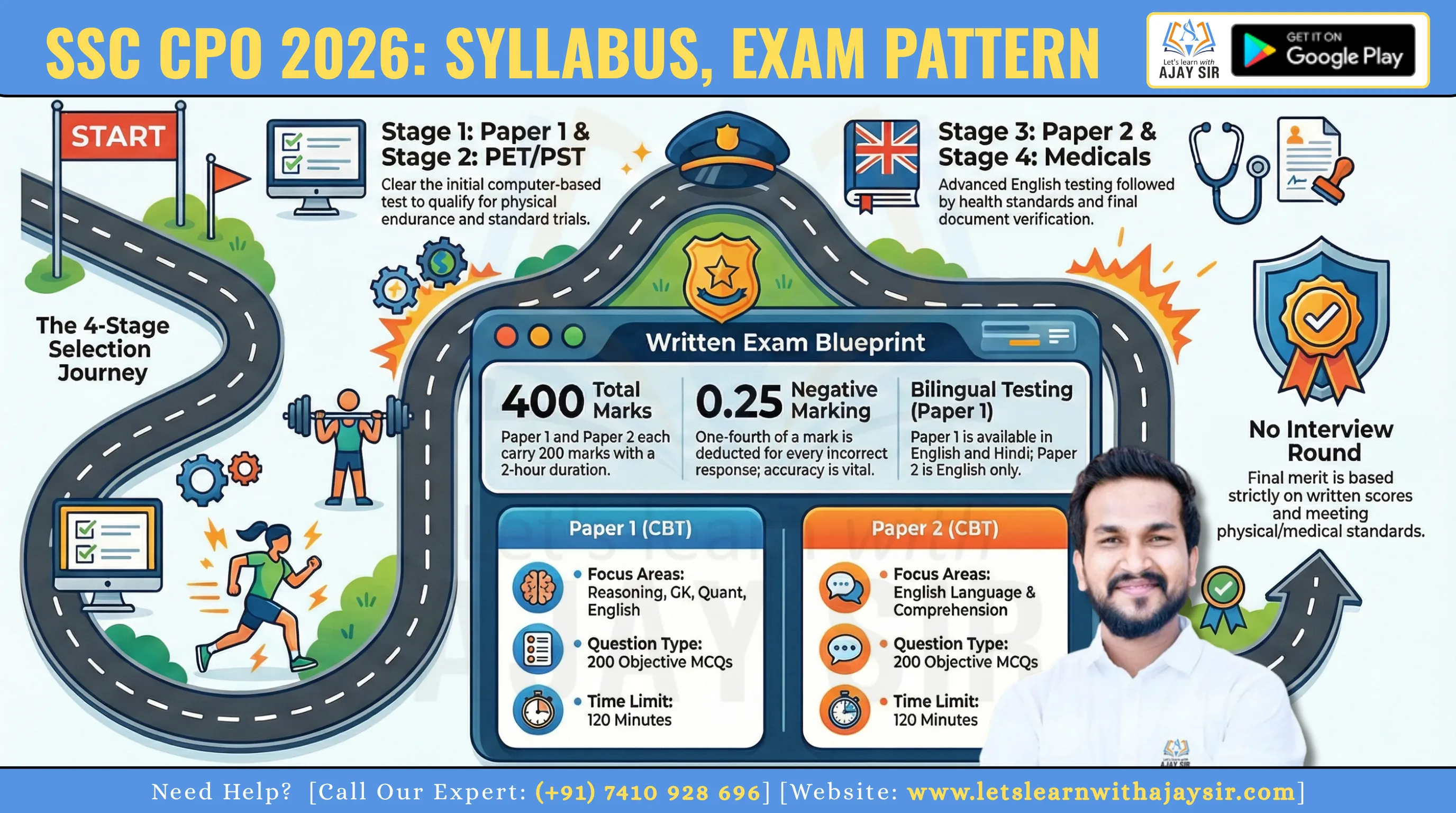
The test structure sets the rules: two objective papers, each lasting two hours and carrying 200 marks. Both papers use a computer-based format, so familiarity with on-screen navigation matters.
Paper 1 has four sections — General Intelligence & Reasoning; General Knowledge & General Awareness; Quantitative Aptitude; English Comprehension. Each section is worth 50 marks. There is no sectional time limit, so you must self-manage time.
Paper 2 focuses on English Language & Language Comprehension. It also totals 200 marks and runs for two hours. This paper assesses grammar, vocabulary and reading ability.
The marking rule awards +1 for a correct answer and deducts 0.25 marks for each wrong response in both papers. Accuracy over guesswork saves marks.
The test is bilingual (English/Hindi) for most sections; English-specific content appears only in English.
No interview is held; final selection rests on written scores plus PET/PST and medical checks.
Prioritise time blocks per section to protect easy marks and maintain pace.
Feature | Paper 1 | Paper 2 | Notes |
Duration | 2 hours | 2 hours | Computer-based; same length for both papers |
Total marks | 200 | 200 | Each paper uses objective questions |
Marking scheme | +1 / -0.25 | +1 / -0.25 | Penalty applies per wrong response |
Language | Bilingual (English/Hindi) | English only | Choose your medium when applying; practise in that medium |
SSC CPO Syllabus 2026: Paper 1 detailed topics
This part breaks down Paper 1 topics so you can map daily practice to high-yield areas.
General Intelligence & Reasoning covers analogies, coding–decoding, syllogisms, series (verbal and non‑verbal), Venn diagrams and spatial visualisation.
Expect both figure‑based questions and verbal puzzles that test quick pattern recognition and logical deduction. Work short timed sets to sharpen speed.
General Knowledge & General Awareness spans current affairs plus static topics: history, geography, polity, economy, culture and science.
Focus on recent national events and basics of physics and chemistry listed below. Short daily notes help retention.
Quantitative Aptitude includes arithmetic (percentages, ratio, averages), algebra (identities, linear equations), geometry, mensuration, trigonometry and data interpretation.
Practice bar, pie and frequency charts to gain quick marks. Split sessions between problem drills and timed DI passages.
English Comprehension tests grammar, vocabulary and passage inference. Work on error spotting, para‑jumbles and reading speed.
Rotate topics: heavy quant days alternated with reasoning and light GA/English review.
Use past papers to turn weak items into safe marks.
Revise science concepts like Newton’s laws, atomic structure and bonding for GA sections.
Section | High‑yield topics | Study tip | Scoring focus |
Reasoning | Series, Venn, coding | Daily 30‑minute timed sets | Accuracy + speed |
General Awareness | Current affairs, science basics | Weekly summary notes | Static facts + recent events |
Quantitative Aptitude | Arithmetic, geometry, DI | Topic-wise problem banks | Fast calculation, DI practice |
English | Grammar, vocab, passages | Read diverse editorials; do cloze tests | Comprehension accuracy |
SSC CPO Syllabus 2026: Paper 2 Detailed Topics
Paper 2 tests how well you use grammar and read complex passages under time pressure. The paper lasts two hours and carries 200 marks. Negative marking of 0.25 per wrong response applies, so accuracy matters as much as speed.
Core topics include error spotting, fill-in-the-blanks (verbs, prepositions, articles), sentence structure, synonyms and antonyms, idioms and phrasal verbs. You’ll also face spelling, usage and common vocabulary traps.
How this paper shapes final merit
Paper 2 focuses entirely on English language comprehension and can significantly influence your final rank. Strong reading skills and grammar control convert into reliable marks that add weight to your overall score.
Practise timed mixed sets to balance speed with precision.
Keep a compact grammar rulebook for weekly revision: tenses, agreement, modifiers, parallelism.
Build vocabulary in context—use sentences, not isolated lists—for better recall in passages.
Maintain an error log from mocks to eliminate recurring mistakes.
Component | Focus | Study tip |
Error spotting & usage | Articles, prepositions, subject‑verb | Daily short drills; review rules |
Vocabulary & spelling | Synonyms, antonyms, common traps | Context sentences; flashcards |
Reading comprehension | Inference, tone, vocabulary in context | Summarise editorials; practice long passages |
Tie your Paper 2 plan to Paper 1 English practice so grammar and usage stay consistent across both papers. Regular, focused work on these areas will reduce careless errors and raise your marks steadily.
Selection Process
SSC CPO Syllabus and Exam Pattern 2026: Selection Process
Your selection journey starts with a computer‑based objective paper and moves through physical trials to final medical checks. The whole process runs once a year in online mode, so set a clear timeline for study and fitness.
Stage-wise flow: Paper 1, PET/PST, Paper 2, medical and document checks
The flow is straightforward: clear Paper 1 (CBT), qualify PET/PST, sit Paper 2, then pass medicals and document verification. PET/PST is qualifying but crucial; meet height, chest where applicable, and endurance benchmarks to proceed.
Train for PET while you revise theory—small daily workouts beat last‑minute rushes.
Prepare identity, degree and category certificates early to avoid verification problems.
Use mock PET trials to gauge timings and recovery under test conditions.
No interview round: what it means for your preparation
There is no interview, so written performance and physical standards fully decide merit. Paper 2 can be decisive in close contests; keep English practice active even during PET conditioning.
Stage | Focus | Tip for candidates |
Paper 1 (CBT) | Objective questions, time management | Build accuracy with timed mocks |
PET/PST | Height, chest, running tests | Consistent conditioning; practice trials |
Paper 2 & Medicals | English proficiency; health standards | Maintain grammar drills; check medical norms |
Plan milestones across the year: concept mastery pre‑Paper 1, PET conditioning, and advanced English for Paper 2. With precise written scores and fitness, your route into Delhi Police and CAPFs/CISF becomes much clearer.
All Details
SSC CPO Syllabus and Exam Pattern 2026: Key Facts at a Glance
A compact summary of papers, time limits and scoring will help you set realistic daily targets for study. Keep this page as your quick reference to align practice, mocks and fitness work.
Papers, sections, marks and duration summary
Paper 1 has four sections: general intelligence reasoning, knowledge general awareness, quantitative aptitude and English comprehension. It totals 200 marks and runs for 2 hours.
Paper 2 is an English language and language comprehension paper. It also carries 200 marks for 2 hours and tests deep reading and grammar skills.
Marking scheme, language medium and attempt policy
Each correct answer gives +1 mark; each wrong reply deducts 0.25 marks. Leave doubtful items rather than guess to protect marks.
The test is computer-based and largely bilingual for Paper 1; English sections must be answered in English. You may attempt while within the notified age limits; follow the official notification for exact attempt rules.
Track provisional answer releases and cut lists after each stage to gauge standing.
Keep a one-page crib sheet with timing, sections and the marking rule for last-minute revision.
Feature | Paper 1 | Paper 2 | Notes |
Sections | Reasoning; GA; Quantitative aptitude; English | English language & language comprehension | Core topics repeat yearly; focus on high-yield chapters |
Duration | 2 hours | 2 hours | Computer-based; practice on screen |
Marks & negative | 200; -0.25 per wrong | 200; -0.25 per wrong | +1 for correct; no marks for unattempted |
Language & attempts | Bilingual (English/Hindi) | English only | Attempt limits follow official notification; no interview stage |
Conclusion
Set clear section targets and protect your score by focusing on accuracy under timed conditions. Balance Paper 1 across all four areas while steadily building English for Paper 2.
Keep an eye on the notification at ssc.gov.in and note the Paper 1 window (9–12 December 2026) as you fix your weekly plan. Use past papers, official answer keys and cut-offs to set realistic score goals.
Train PET/PST alongside written work so fitness and theory progress together. If you act early and practise consistently, you will enter the ssc cpo exam window ready to convert preparation into a uniformed career.
Disclaimer:
All eligible and interested candidates are advised to read the official notification carefully before applying online.
Disclaimer: The examination results and marks published on this website are provided solely for immediate information to candidates and do not constitute a legal document. While every effort has been made to ensure the accuracy and authenticity of the information available on this website, we are not responsible for any inadvertent errors that may occur in the publication of examination results or marks. We shall not be liable for any loss or damage to any individual or entity arising from any deficiency, defect, or inaccuracy in the information provided on this website.

![EMRS PGT [Tier-2] ENGLISH - 2025](https://letslearnwithajaysir.s3.ap-south-1.amazonaws.com/courses/FsnKxIFpiLxbRD418g6vo7AsLy0ge7IP7Iu2fsJY.webp)
![EMRS TGT [Tier-2] ENGLISH - 2025](https://letslearnwithajaysir.s3.ap-south-1.amazonaws.com/courses/BjLXVqVV1SeZKnhYjmPZpz2jQ7r02kS73pGGOLrL.webp)
![KVS/NVS PGT ENGLISH [Tier-2] - 2025](https://letslearnwithajaysir.s3.ap-south-1.amazonaws.com/courses/vqli598KWrKnm4txcsZh5qjMN9UMAX8LvFk9IiF0.webp)
![KVS/NVS TGT ENGLISH [Tier-2] - 2025](https://letslearnwithajaysir.s3.ap-south-1.amazonaws.com/courses/pxC2WhfYKuyaoGqvcTvhTBL2Y44o3TNA0z8NYRB5.webp)