You’ll get a clear, future-focused overview of the exam and the way the process now tests conceptual clarity and timing. The Staff Selection Commission runs the test annually to fill Group B and C central government posts.
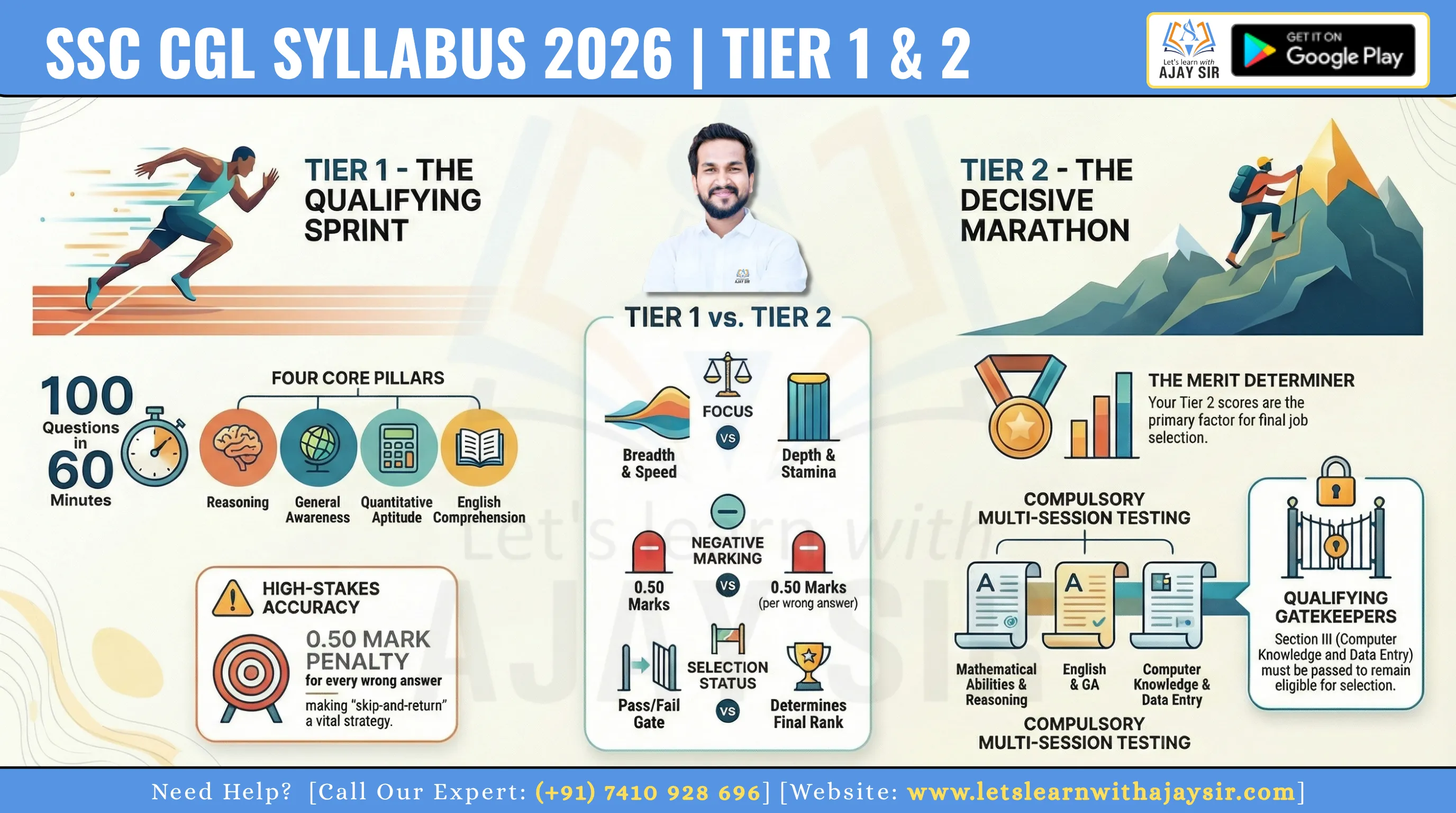
The first tier is MCQ-based with four sections of 25 questions each — 100 questions, 200 marks, and just 60 minutes. Remember, there is a 0.50 mark penalty for each wrong answer, so strategy matters.
Tier 2 centres on Paper I for all candidates with timed modules, and optional Papers II and III for specialist posts in statistics and finance. Final selection hinges on Tier 2 marks, so your plan must shift from breadth to depth as you progress.
This guide maps the syllabus and exam pattern into a practical yearly plan so you know what to study first, how to time mocks, and when to sharpen speed without losing accuracy.
Quick Overview
SSC CGL Syllabus 2026: At A Glance
Begin with a realistic timeline that maps topics, mocks, and revisions onto the online exam pattern.
You face a two-tier, fully online recruitment run by the staff selection commission. Tier 1 is the qualifying round: 100 questions, 200 marks, and 60 minutes. Tier 2 decides the final selection and demands a deeper study.
This guide helps you plan the year. It breaks the syllabus into weekly study blocks, adds previous-year questions early, and builds to full-length mocks. You will learn to track question-level accuracy and use an error log to fix weak spots.
What you’ll gain: clear timelines, daily goals, and focused practice.
Exam tactics: section timing, negative marking (0.50 penalty), and attempt strategy.
Role mapping: Which posts need Paper II/III choices so you target the right papers?
Start today: pick one reliable source, outline a weekly plan, and take a diagnostic mock. Use this guide as a living reference to recalibrate as you progress through the SSC CGL exam cycle.
Syllabus & Exam Pattern
SSC CGL Syllabus 2026: Tier 1 and Tier 2
Know the exact exam pattern and marking rules so every practice session mirrors exam conditions.
Tier 1 at a glance: four sections — General Intelligence & Reasoning, General Awareness, Quantitative Aptitude, and English Comprehension. Each section has 25 questions, giving 100 questions and 200 marks in total. You get 60 minutes to finish; scribe-eligible candidates have 80 minutes.
Component | Questions | Marks | Time |
Tier 1 | 100 (4x25) | 200 | 60 mins (80 mins scribe) |
Tier 2 structure and qualifying modules
Paper I is compulsory and runs in two sessions. Session I covers Section I (Mathematical Abilities 30 Q; Reasoning & General Intelligence 30 Q). Session I also includes Section II (English 45 Q; General Awareness 25 Q). Each section is timed for one hour.
Session II has Section III: a 20-question Computer Knowledge test (15 minutes) and a Data Entry Speed Test (one task; 15 minutes). Both are qualifying and do not add marks to your total.
Negative marking and time limits you must master
Negative marking is strict: most wrong answers cost you 0.50 marks. Build a skip-and-return rule. If a question takes longer than your set threshold, move on to protect accuracy.
Practice pacing: for Tier 1, that’s ~100 questions in 60 minutes.
Structure mocks to follow the real sequence so you handle the cognitive shift between quant/reasoning and English/GA.
Prepare for stamina: two sessions on the same day mean you must manage breaks, food, and focus.
SSC CGL Syllabus 2026
This section breaks the full exam programme into clear topic blocks so you can plan study rounds with precision.
Tier 1 topics (concise list)
Tier 1 covers four focused areas. Each demands speed and accuracy under time pressure.
General Intelligence & Reasoning: analogy, coding-decoding, series, blood relations, Venn diagrams, classification.
General Awareness: current affairs, history, polity, geography, economy, science, static GK.
Quantitative Aptitude: number system, percentages, ratio & proportion, algebra, geometry, mensuration, trigonometry, data interpretation.
English Comprehension: vocabulary, grammar, error spotting, cloze, reading comprehension, sentence improvement, synonyms/antonyms, idioms, one-word substitution.
Tier 2 modules (Paper I focus)
Tier 2 expands depth, especially in mathematical and reasoning topics. You must shift to accuracy and longer problems.
Mathematical Abilities: arithmetic, algebra, geometry, mensuration, trigonometry, statistics & probability.
Reasoning & General Intelligence: verbal and non-verbal reasoning, embedded figures, pattern folding, and critical thinking.
English Language & Comprehension: grammar, vocabulary, error spotting, RC, cloze, voice, and narration.
General Awareness: current events, science & society, Indian polity, economy, history, and geography.
Section III is qualifying: basic computer knowledge and a data entry speed test. Treat these as pass/fail gates and practise accordingly.
Module | Key topics | Study focus | Suggested weekly time |
Reasoning | Analogy, series, coding, Venn, embedded figures | Speed drills + mixed sets | 4–6 hours |
Quantitative Aptitude | Arithmetic, algebra, geometry, DI, trigonometry | Concepts → topic tests → timed papers | 6–8 hours |
English & GA | RC, grammar, vocab; current affairs, polity, science | Daily reading + weekly quizzes | 3–5 hours |
Tier 1 detailed syllabus and topic-weight trends
A topic-wise view of Tier 1 shows where to invest quick wins and deep practice. Use this to build a focused weekly routine and to prioritise mixed-section drills that mirror the real exam pattern.
General Intelligence & Reasoning
High-frequency staples: analogy, coding-decoding, and series. These often total 7–11 questions, so secure them early.
General Awareness
Prioritise current affairs (5–7 Q), general science (4–6), and static GK (3–5). Short daily reviews plus a monthly capsule improve recall for fast questions.
Quantitative Aptitude
Plan study around Geometry and Algebra (4–6 combined) and arithmetic topics like profit & loss, percentages, and ratios (5–7 combined). Add DI and number-system practice to round out your score.
English Comprehension
Focus on error spotting, cloze, and sentence improvement for accuracy. Then add reading comprehension practice to build consistent marks.
Use the previous year's analysis to craft a topic-first schedule.
Keep a formula-sheet for quick revision.
Run mini-mocks (25 Q blocks) to track weekly gains.
Section | High-frequency topics | Typical range (Q) |
Reasoning | Analogy, Coding, Series | 7–11 |
General Awareness | Current affairs, Science, Static GK | 12–18 |
Quantitative Aptitude | Arithmetic, Algebra, Geometry, DI | 8–12 |
Tier 2 deep dive: modules, qualifying tests, and special papers
Preparing for Tier 2 means moving from speed-focused drills to sustained problem-solving and subject depth. You will face two core one-hour papers in Paper I and additional qualifying checks that you must pass to progress.
Paper I — Section I: Mathematical Abilities and Reasoning & General Intelligence
Section I includes 30 questions in mathematical abilities and 30 in reasoning/general intelligence. Practice mixed sets to maintain accuracy under the real CGL tier exam pattern.
Upgrade quantitative aptitude topics—algebra, geometry, mensuration, and statistics—and widen reasoning to embedded figures, space orientation, and pattern folding.
Paper I — Section II: English Language & General Awareness
Section II has 45 English and 25 general awareness questions, each hour-long. Focus on longer passages, advanced grammar, and a curated GA revision plan covering polity, economy, and science.
Paper I — Section III: Computer Knowledge Test and Data Entry Speed Test (qualifying)
The qualifying module contains a 20-question computer knowledge test (15 minutes) and a DEST task (15 minutes). Schedule weekly computer knowledge drills and daily short DEST typing practice to clear these gates.
Paper II (Statistics) and Paper III (Finance & Economics)
Only choose Paper II if you aim for specialist posts like JSO; cover distributions, sampling, inference, ANOVA, and time series deeply.
Pick Paper III for finance-related officer roles. Study basic accounting, Indian economy topics, money and banking, fiscal policy, and governance themes.
Focus: align daily practice to the exact paper format so your performance maps onto the tier exam pattern.
All Details
Conclusion
Close your preparation loop by turning topic drills and mock insights into repeatable exam-day routines.
Tier 2 performance decides final selection while Tier 1 remains a qualifying gate. Keep negative marking—0.50 marks per wrong answer—front of mind and favour accuracy over blind attempts.
Use previous year papers and pattern-aligned mocks to shape your timing and question strategy. Choose Paper II (Statistics) or Paper III (Finance & Economics) early, based on the posts and officer roles you target.
Track simple data—accuracy, time per section, question types missed—and turn that into next‑week actions. Set your timetable, start a diagnostic mock, and build steady weekly gains to reach the cgl exam goal this year.
Disclaimer:
All eligible and interested candidates are advised to read the official notification carefully before applying online.
Disclaimer: The examination results and marks published on this website are provided solely for immediate information to candidates and do not constitute a legal document. While every effort has been made to ensure the accuracy and authenticity of the information available on this website, we are not responsible for any inadvertent errors that may occur in the publication of examination results or marks. We shall not be liable for any loss or damage to any individual or entity arising from any deficiency, defect, or inaccuracy in the information provided on this website.

![EMRS PGT [Tier-2] ENGLISH - 2025](https://letslearnwithajaysir.s3.ap-south-1.amazonaws.com/courses/FsnKxIFpiLxbRD418g6vo7AsLy0ge7IP7Iu2fsJY.webp)
![EMRS TGT [Tier-2] ENGLISH - 2025](https://letslearnwithajaysir.s3.ap-south-1.amazonaws.com/courses/BjLXVqVV1SeZKnhYjmPZpz2jQ7r02kS73pGGOLrL.webp)
![KVS/NVS PGT ENGLISH [Tier-2] - 2025](https://letslearnwithajaysir.s3.ap-south-1.amazonaws.com/courses/vqli598KWrKnm4txcsZh5qjMN9UMAX8LvFk9IiF0.webp)
![KVS/NVS TGT ENGLISH [Tier-2] - 2025](https://letslearnwithajaysir.s3.ap-south-1.amazonaws.com/courses/pxC2WhfYKuyaoGqvcTvhTBL2Y44o3TNA0z8NYRB5.webp)