You need a clear plan. This guide provides an overview of the senior teacher selection process, allowing you to set focused goals quickly.
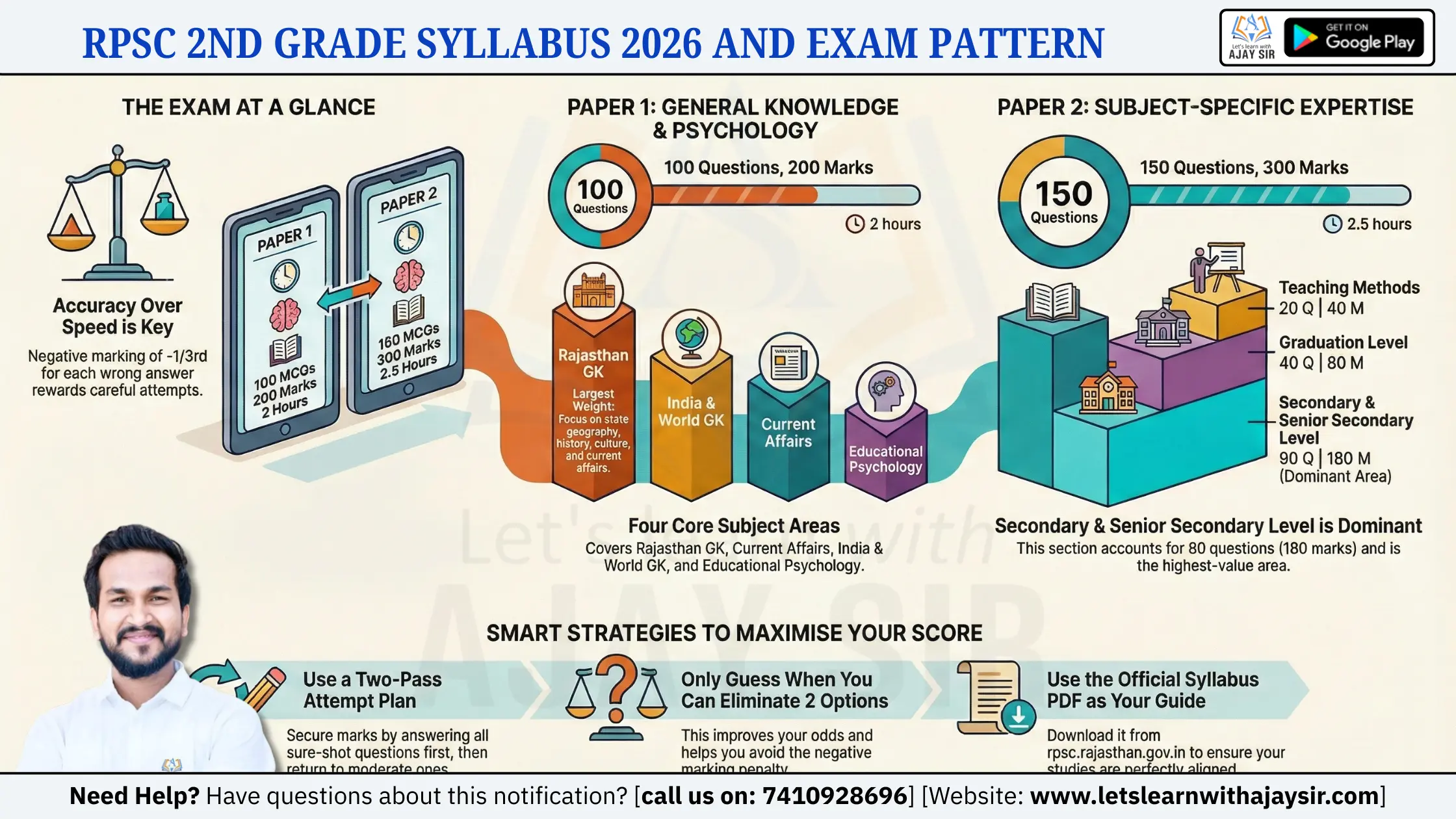
Paper 1 is 100 MCQs for 200 marks in 2 hours and covers Rajasthan general knowledge, current state affairs, India & world general knowledge, and educational psychology.
Paper 2 has 150 MCQs for 300 marks in 2 hours and 30 minutes. It tests secondary and senior secondary level knowledge, graduation-level depth, and teaching methods for your subject.
Key rules: all questions carry equal marks and wrong answers cost -1/3. Use this to favor accuracy over blind guessing.
You can download the official PDF from the authority’s site to make a topic checklist. This intro helps you map study hours, mock tests, and high-weight topics quickly.
Syllabus & Exam Pattern
Start by noting exact question counts, time limits, and total marks so your prep matches the test. This quick snapshot helps you plan weekly blocks that reflect real weights and timings.
Quick numeric view:
Paper | Questions / Marks | Time |
Paper 1 | 100 MCQs / 200 marks | 2 hours |
Paper 2 | 150 MCQs / 300 marks | 2 hours 30 minutes |
Each question carries equal marks. Wrong answers cost -1/3 per item, so accuracy beats random guessing. Use this rule to limit risky attempts.
Paper 1 splits into four focused parts: Rajasthan general knowledge (largest weight), current affairs of the state, India & world general knowledge, and educational psychology. Paper 2 focuses on subject depth: secondary/senior secondary level holds the major share, with graduation-level questions and teaching methods making up the rest.
Plan practice that mirrors question counts and time limits.
Prioritize high-weight sections first—this improves marks fast.
Use timed mocks to build speed; finish Paper 1 within 120 minutes and Paper 2 within 150.
Following these steps helps candidates balance breadth in general knowledge with deep subject learning for better results.
Exam Pattern 2025 at a Glance: Paper 1 and Paper 2 Structure
Start by getting a tight snapshot of how both papers are built; this guides every practice session.
Paper 1: 100 MCQs, 200 Marks, 2 Hours, Negative Marking
Paper 1 has 100 multiple-choice questions for 200 marks. You get 2 hours to finish. All items carry equal marks, so speed with accuracy is vital. Negative marking applies at -1/3, so avoid wild guesses.
Paper 2: 150 MCQs, 300 Marks, 2 Hours 30 Minutes, Negative Marking
Paper 2 contains 150 MCQs totaling 300 marks. The duration is 2 hours 30 minutes. This paper favors subject depth, so pace your attempts to balance difficult and moderate questions. Equal weight per question means time allocation matters for high scoring.
Plan sections: secure easy items first, then tackle moderate, then hard.
Use logical elimination to limit errors from negative marking.
Practice OMR bubbling to prevent avoidable mistakes on test day.
Track speed and accuracy in mocks; aim to finish within the allotted hours.
Paper | Questions / Marks | Time |
Paper 1 | 100 MCQs / 200 marks | 2 hours |
Paper 2 | 150 MCQs / 300 marks | 2 hours 30 minutes |
RPSC 2nd Grade Syllabus 2026: Paper 1 Syllabus Breakdown
Break Paper 1 into clear modules so you can target study time where it pays off most. Focus on four parts: state general knowledge, current affairs of the state, India and world general knowledge, and educational psychology.
Geography, history, culture, and state knowledge
Rajasthan topics include physical geography (climate, drainage, agriculture), key archaeological sites, medieval to early modern rulers, and cultural markers like forts, painting schools, and fairs.
Prioritize geography and medieval-modern links with Mughal relations for steady marks.
Current affairs of the state
Keep a monthly digest of socio-economic updates, political changes, sports, and cultural events. Short notes make quick revision before the test.
India and world general knowledge
Cover global systems (continents, oceans, wind and monsoon systems), population trends, national income basics, major welfare schemes, and constitutional milestones from 1919/1935 to the present.
Educational psychology
List major learning theories—behaviorism, cognitivism, constructivism—and their classroom uses. Add topics like motivation, intelligence, creativity, individual differences, and inclusive teaching practices.
Break Paper 1 into four modules and assign time by weight.
Create one-pagers for forts, Lok Devata, and painting schools to speed review.
Practice mixed quizzes that combine state GK, global GK, and pedagogy to mirror real questions.
RPSC 2nd Grade Syllabus 2026: GK for Paper 1
Start by mapping Rajasthan's physical layout to link rivers, climate zones, and crop belts for quick recall. A clear map makes it easier to connect relief with agriculture, industry, and tourist hubs.
Physical & Economic Geography
Focus on climate types, major drainage basins, and vegetation zones. Relate rivers to irrigation, crops, and local industries.
Tip: sketch district-wise agro-climatic links to answer interdisciplinary questions on the exam.
Ancient to Early Modern Rajasthan
Memorize key sites like Kalibangan, Ahar, and Ganeshwar. Build timelines from Gurjar-Pratiharas to Chauhans and Mughal interactions.
Freedom Struggle & Movements
Summarize the 1857 events, Prajamandal actions, and major peasant and tribal uprisings. Note the state’s integration steps after independence.
Society, Culture & Polity
Learn Lok Devata, saints, painting schools, forts, fairs, language, and folk forms. Keep short fact-sheets on the Governor, CM, Secretariat, RPSC, the Human Rights body, and Panchayati Raj for governance questions.
Create flashcards for art, festivals, and tourist circuits.
Use monthly current affairs to update static general knowledge.
Practice mixed MCQs that pair geography with economy for better retention.
RPSC 2nd Grade Syllabus 2026: India & World GK for Paper 1
Build a compact map of world systems and Indian polity to speed recall under pressure. Start by grouping continents, oceans, global wind belts, and major population patterns. Link these basics to environmental issues and global responses so you can answer applied questions fast.
Global systems and environment
Know continents, oceans, and wind systems. Relate them to climate change, biodiversity threats, and international strategies.
Study population trends and globalization impacts to handle modern general knowledge world items in the paper.
Indian polity and constitutional landmarks
Memorize the Government of India Acts of 1919 and 1935, steps in constitution making, and Ambedkar’s role. Be clear on Fundamental Rights, Duties, and Directive Principles.
Understand the offices of the President and Prime Minister, federal features, and party systems for quick political recall.
Economy and foreign policy essentials
Cover sectoral shifts, national income basics, and key poverty reduction schemes. Link trade trends to India‑UN ties and Nehru’s foreign policy for international affairs questions.
Use timelines and small charts to memorize facts and mark-heavy items.
Integrate current affairs with static topics—e.g., climate summits with environmental policy.
Practice mixed quizzes that combine geography, polity, and economy for better retention.
Topic | Focus | Why it matters | Study tip |
Global Systems | Continents, winds, population | Frame environmental and migration questions | Create one‑page maps and trend charts |
Indian Polity | 1919/1935 Acts, FRs, DPSP | Core for constitutional and political items | Use flash timelines and key articles list |
Economy & Foreign Policy | National income, schemes, India‑UN | Links domestic growth to global role | Practice data questions and policy notes |
Current Affairs | Climate, trade, treaties | Updates static GK with recent events | Revise weekly digests and integrate with static notes |
RPSC 2nd Grade Syllabus 2026: Educational Psychology for Paper 1
Think of educational psychology as a toolkit for solving real classroom puzzles. This section links theory to quick strategies you can use while teaching. Keep notes that pair each idea with one classroom action.
Core ideas and classroom use
Quick-reference map: list leading psychologists (Piaget, Vygotsky, Skinner, Bandura) with one classroom tip each. This helps answer scenario-based questions fast.
Learning, motivation, intelligence, creativity, and emotional intelligence
Compare behaviorist, cognitive, and constructivist views so you know when to use direct instruction, guided discovery, or project work.
Summarize the transfer of learning and the main factors affecting learning for the principle questions.
Note the motivation types and simple achievement strategies you can name in answers.
Distinguish intelligence from creativity and list common measures used in schools.
Practice short examples of emotional intelligence: self-regulation, empathy, and engagement.
Individual differences and inclusive practices
Prepare intervention steps for gifted pupils, slow learners, and students with conduct issues. Use short caselets to train application skills.
Area | What to Memorize | Classroom Tip |
Development | Stages & implications | Adapt tasks by age |
Personality | Theories & tests | Use simple checklists |
Inclusion | Strategies for varied needs | Use scaffolds and peer support |
Make one‑page notes linking theory to practice for fast recall during the exam.
Use mini-scenarios in mocks to test application skills.
Memorize key definitions like self-concept, attitude, habit, aptitude, and social skills for quick scoring.
RPSC 2nd Grade Syllabus 2026: Paper 2 Exam Pattern and Subject Weightage
Start by mapping how marks split across subject levels so your revision hits high-value targets. Paper 2 has 150 MCQs for 300 marks to be finished in 2 hours and 30 minutes. Negative marking is -1/3 for each wrong answer, so accuracy matters as much as speed.
Secondary & Senior Secondary Standard Knowledge (Major Weight)
Sixty percent of paper marks come from this section: 90 questions worth 180 marks. Make NCERTs your base. Build weekly deep dives and timed practice that mirror actual questions.
Graduation Level Knowledge
This area gives 40 questions (80 marks). Reserve focused study blocks to close conceptual gaps. Use standard graduation texts to back up quick revision notes and formula sheets.
Teaching Methods of the Relevant Subject
Twenty questions (40 marks) are pedagogy-focused. Treat this as a scoring booster: revise assessment techniques, classroom strategies, and subject-specific methods each week.
Design mocks with a 90-40-20 split to match real weightage.
Track topic-wise speed and accuracy; shift practice to weak, high-weight items.
Use past-question trends and maintain concise theory sheets for last week's review.
Remember negative marking: skip unclear items to avoid avoidable deductions.
Area | Questions | Marks |
Secondary & Senior Secondary | 90 | 180 |
Graduation Level | 40 | 80 |
Teaching Methods | 20 | 40 |
Marking Scheme and Negative Marking: Maximize Marks, Minimize Penalties
A precise attempt strategy protects your score more than raw speed. Each multiple‑choice item carries 2 marks. That makes scoring simple: correct picks add clear value, while wrong ones cut into your total.
For every incorrect response, you lose 1/3 of the question’s value. In practice, a wrong answer costs -0.67 marks. Because all items share equal weight, this rule applies across both papers of the rpsc 2nd grade selection.
How to attempt with smart risk control
Attempt sure-shot items first to lock in marks.
Use a two-pass plan: clear easy questions, then return to moderate ones.
Guess only when you can eliminate at least two options; that raises the expected gain above the risk from negative marking.
Skip low-confidence items to avoid steady losses; quality of attempts beats quantity.
Track your net gain in practice: monitor correct versus wrong attempts and aim for 80%+ accuracy rather than full attempts with many penalties.
Item | Value | Penalty |
Correct answer | +2 marks | — |
Incorrect answer | — | -0.67 marks (-1/3 of 2) |
Unattempted | 0 | 0 |
Practice OMR-like sheets to avoid mis-bubbling that costs marks.
Analyze penalty hotspots in mocks and reduce risky attempts on those topics.
Keep a short pre-test checklist: attempt plan, elimination rules, and a stop-loss for guesses.
All Details
Time Management and Strategy: Attempt Planning for 2 Hours and 2.5 Hours Papers
Smart pacing turns long tests into manageable sessions you can own. Start by fixing your broad plan: Paper 1 is 100 questions in 2 hours; Paper 2 is 150 questions in 2.5 hours. Use this to set section targets before you begin.
Optimizing attempts by section weightage in Paper 1
Split time by weight. Spend about 45–50 minutes on Rajasthan GK, 20–25 minutes on India & world GK, 10–12 minutes on educational psychology, and 8–10 minutes on current affairs.
Work in two passes: clear high-certainty items first, then return to moderate ones. Flag doubts and avoid deep dives that cost marks.
Balancing depth and speed for Paper 2 subject components
Give bulk time to secondary/senior secondary material (the largest share). Use a per-25-question timer—about 37–38 minutes—to keep pace.
Take 10–15 second micro-breaks every 20–25 questions to reset focus.
Use "skip and mark" for uncertain items; pre-define an attempt ceiling to protect accuracy.
Keep short formula sheets and concept maps for fast recall during the paper.
In mocks, track time per topic and reallocate study to slow areas. Build an exam-day routine: sleep well, hydrate, eat, and arrive early to stay calm.
Paper | Questions | Duration | Per-25 Q Timer |
Paper 1 | 100 | 2 hours | ~30 minutes |
Paper 2 | 150 | 2 hours 30 minutes | ~37–38 minutes |
Strategy focus | Section-weighted attempts | Two-pass + skip/mark | Micro-breaks + formula sheets |
Conclusion
Wrap your prep with a clear checklist that turns goals into daily wins. Use the official pdf as your north star, match weekly blocks to paper weight, and practice under timed hours to build a reliable pace.
Prioritize accuracy over raw attempts—negative marking rewards careful elimination. Balance static topics like the freedom struggle and general knowledge of the world with frequent updates on state affairs.
Reinforce educational psychology with classroom actions and go deep on secondary subject matter for Paper 2. Track attempts, accuracy, and section-wise marks. Stay consistent, trust the roadmap, and keep focused until test day.