Exam Category:
Banking Exams
Ready to plan your preparation? This short guide gives you a clear overview of the rbi assistant syllabus and the assistant exam pattern so you can map out study goals with confidence.
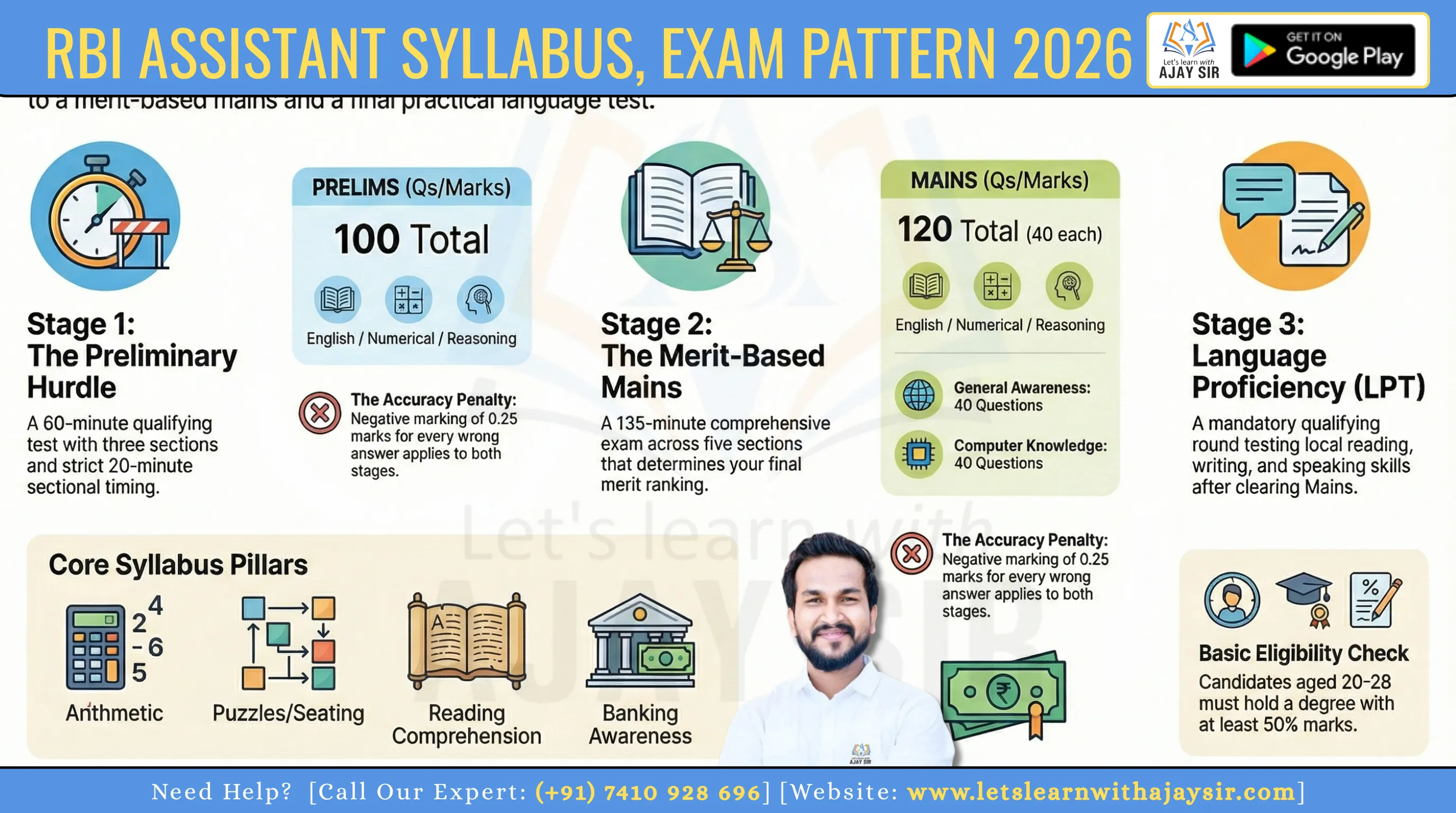
You will see how the three-stage structure — Prelims, Mains and the Language Proficiency Test — fits together. The prelims covers english language, numerical ability and reasoning with a strict time split, while the mains adds general awareness and computer knowledge.
Key details include section-wise question counts, marks, total duration and the negative marking rule of one-quarter per wrong answer. We also note the qualifying role of the LPT and how local language proficiency affects final appointment.
Check official updates at rbi.org.in for notifications, admit cards and results. We also flag basic eligibility checks, fee slabs and a salary snapshot so you start with realistic expectations.
Quick Overview
RBI Assistant Syllabus and Exam Pattern 2026: at a glance
Start here: a compact checklist helps you confirm eligibility, fees and the online application route so you avoid wasted effort.
Core facts: the application mode is online via rbi.org.in. Fees are Rs 450 (Gen/OBC) and Rs 50 (SC/ST/PwD/Ex‑Servicemen). Age and education limits matter: typical range is 20–28 years with relaxations, and most posts ask for a graduate with 50% (pass marks accepted for SC/ST/PwBD).
Stages are simple: a qualifying prelims, a merit‑based mains exam and a final language proficiency test. Knowing this helps you plan preparation: focus early on sections that appear in assistant prelims, then widen your scope for the mains exam.
Check documentation and timelines as soon as the notification is live.
Watch cut‑offs and normalisation; they influence shortlisting.
Keep rbi.org.in as your primary source to avoid third‑party errors.
Tip: review salary components and local language requirements before you apply so there are no surprises if you clear the process.
Syllabus & Exam Pattern
RBI Assistant Syllabus and Exam Pattern 2026
This concise blueprint explains what topics appear in each stage, how long you get for them and what mistakes cost you.
Quick overview: Prelims has three sections with a total of 60 minutes and a fixed 20-minute slot per section. The mains paper expands to five tests, runs for 135 minutes and keeps sectional timing to maintain balance between topics.
Negative marking is strict: a quarter mark is deducted for each wrong response. Prelims is a qualifying hurdle — your scores decide who reaches mains, though final merit depends on mains performance.
Subjects in Prelims: English, Numerical Ability, Reasoning (sectional timing enforced).
Mains adds General Awareness and Computer Knowledge to the existing sections.
Medium: tests are available in English and Hindi except the English section, which is only in English.
Stage | Sections | Duration |
Prelims | 3 | 60 minutes (20 min each) |
Mains | 5 | 135 minutes (sectional timing) |
How to use this guide: mirror the official layout in mocks, practise within sectional limits, and focus on accuracy to reduce penalties. Align your topic list with this outline so you avoid blind spots before the mains exam.
RBI Assistant Exam Pattern 2026: Prelims exam
Get a clear map of the prelims: section sizes, timings and what each short window demands. This helps you practise with purpose and avoid time traps on test day.
Three sections and 60‑minute structure
The prelims is split into three sections. Each section runs for 20 minutes with strict sectional timing.
Section | Questions | Marks | Time |
English Language | 30 | 30 | 20 min |
Numerical Ability | 35 | 35 | 20 min |
Reasoning Ability | 35 | 35 | 20 min |
Marking scheme and negative marking
The total is 100 questions for 100 marks in 60 minutes. Each incorrect response costs 0.25 marks. Skipping doubtful items often protects your score more than guessing.
Medium of test and sectional timing
The english language section is in English only. Numerical ability and reasoning ability are offered in English and Hindi.
Practise within 20‑minute slots to mirror the assistant prelims exam.
Set target attempts per section with safety margins for accuracy.
Use timed mocks to match on‑screen constraints and build a steady rhythm for the rbi assistant prelims.
RBI Assistant Exam Pattern 2026: Mains exam
The mains phase is a longer, multi‑section test that requires a steady pace from start to finish. You face five tests: reasoning, english language, numerical ability, general awareness and computer knowledge. Each section has fixed timing to keep the test balanced.
Sectional breakdown and total layout
Test | Questions / Marks | Time (minutes) |
Reasoning | 40 / 40 | 30 |
English Language | 40 / 40 | 30 |
Numerical Ability | 40 / 40 | 30 |
General Awareness | 40 / 40 | 25 |
Computer Knowledge | 40 / 40 | 20 |
Marking, language and merit
The mains carries a total of 200 questions for 200 marks and runs for 135 minutes. Each wrong answer costs 0.25 marks, so accuracy matters as much as speed.
The English language paper is only in English. Other tests are available in English and Hindi. Mains marks form the basis of final merit, so balance across sections will boost your chances.
Prioritise high‑yield topics in each test to maximise returns.
Use sectional mocks to match the real environment for the mains exam.
Secure safe scores in your strong sections to hedge cut‑off risk.
Detailed syllabus for Prelims & Mains: topic-by-topic breakdown
A topic-by-topic checklist helps you plan weekly drills and track progress with ease. Below is a clear list of the items to cover in each section so you can build a revision loop and a mock schedule.
English Language
Focus on reading comprehension, cloze tests, synonyms and antonyms. Add sentence correction, phrase completion and rearrangement drills.
Also practise voice change, word meanings and short-passages to boost speed and accuracy.
Numerical Ability / Quantitative Aptitude
Cover high-yield arithmetic: time & distance, time & work, averages, percentage, and SI/CI.
Include number system, HCF/LCM, ratio, probability, trains, pipes and mensuration. Study algebra, geometry and trigonometry for tougher slots.
Reasoning Ability
Drill puzzles, seating arrangements, blood relations and direction tests. Add coding-decoding, series, analogies and odd-one-out practice.
Work on symbol and statement reasoning to sharpen logical moves under time pressure.
General Awareness
Keep daily notes on current affairs (India and world) and banking awareness. Learn key central bank terms, recent policy moves and relevant acts.
Make short lists for emoluments, benefits and frequent topics that appear in quizzes.
Computer Knowledge
Study basic concepts of hardware and software, operating systems, common devices and internet security. Know common viruses, hacking terms and basic history of computing.
How to use this list
Turn topics into weekly buckets with revision loops.
Align mock analysis to topic gaps and assign spaced-repetition for hard subtopics.
Keep a formula sheet and a daily vocabulary deck for quick reviews.
Section | Core topics | Study focus |
English Language | RC, cloze, grammar, vocab | Speed reading, error spotting, daily vocab |
Numerical Ability | Arithmetic, algebra, geometry, DI | Concept drills, timed problem sets |
Reasoning Ability | Puzzles, series, arrangements, coding | Pattern recognition, practice sets |
General Awareness | Current affairs, banking terms, laws | Daily notes, monthly revisions |
Computer Knowledge | Hardware, software, security, history | Concept maps, short quizzes |
RBI Assistant Syllabus and Exam Pattern 2026: Language Proficiency Test (LPT)
Shortlisted candidates face a practical check of reading, writing and speaking in the office's official language. The language proficiency test is held after mains for those who make the cut. It is a qualifying round and must be passed to keep your place in the final selection.
What the test checks and when it is held
The proficiency test assesses reading, comprehension, basic writing and spoken fluency. It is organised once mains shortlists are finalised. Non‑proficiency leads to disqualification even if you clear the paper stages.
Stage | When | Consequence |
Language proficiency test | After mains for shortlisted candidates | Qualifying; failure leads to disqualification |
Assessment | Reading, writing, speaking, comprehension | No marks; affects final selection |
Office mapping | Region-wise official/local language | Choose posting based on fluency |
All Details
Conclusion
This final note ties the core milestones into a simple action plan you can follow each week.
You’ve seen the full rbi assistant syllabus and the layout of the rbi assistant exam. Set weekly targets that mix concept drills, timed mocks and short reviews. Treat prelims as the gateway and mains as the merit-maker; the language proficiency test is mandatory to clear final selection.
Keep one file with your documents, set alerts at rbi.org.in, and run mocks that mirror sectional timing and the 0.25 negative marking rule. Focus your preparation on high‑yield topics, daily revision, and local language practice if you aim for a specific office.
Move ahead with clarity, discipline and a steady plan to secure your assistant seat.
Disclaimer:
All eligible and interested candidates are advised to read the official notification carefully before applying online.
Disclaimer: The examination results and marks published on this website are provided solely for immediate information to candidates and do not constitute a legal document. While every effort has been made to ensure the accuracy and authenticity of the information available on this website, we are not responsible for any inadvertent errors that may occur in the publication of examination results or marks. We shall not be liable for any loss or damage to any individual or entity arising from any deficiency, defect, or inaccuracy in the information provided on this website.


![EMRS PGT [Tier-2] ENGLISH - 2025](https://letslearnwithajaysir.s3.ap-south-1.amazonaws.com/courses/FsnKxIFpiLxbRD418g6vo7AsLy0ge7IP7Iu2fsJY.webp)
![EMRS TGT [Tier-2] ENGLISH - 2025](https://letslearnwithajaysir.s3.ap-south-1.amazonaws.com/courses/BjLXVqVV1SeZKnhYjmPZpz2jQ7r02kS73pGGOLrL.webp)
![KVS/NVS PGT ENGLISH [Tier-2] - 2025](https://letslearnwithajaysir.s3.ap-south-1.amazonaws.com/courses/vqli598KWrKnm4txcsZh5qjMN9UMAX8LvFk9IiF0.webp)
![KVS/NVS TGT ENGLISH [Tier-2] - 2025](https://letslearnwithajaysir.s3.ap-south-1.amazonaws.com/courses/pxC2WhfYKuyaoGqvcTvhTBL2Y44o3TNA0z8NYRB5.webp)