Get a clear, future-focused map of the upcoming selection cycle with the IBPS PO Syllabus & Exam Pattern 2026 at the heart of your planning. You’ll see how dates, stages and vacancy trends shape what to study and when to practise.
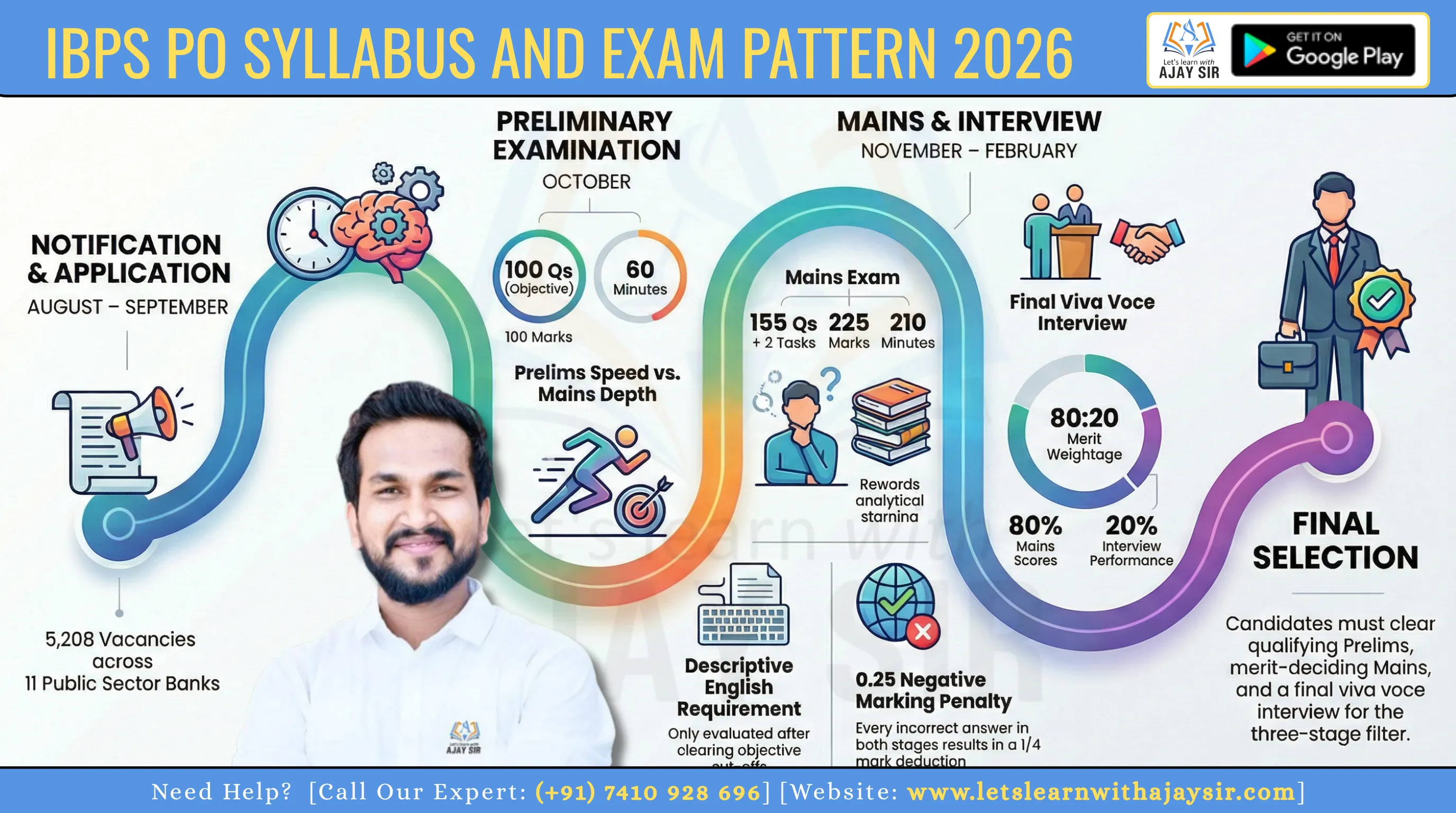
Expect the notification around August, Prelims in October and Mains in November, with interviews in January–February. Use this timeline to plan mocks and revision blocks.
With 5,208 vacancies in ibps 2026 across 11 public sector banks, you can benchmark competition and target realistic scores. The selection has three stages: a qualifying prelims, mains that decide merit, and an interview that completes the score.
Note how the mains carries weight: final merit uses Mains 80% + Interview 20%, so focus your effort on reasoning, data analysis and descriptive English.
This guide explains the ibps syllabus, the likely pattern and practical steps to move from speed-based prelims to depth-driven mains so you can position yourself as a competitive officer aspirant.
Quick Overview
IBPS PO Syllabus and Exam Pattern 2026: Ultimate Guide Overview
This guide gives you a clear route from speed-focused prelim practice to depth-driven mains readiness. It explains what the selection tests are and how to switch gears between fast, accurate objective rounds and analytical, descriptive tasks.
Key rules matter: there is a 0.25 negative mark per wrong answer in both stages, and descriptive English is marked only after you clear objective cut-offs.
Save weeks by following a mapped study plan that avoids off-topic detours and aligns with the official syllabus.
Learn why candidates must balance quick accuracy in prelims and build depth for mains, where merit is decided.
Use structured mock schedules early to expose gaps and tune section timing.
Build knowledge stepwise: core topics first, then advanced puzzles, mixed DI and editorial-grade English.
Adopt revision loops and post-test analysis to turn mistakes into steady score gains, not just more practice questions.
With a staged plan you avoid burnout, manage attempts smartly under negative marking, and focus on outcomes across both exams and the interview.
IBPS PO 2026 at a glance: what you should expect
Plan with dates and priorities in mind. Knowing the likely timeline helps you schedule mock tests, reserve buffer weeks and set realistic targets. Keep your focus on staged practice rather than last-minute cramming.
Tentative timeline and important dates
The likely calendar runs: notification in August, online applications in August–September, the preliminary exam in October, mains in November and interviews in January–February.
Both prelims and mains will be online objective papers with a 0.25 negative mark per wrong answer, so practise accuracy under time pressure.
Vacancy trends and competition outlook
Use previous year data to measure competition. There were 5,208 vacancies in ibps 2026 across 11 public sector banks, and multi-year totals usually fall between 5,000–6,000.
That range tells you how many candidates are likely to compete and helps set shortlisting targets. Do a regular analysis of cut-offs and adjust your study pace accordingly.
Stage-wise plan: speed drills before prelims; depth work between prelims and mains.
Subject focus: reasoning, quantitative aptitude, English, general awareness, banking awareness and basic computer concepts.
Preparation tip: follow the official site for the brochure and build full-length simulations ahead of the preliminary exam and mains.
Syllabus & Exam Pattern
IBPS PO Syllabus & Exam Pattern 2026
Knowing the likely framework helps you build a study plan that fits speed tests and depth assessments. The structure has proven stable, so you should focus on stage-specific skills and avoid wide detours in late preparation.
What’s new or likely unchanged
Expect continuity: the core layout is likely unchanged. Reasoning and computer aptitude remain combined in the mains, with more emphasis on applied tasks and advanced puzzles. Continue weekly updates for general awareness—RBI policy, Budget and key schemes matter.
Stage-wise structure: Prelims, Mains and Interview
See how each stage tests different strengths. Prelims is a fast filter; mains rewards depth; the interview assesses communication and banking awareness.
Stage | Format | Marks / Time | Key focus |
Prelims | Objective, 3 sections | 100 marks, 60 minutes, 0.25 negative | Speed, sectional timing, accuracy |
Mains (Objective + Descriptive) | Objective + Descriptive | 155 Qs, 200 marks, 180 min; Descriptive 25 marks, 30 min | DI, complex reasoning, essays |
Interview | Viva voce | 100 marks; qualifying: 40% Gen, 35% categories | Communication, attitude, banking awareness |
Final merit = Mains 80% + Interview 20% — focus your effort accordingly.
Data handling in mains will strongly affect your selection chances.
Use the stable exam pattern to lock a study schedule, then tweak if the official notification changes the process.
IBPS PO Prelims Exam Pattern: sections, marks and timing
In the first online filter you get three twenty-minute slots; how you use each minute matters more than how many questions you try.
The preliminary exam has three sections: English Language, Quantitative Aptitude and Reasoning Ability. Each section gives a fixed time of 20 minutes. The total is 100 questions and 100 marks in 60 minutes.
Sectional timing and negative marking explained
Remember: every wrong answer costs 0.25 marks. Language options are English or Hindi for Quantitative and Reasoning, but the English Language section stays in English only.
Section | Questions | Marks | Time |
English Language | 30 | 30 | 20 minutes |
Quantitative Aptitude | 35 | 35 | 20 minutes |
Reasoning Ability | 35 | 35 | 20 minutes |
Scoring strategy: accuracy vs speed
You should build an attempt order based on strengths and sectional cut-offs. It is wiser to answer fewer questions correctly than to attempt many and lose marks to negatives.
Use micro-timers in each 20-minute block (for example, 12–13 minutes for core sets, 7–8 minutes to review and mop up).
Candidates must master mental maths, quick elimination and simple approximation to protect accuracy.
Practice full-length mock test routines and cap time on hard puzzles—move on after two minutes to avoid loss.
In English, pre-identify fast lanes such as error spotting and cloze tests; treat RC as variable based on passage difficulty.
IBPS PO Syllabus & Exam Pattern 2026: Prelims syllabus breakdown
This section explains the three prelims sections and the specific topics you must master. Use this breakdown to plan daily drills and focused weekly mock tests that mirror real timing and difficulty.
English language topics you must master
Reading comprehension with banking and economy passages should be your top priority. Add cloze tests, para jumbles and error spotting next.
Work on sentence improvement, fillers and phrase replacement. Build targeted vocabulary for synonyms, antonyms and word usage to boost scoring speed.
Quantitative aptitude: arithmetic and DI focus
Daily practice on data interpretation (tables, pie, bar, line, radar, caselets) is essential. Keep core arithmetic sharp: ratio, percentages, averages, profit & loss, SI/CI, time & work and TSD.
Use number series, simplification/approximation and quadratic problems as time anchors. Cover mensuration, mixtures, probability, permutation & combination and basic data sufficiency.
Reasoning ability: puzzles, seating and logic
Progress from single-variable puzzles to multi-layer seating, floor and schedule arrangements. Then practise syllogism, inequalities, blood relations and direction sense.
Also include coding–decoding, order & ranking, alphanumeric series, input–output and statement-based logical reasoning. Build templates for standard puzzle frames to save time.
Quick plan: mix topic drills and mini-mocks; add a full-length sectional each week.
Use previous year trends to prioritise repeating question types and calibrate difficulty expectations.
Track errors by type—concept, misread or timing—and correct them before they cost marks.
IBPS PO Syllabus & Exam Pattern 2026: Mains exam pattern
Your mains day requires stamina: four objective sections followed by a short descriptive writing slot. The full test gives you 210 minutes in total, so pacing and section strategy matter more than raw speed.
Weightage and duration: where your merit is decided
Objective layout: Reasoning & Computer (45 Qs, 60 marks, 60 mins), General Awareness/Banking (40 Qs, 40 marks, 35 mins), English Language (35 Qs, 40 marks, 40 mins) and Data Analysis & Interpretation (35 Qs, 60 marks, 45 mins).
Negative marking is 0.25 per wrong answer and sectional timing applies. Treat Reasoning and Data Interpretation as high-weight zones for your final merit.
Descriptive English: letter and essay essentials
The descriptive paper has two tasks — a formal letter and an analytical essay — totalling 25 marks and 30 minutes. Build concise templates for introductions, supporting points and conclusions so writing flows under time pressure.
Use mains-specific mocks that combine objective sections with the descriptive slot to practise the transition.
Prioritise quantitative aptitude, reasoning and data interpretation practice while keeping English and general awareness daily.
Maintain a facts capsule for banking awareness and recent policy updates to strengthen your interview readiness.
IBPS PO Syllabus & Exam Pattern 2026: Mains [Reasoning & Computer Aptitude]
You need a steady approach to tackle complex puzzles and applied computer questions in the mains. Focus on diagram templates, rule-ordering and quick contradiction checks. These cut solving time and protect accuracy.
Advanced puzzles, input-output and critical reasoning
Master multi-variable frames: circular, linear, square and hexagonal seating, double lineups and scheduling. Work with floor, box and age-based puzzles by listing constraints and drawing compact diagrams.
Practise machine input-output patterns for shifting, pairing and coded steps. Automate a step-tracking routine so you do not rework previous lines.
Train timed sets (8–12 minutes) for each complex puzzle to sharpen skip/attempt decisions.
Build rapid checks for coded inequalities and reverse syllogism to spot contradictions fast.
Use elimination maps for assumption/inference and cause–effect questions.
Computer aptitude and banking-oriented basics
Cover OS, networking, hardware vs software, memory/storage and common file formats. Learn MS Office shortcuts, common abbreviations and basic security hygiene.
Tie knowledge to banking tasks such as spreadsheet use, secure email, KYC systems and safe data handling. This makes application-style questions easier to answer and strengthens your interview readiness.
IBPS PO Syllabus & Exam Pattern 2026: Mains [ Data Analysis & Interpretation]
Tackling layered charts and dense caselets needs a clear plan and calm focus. This section tests how you extract facts, run quick calculations and apply quantitative aptitude under time pressure.
Formats to train: tables, bar/line/pie/radar charts, mixed sets and caselets. Each set can require arithmetic crossovers such as ratios, percentages, SI/CI, averages, mixtures, time, speed & distance and work.
Graphs, mixed DI and caselets
Start with single-chart practice, then move to mixed sets and dense caselets. Skim all sets first; pick two quick gains, one medium and one advanced to fit the 45-minute section window.
Arithmetic-heavy DI and time management
Build an arithmetic toolkit so you can apply formulae without pausing. Use estimation where exactness is unnecessary and guard accuracy when values are close.
Read → plan → execute: skim, allocate time, solve in order of return.
Practise data sufficiency to avoid over-calculation and to decide when info is enough.
Create a timing grid (for example 10–12–10–10 minutes per set) and rehearse it in full mocks.
Keep working neat and annotate % changes or ratios early to cut re-reading time.
DI Type | Core arithmetic | Expected time | Fast solving tip |
Single-chart (bar/line) | Percentages, differences | 8–12 mins | Direct read & quick formula |
Mixed sets (multi-chart) | Ratio, averages | 10–12 mins | Tabulate key values first |
Caselets (dense) | SI/CI, mixtures, TSD, work | 12–15 mins | Sketch small notes and use approximation |
Data sufficiency | All of the above | 3–5 mins per item | Decide sufficiency before computing |
Candidates must catalogue recurring patterns (ratio tables, growth rates, allocations) and learn the fastest route for each. Regular mains-style practice will stabilise your analysis and boost score consistency.
IBPS PO Syllabus & Exam Pattern 2026: Mains[English Language]
A tight English plan blends targeted reading with grammar drills so you can convert comprehension into marks. Focus on economy and banking passages, and practise spotting tone, inference and fact versus opinion.
High-level RC, vocabulary and grammar
Prioritise high-level RC with economy and policy angles. Read short editorials and make quick notes on argument flow.
Expand vocabulary with thematic lists—finance, policy and social issues—and test those words in error spotting and usage items.
Use a compact grammar checklist for common slips: subject–verb agreement, modifiers, pronouns, parallelism and prepositions. This speeds elimination under pressure.
Techniques for para jumbles and cloze tests
For para jumbles, identify likely opening and closing lines first. Look for chronological markers and linking words before pairing sentences.
Approach cloze tests with context-first reading, then check grammar and collocation. Collocations often give away the best fit quickly.
Build descriptive templates for essay and letter: crisp intro, two clear body points with examples, and a short conclusion.
Calibrate reading speed with daily editorials (The Hindu, Business Standard, RBI bulletins) and turn notes into flash cards.
Use mains mocks to tune time splits between RC and non-RC items and to practise concise, error-free writing.
Area | Focus | Quick tip |
Reading comprehension | Economy, policy, social issues | Skim for tone, then answer detail questions |
Vocabulary & usage | Thematic lists + application | Create 5-word daily cards |
Grammar & errors | Agreement, modifiers, pronouns | Use elimination and grammar checklist |
Para jumble & cloze | Connectors, chronology, collocations | Find opening line; test connections |
Tip: practise with timed mocks so your ability to manage RC and written tasks under the mains time frame becomes routine. This will help you face the exam with calm and clarity.
IBPS PO Syllabus & Exam Pattern 2026: Mains [General, Economy & Banking Awareness]
Keep a rolling six‑month tracker for policy moves, budgets and sector news so you can link facts to questions quickly.
Focus your daily routine on three streams: recent policy actions, static facts and sector-specific knowledge. Read RBI circulars, budget highlights and major reports. Relate each item to banking functions so it becomes usable, not just memorable.
RBI, Budget and static GK essentials
Track: repo/CRR changes, Financial Stability reports, Budget headlines and Economic Survey trends.
Cycle static lists—state capitals, rivers, national parks, awards—during short breaks to keep them fresh.
Banking awareness and current affairs
Daily banking awareness should cover payments (UPI/RTGS/NEFT), priority sector norms, NPA basics and major regulatory moves. Monitor leadership changes, mergers and fintech updates.
Use monthly CA PDFs and weekly quizzes to reinforce recall.
Create a one‑page sprint sheet of high‑value facts for final-week revision.
Tie news to practice: e.g. how a repo change affects lending spreads.
Topic | Key sources | Study tip | Time to revise |
RBI policies & circulars | RBI website, press releases | Summarise impact on rates and liquidity | Weekly |
Budget & Economic Survey | Finance Ministry, official docs | Note key allocations and fiscal ratios | Monthly |
Banking awareness | Bank reports, regulator notes | Make short case notes on priority sector, payments | Daily |
Static GK & CA | Monthly compendiums, newspapers | Use flashcards and 3× revision cycle | Daily short sessions |

![EMRS PGT [Tier-2] ENGLISH - 2025](https://letslearnwithajaysir.s3.ap-south-1.amazonaws.com/courses/FsnKxIFpiLxbRD418g6vo7AsLy0ge7IP7Iu2fsJY.webp)
![EMRS TGT [Tier-2] ENGLISH - 2025](https://letslearnwithajaysir.s3.ap-south-1.amazonaws.com/courses/BjLXVqVV1SeZKnhYjmPZpz2jQ7r02kS73pGGOLrL.webp)
![KVS/NVS PGT ENGLISH [Tier-2] - 2025](https://letslearnwithajaysir.s3.ap-south-1.amazonaws.com/courses/vqli598KWrKnm4txcsZh5qjMN9UMAX8LvFk9IiF0.webp)
![KVS/NVS TGT ENGLISH [Tier-2] - 2025](https://letslearnwithajaysir.s3.ap-south-1.amazonaws.com/courses/pxC2WhfYKuyaoGqvcTvhTBL2Y44o3TNA0z8NYRB5.webp)