> SSB Constable Tradesman Recruitment 2026: Apply Online for 827 Posts, Eligibility, Vacancy & Selection Process
SSB Constable Tradesman Recruitment 2026: Apply Online for 827 Posts, Eligibility, Vacancy & Selection Process
Exam Category:Defence Exams
Welcome to your complete guide for a significant government career opportunity in India. If you have specialist skills and seek a stable, respected role, this information is for you.
We will explore the upcoming drive by the Sashastra Seema Bal (SSB). This is a major event for skilled individuals across the country.
The process aims to fill numerous vacancies for various tradesman and driver posts. Roles include positions for drivers, veterinary assistants, tailors, and other specialists.
This article acts as your roadmap. We will walk you through every step, from checking your eligibility to submitting your application. Our goal is to make your journey clear and straightforward.
You will learn how to find the official notification and understand its details. With the right preparation, your path to success can be much smoother.
Key Takeaways
This guide covers a major government recruitment drive for skilled tradesmen and drivers.
Over 800 vacancies are expected for various specialist constable roles.
You will find a clear breakdown of the eligibility criteria and required documents.
We explain the complete application process and how to apply online correctly.
Important dates for the notification, exam, and other tests will be detailed.
Accurate, up-to-date information is crucial for a successful application.
This resource is designed to simplify your preparation and build your confidence
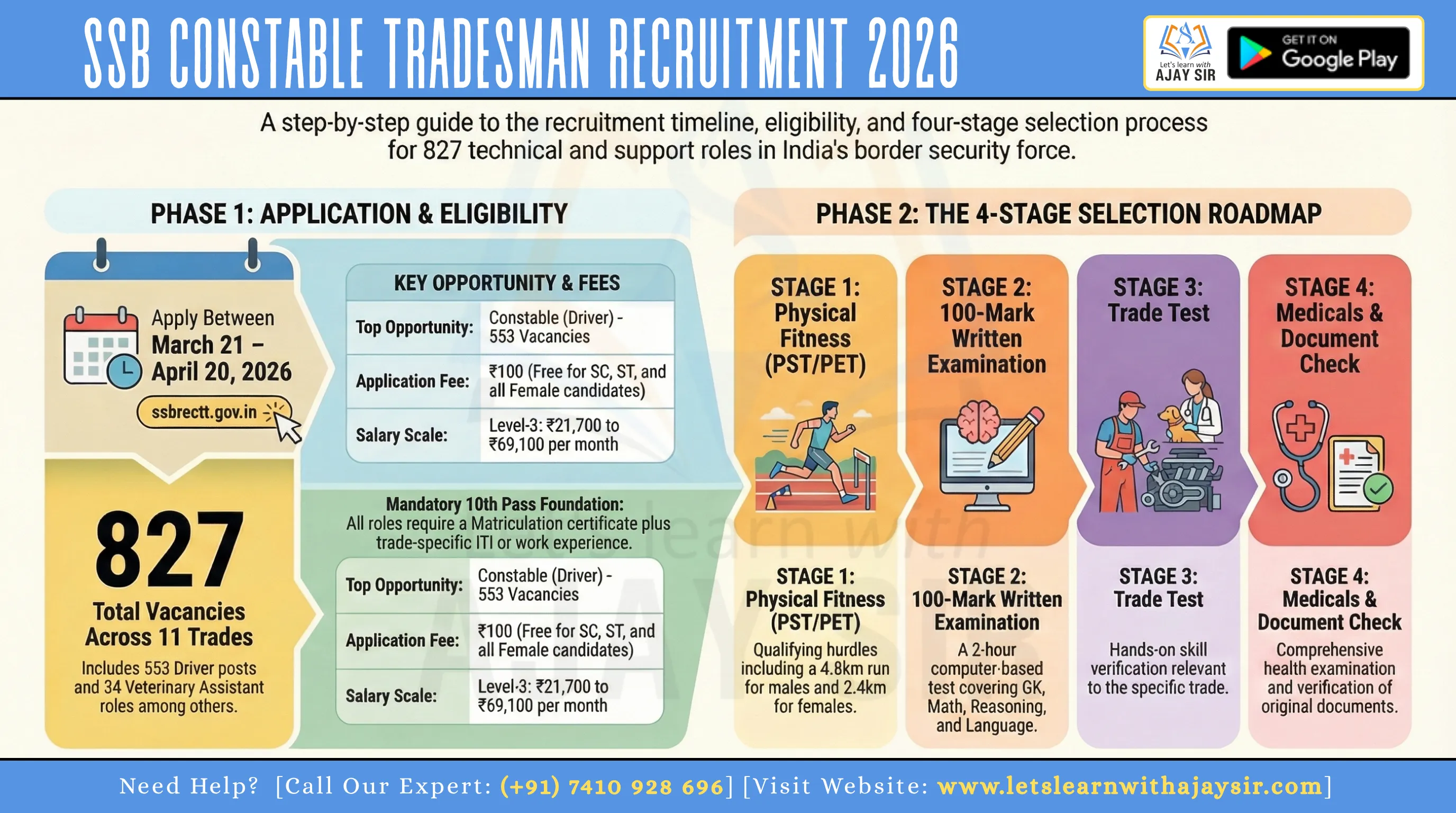
For skilled individuals across the nation, a unique opportunity to join a premier border security force is now unfolding. This drive, known officially as the SSB Constable Tradesman Recruitment 2026, is a significant event for those with specialist abilities.
The Sashastra Seema Bal (SSB) is one of India's central armed police forces. Its primary role is to guard the country's borders, ensuring national security and integrity. Serving in this force is a respected form of national service.
The purpose of this specific drive is to fill 827 posts for skilled roles. It offers a chance to serve the nation in a specialised capacity, blending technical expertise with patriotic duty. This is more than just a job; it is a career with profound purpose.
This opportunity is designed for Indian citizens who possess verified skills in specific trades or professional driving. If you are looking for a stable and respectable government position, this could be your ideal path.
The available posts are broadly categorised into two groups. The first includes technical trade roles such as Carpenter, Tailor, and Painter. The second covers essential support functions like Driver and Veterinary Assistant.
Key Details of the Upcoming Recruitment Drive
Detail
Information
Conducting Organisation
Sashastra Seema Bal (SSB)
Official Advertisement Number
524/RC/SSB/Combined Advt./CTs/2025
Total Number of Posts
827
Primary Post Categories
Constable (Tradesman) and Constable (Driver)
Nature of Recruitment
All-India, Central Government
Key Stages in Selection
Physical Tests, Written Exam, Trade/Skill Test
Referencing the official advertisement number is crucial for all applicants. The entire recruitment cycle, from the release of the notification to the final selection, will be governed by this document.
Before you proceed with your application, it is vitally important to read the official notification thoroughly. It contains all the precise details regarding eligibility, dates, and the process.
Do not worry if the official information seems complex. This guide is designed to simplify everything into an easy-to-follow format. We will help you understand each step clearly, building your confidence for a successful application
Important Dates
1.
Online Apply Start Date : 21 March 2026
2.
Online Apply Last Date : 20 April 2026
3.
Last Date For Fee Payment : 20 April 2026
4.
Exam Date : Notify Later
5.
Admit Card : Before Exam
6.
Result Declared Date : Will Be Updated Here Soon
Note
Candidates Are Advised To Confirm From The SSB Official Website.
Your application's success hinges on one fundamental step: meeting all the specified eligibility conditions. These rules are non-negotiable. The authorities will scrutinise your details against them at every stage.
Failing to meet even one criterion can lead to disqualification. This section breaks down the essential requirements for educational qualification, age limit, and necessary experience.
Educational Qualifications and Experience
The common foundation for all posts is a Matriculation (10th pass) certificate. You must have passed this exam from a recognised board or institution.
Beyond this base, each trade has its own specific requirements. These often involve proven work experience or a professional certificate. You must provide valid proof for these additional conditions.
Here is a clear breakdown of the extra requirements for key roles:
Driver: A valid Heavy Motor Vehicle (HMV) or Heavy Goods Vehicle (HGV) driving licence is mandatory.
Veterinary Assistant: You need your 10th pass certificate with Science subjects. Additionally, one year of relevant experience is required.
General Trades (e.g., Barber, Tailor, Carpenter): Alongside Matriculation, you need either a two-year ITI certificate in the relevant tradeor two years of documented work experience in that field.
Nursing Orderly: You must hold a valid First Aid certificate. One year of experience in a hospital with at least 50 beds is also essential.
Gather your educational certificates, experience letters, and any professional diplomas well in advance. Official, legible documents are your key proof of eligibility.
Age Limit & Relaxations
Your age is calculated as of a fixed cutoff date: 20th April 2026. You must ensure your age in years falls within the bracket specified for your chosen post on that date.
The age limit is not uniform. It varies depending on the specific role you are applying for. The table below summarises the different brackets.
Post Category
Age Limit (As on 20/04/2026)
Standard Trades
18 to 25 years
Certain Specialist Roles
18 to 23 years
Driver & Nursing Orderly
18 to 27 years
The government provides age relaxations for candidates from reserved categories. These follow standard central government norms.
Typically, candidates from Scheduled Caste (SC) and Scheduled Tribe (ST) categories receive a 5-year relaxation. Other Backward Classes (OBC) candidates often get a 3-year relaxation.
Ex-servicemen may also be eligible for specific relaxations. The official notification will contain the precise details for all categories.
Do not leave your document check until the last minute. Verify your age proof, caste certificate (if applicable), and all educational qualification papers now. Being prepared is the first smart move in your selection process.
Analysing the vacancy distribution helps you gauge your chances and select your preferred role wisely. This section provides a meticulous breakdown of all 827 positions available. You will see exactly how many openings exist for each skilled trade.
Knowing these numbers is a crucial part of your strategy. It allows you to make an informed choice based on opportunity size. We present the data in a clear, post-wise and category-wise format.
Post-Wise and Category-Wise Vacancies
The table below lists every role included in this hiring drive. The second column shows the total number of vacancies for each post. This is the figure you should note first.
The following columns break down these totals by reservation category. These categories are: Unreserved (UR), Economically Weaker Section (EWS), Other Backward Classes (OBC), Scheduled Castes (SC), and Scheduled Tribes (ST).
The exact distribution for each post follows government reservation rules. The final, official category-wise figures will be in the notification. Use this table to understand the scale of opportunity for your desired trade.
Complete Vacancy Distribution for All Posts
Serial No.
Name of Post
Total Vacancies
1
Constable (Veterinary)
34
2
Constable (Driver) - Male
553
3
Constable (Gardener)
41
4
Constable (Water Carrier)
5
5
Constable (Cobbler)
25
6
Constable (Tailor)
41
7
Constable (Washerman)
74
8
Constable (Barber)
43
9
Constable (Waiter)
3
10
Constable (Carpenter)
7
11
Constable (Nursing Orderly)
1
*The precise number of vacancies per category will be specified in the official advertisement. The totals shown are definitive.
Two posts immediately stand out. The Driver role has a massive 553 openings. This represents the largest single opportunity in this recruitment drive.
Conversely, some positions have very few vacancies. For example, the Waiter post has only 3 openings. The Nursing Orderly role has just 1 vacancy.
This disparity is important for your planning. A post with more vacancies might offer a better chance of selection. However, you should always apply for the trade where you have proven skill and year experience.
The reservation system ensures fair representation. Your category status determines which pool of vacancies you compete within. Always check the official details for your category's exact seat count.
Remember, these 827 vacancies are specifically for the constable tradesman level. Separate hiring exists for higher ranks like Head Constable.
You will typically be allowed to apply for only one trade. Choose your applied post with great care, considering both opportunity and your qualifications.
Syllabus & Exam Pattern
SSB Constable Tradesman Recruitment 2026: The Written Exam Pattern and Syllabus
Mastering the written examination is your key to advancing in this competitive selection journey. This computer-based stage is a major scored component. Your performance here directly influences your final ranking on the merit list.
Understanding the format and content is crucial for effective preparation. We break down the structure, subjects, and key study areas below. This knowledge helps you create a targeted revision plan.
Subject-Wise Marks Distribution
The written test follows a standardised objective pattern. It is designed to assess your general aptitude and awareness. The table below details the exact weightage for each subject.
Detailed Breakdown of the Written Examination
Subject
Number of Questions
Maximum Marks
Key Focus Area
General Knowledge & Awareness
25
25
Current affairs, history, geography, general science.
Numerical Ability
25
25
Basic arithmetic, number systems, simple maths.
Logical Reasoning
25
25
Verbal and non-verbal reasoning, patterns, sequences.
Language (Hindi & English)
25
25
Grammar, comprehension, vocabulary in both languages.
Total
100
100
-
The exam duration is 120 minutes (two hours). A negative marking scheme applies, with 0.25 marks deducted for each incorrect answer. This means accuracy is as important as speed.
Key Topics to Study
Focus your study efforts on the core topics within each subject. This targeted approach prevents you from wasting time on irrelevant material. Here is a focused list for each section.
General Knowledge: Indian history, culture, geography, polity, current national and international events, basic science, environmental studies, and awards.
Numerical Ability: Number systems, simplification, percentages, ratio & proportion, average, profit & loss, simple interest, time & work, and basic geometry.
Logical Reasoning: Analogies, classification, series completion, coding-decoding, blood relations, direction sense, puzzles, and non-verbal series (figures).
Language (Hindi & English): Grammar rules, synonyms, antonyms, sentence correction, reading comprehension passages, and one-word substitutions.
All questions are multiple-choice (objective type). You will select one correct answer from four or five given options. The entire test is conducted on a computer at a designated centre.
Effective time management during the two-hour window is vital. A good strategy is to allocate your time based on the marks distribution. Many candidates aim to complete the numerical and reasoning sections first.
You could spend roughly 25-30 minutes on each subject. Always keep 10-15 minutes at the end to review your answers. Avoid spending too long on any single difficult question.
The difficulty level is generally set at the matriculation (10th pass) standard. Questions test fundamental concepts rather than advanced knowledge. The challenge often lies in solving problems quickly and accurately under exam pressure.
For reliable preparation, consider standard books for competitive exams. Publications by authors like R.S. Aggarwal for maths and reasoning are highly recommended. Regular reading of a national newspaper builds strong general awareness.
Practising with mock tests and previous years' papers is perhaps the most important step. It familiarises you with the exam pattern, improves your speed, and builds confidence. Analyse your performance in these practice sessions to identify weak areas.
This written test is a decisive hurdle. A solid grasp of the syllabus and consistent practice will place you in a strong position. Your goal is to maximise your score to ensure you progress to the next stage.
Salary Details
SSB Constable Tradesman Recruitment 2026: Salary Structure and Benefits
Beyond the honour of service, a career offers financial stability through a well-defined pay scale. This is a major advantage of securing a government position. Let's examine the attractive compensation package awaiting successful candidates.
The complete salary structure is designed to provide a respectable and secure livelihood. It includes a solid basic pay, regular allowances, and long-term benefits.
Pay Scale as per 7th CPC
Your remuneration is governed by the 7th Central Pay Commission (CPC). The post is classified under Pay Level-3. This is a standardised grade for such entry-level technical and support roles.
The table below outlines the core financial details.
Core Pay Scale Details
Component
Details
Pay Band
₹21,700 to ₹69,100
Basic Pay (Starting)
₹21,700 per month
Grade Pay
As applicable to Level-3
Your salary begins at the minimum of the band. You then receive annual increments. These raise your basic pay progressively each year.
Over time, your earnings can grow significantly within this band. This system rewards your continued service and dedication.
On top of the basic pay, you receive several monthly allowances. These adjust for living costs and location. The key allowances include:
Dearness Allowance (DA): This is a cost-of-living adjustment. It is revised twice a year by the central government.
House Rent Allowance (HRA): This subsidy depends on your city of posting. It helps cover rental costs.
Travel Allowance (TA): This covers official travel expenses you may incur.
Medical Facilities: You and your family gain access to central government health services. This is a valuable benefit.
When combined, these elements create a truly competitive take-home salary. The package is designed for a comfortable standard of living.
A central government role brings unparalleled job security. You also join the National Pension System (NPS). This provides a structured retirement fund.
Compared to similar skilled roles in other forces, this compensation is very favourable. It recognises the specialist nature of the constable tradesman work.
This financial stability allows you to plan your future with confidence. It transforms a job into a lifelong, respected career.
Furthermore, joining as a constable opens doors. The SSB provides clear pathways for promotion. With performance and experience, you can advance to higher ranks.
This recruitment drive is your gateway to this secure future. The salary and benefits form a cornerstone of the opportunity's appeal.
Selection Process
SSB Constable Tradesman Recruitment 2026: Selection Process
Navigating the selection pathway requires a clear map of each hurdle you must clear. The selection process is a multi-stage filter designed to find the most capable individuals.
It follows a strict sequence. You must qualify at each stage to proceed to the next one. Failing any single step means you will not move forward.
This section walks you through the entire journey. You will learn what happens after you submit your online application. Knowing what to expect builds confidence and helps you prepare effectively.
Stage 1: Physical Efficiency Test (PET) & Physical Standard Test (PST)
The first hurdle assesses your basic fitness and bodily measurements. These tests are qualifying in nature. You do not get marks for them, but you must pass.
The Physical Standard Test (PST) checks your height, chest, and weight. These measurements must meet the minimum standards set for your category.
The Physical Efficiency Test (PET) evaluates your physical stamina. You may be asked to run a certain distance within a time limit. This test proves you have the foundational fitness for the role.
Authorities usually conduct the PET and PST first. Only candidates who clear this stage become eligible for the written exam.
Stage 2: Written Examination
This is a computer-based test that assesses your general knowledge and aptitude. It is a scored examination, meaning your marks here count towards your final ranking.
The paper typically covers subjects like General Awareness, Numerical Ability, and Reasoning. The exact syllabus and marking scheme will be in the official notification.
Performing well in this exam is crucial. Your score, combined with performance in later stages, determines your place on the merit list.
Stage 3: Trade Test or Skill Test
This is where your specialist skills are put to the practical test. If you applied for a trade like Tailor or Carpenter, you will demonstrate your craft.
For driver candidates, this involves a driving test. The evaluating officers will assess your proficiency and safety behind the wheel.
The trade test is designed to verify the year of experience or training you claimed. It ensures you genuinely possess the required hands-on skill for the post.
Final Stage: Documentation and Medical Examination
The last step is a thorough verification of your original documents. You must present all certificates for education, age, caste, and experience.
Officials will check every detail against your application form. Any discrepancy can lead to disqualification.
You will also undergo a comprehensive medical examination. A government medical board assesses your overall health and fitness for service. This ensures you can handle the demands of the job.
Overview of the Multi-Stage Selection Process
Stage Sequence
Name of the Stage
Primary Purpose
Nature of Assessment
1
Physical Efficiency & Standard Test (PET/PST)
To filter candidates based on basic physical fitness and measurements.
Qualifying (Pass/Fail)
2
Written Examination
To assess general knowledge, aptitude, and reasoning abilities.
Scored (Marks count for merit)
3
Trade Test / Skill Test
To evaluate practical, hands-on skill in the applied trade.
Qualifying & Scored (Varies by trade)
4
Document Verification & Medical Exam
To authenticate submitted details and ensure medical fitness for service.
Qualifying (Pass/Fail)
Remember, this process is your roadmap to success. Prepare for each stage with equal seriousness. The upcoming sections will delve deeper into the physical standards and written exam pattern.
How to Apply
SSB Constable Tradesman Recruitment 2026: Step-by-Step Guide to Apply Online
To transform your eligibility into a genuine opportunity, you must master the official online application procedure. This digital form is your formal entry into the selection process. A single error here can delay or disqualify your application.
We will guide you through each click and entry. Follow these steps meticulously to ensure a smooth submission. Remember, the only valid portals are ssbrectt.gov.in and ssb.gov.in.
Registration and Form Filling
Your journey begins with creating a profile on the official website. You need a valid email address and mobile number for this. The authorities use these for all communication and OTP verification.
Here is the sequence for the initial setup:
Visit the primary recruitment website
Locate and click the link for the relevant recruitment 2026notification.
Select the 'Apply Online' option to start your registration.
Enter your basic details to generate a provisional registration number and password.
Keep your login credentials safe. You will need them to access the online application form later.
Filling the form demands utmost care. You must enter your personal, educational, and trade details exactly as they appear on your certificates. Double-check every entry against your documents.
Key sections include your name, father's name, date of birth, and category. You will also input your educational qualification (Matriculation pass details) and any year of tradeexperience. Any mismatch during document verification can be costly.
Document Upload and Fee Payment
Next, you must upload scanned images of your photograph and signature. The specifications are strict and non-negotiable. Files outside these limits will cause your application to be rejected.
Photograph: Recent passport-size, JPG format, 4-12 KB in size, dimensions 100x120 pixels.
Signature: Scanned on white paper, JPG format, 4-12 KB in size, dimensions 140x60 pixels.
After uploading, you will proceed to the payment gateway. The fee structure is designed to be accessible. Refer to the table below for the complete breakdown.
Application Fee Structure and Payment Details
Category of Candidate
Application Fee
Accepted Payment Modes
General, OBC, and EWS candidates
₹ 100 (Rupees One Hundred)
Credit Card, Debit Card, Net Banking
SC, ST, and Female candidates
Nil (No fee required)
If a fee applies to you, complete the payment using any of the online methods. Ensure you receive a successful transaction ID. This is proof of payment.
Before you finally submit, review your entire online application form. Check for typos, correct details, and successful uploads. Most portals do not allow edits after the final submission.
Once satisfied, submit the form. Immediately download and print the acknowledgement slip. This page contains your unique application number and is vital for all future stages, like the exam admit card download.
Adhere to the last date strictly. The portal will not accept submissions after the deadline. Completing the process early avoids last-minute technical stress.
With your application successfully submitted, you have cleared the first official hurdle. Your focus can now shift to preparing for the physical and written tests that lie ahead.
All Details
SSB Constable Tradesman Recruitment 2026: Physical Standards and Test Requirements
Your physical fitness and measurements form the initial gateway to a career in border security. This stage acts as the first major filter in the selection process. You must meet the set benchmarks to proceed further.
These standards ensure you have the basic bodily capacity for the role. They are non-negotiable and verified by a board of officers. We break down the key requirements below.
Height and Chest Requirements
Your height and chest measurements are checked during the Physical Standard Test (PST). The requirements differ slightly between posts and genders. The table provides the core standards for general category candidates.
Key Physical Standards for Select Posts
Post Applied For
Gender
Minimum Height
Minimum Chest
Chest Expansion
Constable (Driver)
Male
170 cm
80 cm
5 cm
Constable (Veterinary)
Male
170 cm
80 cm
5 cm
Constable (Veterinary)
Female
157 cm
-
-
These figures are for the general category. Significant relaxations exist for candidates from specific regions. This is per government policy.
Individuals from hill areas, tribal regions, and certain states often get concessions. For example, the height requirement may be reduced by 5 cm. Chest measurements might also be lower.
You must check the official notification for precise details for your category. Your caste certificate and domicile proof determine your eligibility for relaxations.
Physical Efficiency Test Parameters
The Physical Efficiency Test (PET) assesses your stamina. It is a straightforward running test. You must complete the distance within the allotted time.
The parameters for the running test are:
For Male Candidates: Run 4.8 kilometres within 24 minutes.
For Female Candidates: Run 2.4 kilometres within 18 minutes.
This test is qualifying. You do not get extra marks for finishing faster. You simply need to pass within the time limit.
Preparation is key. Do not assume your current fitness is sufficient. Start a dedicated training regimen well in advance.
Begin with shorter runs and gradually increase your distance. Time yourself regularly. Building endurance takes consistent effort over weeks.
Remember, the PST involves official measurement of your height, chest, and weight. Wear appropriate clothing for accurate assessment. The PET follows, testing your practical endurance.
Meeting these physical criteria is absolutely mandatory. They are the first hurdle after your application. Failing here ends your journey in this recruitment drive.
Always refer to the latest official notification for the most accurate standards. This ensures you prepare for the correct test parameters.
Conclusion
With the key information at your fingertips, you are ready to take the next decisive step. This guide serves as your roadmap for the upcoming government recruitment drive. Your first actions are to mark the important dates and double-check your eligibility against the official criteria.
Remember to start your online application as soon as the portal opens. Begin your physical and academic preparations with dedication and consistency. For all official details, always refer directly to the official Sashastra Seema Bal notification and website.
We wish you the very best for your application and the entire selection process. With focus and preparation, you can confidently pursue this proud career path. Your skills can find a true home in service to the nation.
All eligible and interested candidates are advised to read the official notification carefully before applying online.
Disclaimer: The examination results and marks published on this website are provided solely for immediate information to candidates and do not constitute a legal document. While every effort has been made to ensure the accuracy and authenticity of the information available on this website, we are not responsible for any inadvertent errors that may occur in the publication of examination results or marks. We shall not be liable for any loss or damage to any individual or entity arising from any deficiency, defect, or inaccuracy in the information provided on this website.

![EMRS PGT [Tier-2] ENGLISH - 2025](https://letslearnwithajaysir.s3.ap-south-1.amazonaws.com/courses/FsnKxIFpiLxbRD418g6vo7AsLy0ge7IP7Iu2fsJY.webp)
![EMRS TGT [Tier-2] ENGLISH - 2025](https://letslearnwithajaysir.s3.ap-south-1.amazonaws.com/courses/BjLXVqVV1SeZKnhYjmPZpz2jQ7r02kS73pGGOLrL.webp)
![KVS/NVS PGT ENGLISH [Tier-2] - 2025](https://letslearnwithajaysir.s3.ap-south-1.amazonaws.com/courses/vqli598KWrKnm4txcsZh5qjMN9UMAX8LvFk9IiF0.webp)
![KVS/NVS TGT ENGLISH [Tier-2] - 2025](https://letslearnwithajaysir.s3.ap-south-1.amazonaws.com/courses/pxC2WhfYKuyaoGqvcTvhTBL2Y44o3TNA0z8NYRB5.webp)