You will find a clear, future‑ready guide here that maps the core syllabus to a practical study plan. It shows how the CBT structure affects pacing, question choice, and time on task.
Focus areas include general knowledge (India‑Rajasthan), general science, current affairs, reasoning, arithmetic, and basic computer knowledge. Knowing where marks cluster helps you pick high‑yield topics first.
What you gain: a concise prep strategy that links history, geography, polity, and economy so you remember facts together, not in isolation. The guide also explains selection stages such as document checks and any physical or medical tests.
Read on to turn syllabus detail into daily practice, smart revision, and confident performance on test day.
Quick Overview
1. Rajasthan CET Syllabus 2026: At a glance.
This concise snapshot shows who runs the test, which post streams it feeds, and why the recent format matters for your prep.
1.1 Who runs the test, and which posts it covers
The common eligibility test is led mainly by the Rajasthan Subordinate & Ministerial Services Selection Board (RSMSSB); in some cycles, RPSC also plays a part. The services selection board names, notifications, and clarifications appear through official portals in this system.
Covered posts include graduate-level roles such as Junior Accountant, Patwari, Supervisor, Tehsil Revenue Accountant, and Village Development Officer, plus ministerial services selection at the 12th level like Clerk, Junior Assistant, and Stenographer.
1.2 Future-ready prep: 2026 rules guiding your plan
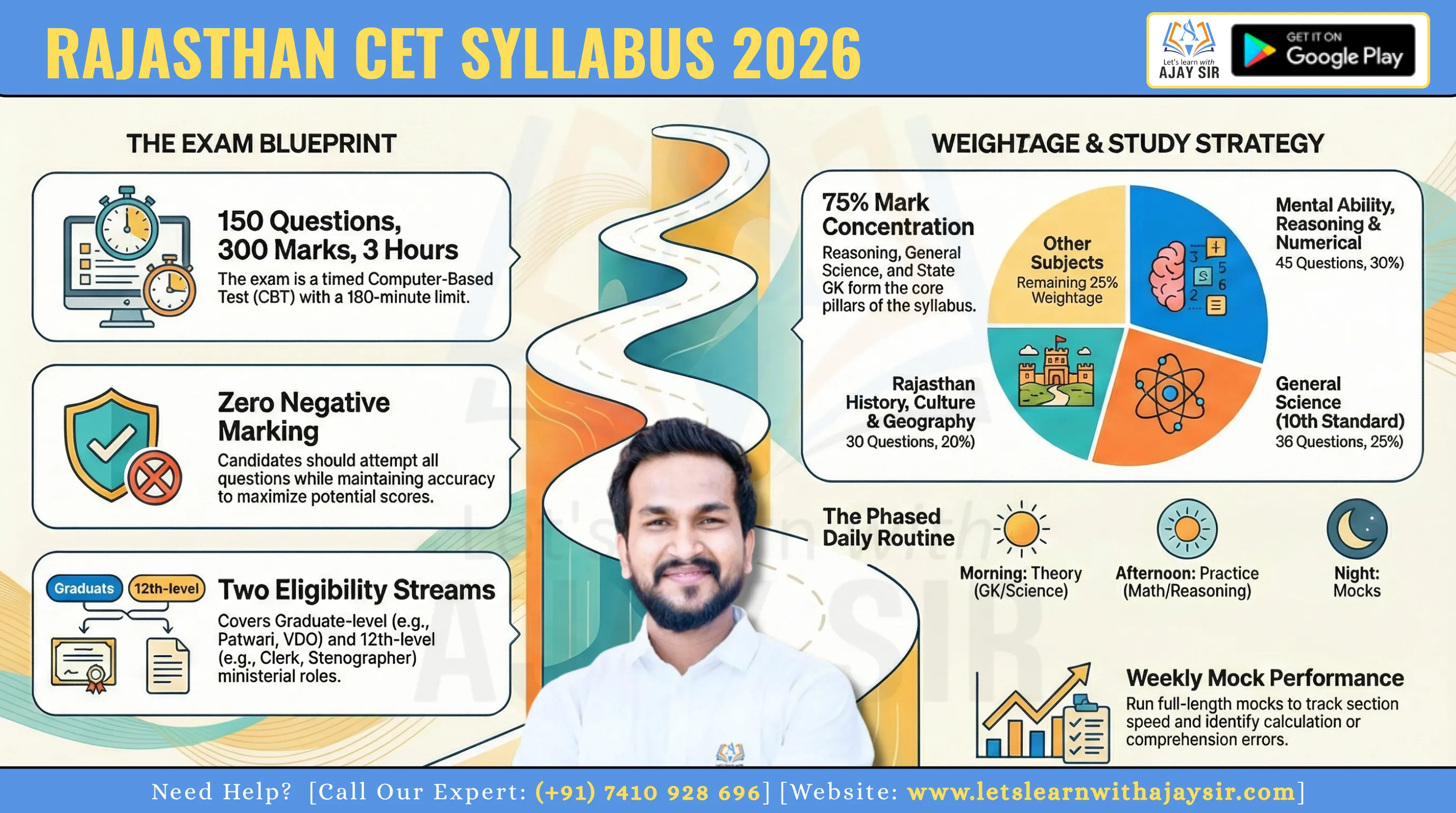
You should set practice rounds to the stated structure: 150 questions, 300 marks, 3 hours, no negative marking.
Anchor early notes on constitutional and administrative basics — core Indian Constitution points often recur.
Use the steady format to focus on revision, time management, and current affairs consolidation so your study is efficient.
Syllabus & Exam Pattern
2. Rajasthan CET Syllabus and Exam Pattern 2026
Know the core mechanics of the common eligibility test to build timing plans and target scores.
2.1 Core structure
The test runs as an online Computer‑Based Test (CBT). You face 150 multiple‑choice questions for a total of 300 marks within three hours (180 minutes).
Questions cover General Knowledge (India & state), General Science, Current Affairs, Arithmetic, Reasoning, plus Basic Computer Knowledge. The absence of negative marking lets you attempt widely while keeping accuracy in focus.
2.2 Selection flow
Selection proceeds beyond the CBT: shortlisted candidates move to document verification, then any required physical or medical checks for specific posts.
Align mocks to the CBT pattern, timing, and MCQ style.
Set section targets from the 300‑mark framework to prioritise high‑yield topics.
Keep a checklist for the services selection board and Rajasthan subordinate ministerial/subordinate ministerial services posts, so applications match process needs.
3. Rajasthan CET Syllabus 2026: Graduation Level exam pattern
This segment breaks down the graduation-level mix of subjects, showing where most marks sit and how to aim your study time.
Core distribution: 150 questions for 300 marks in 180 minutes. No negative marking means you should attempt liberally, but check accuracy.
Subject group | Questions | Marks | Suggested time (mins) |
Mental ability, reasoning & basic numerical | 45 | 90 | 35–40 |
India: general science, history, polity, geography, current affairs | 38 | 76 | 45–50 |
State geography, history, culture, and polity | 30 | 60 | 35–40 |
General English & Hindi | 22 | 44 | 20–25 |
Basic computer knowledge | 15 | 30 | 15–20 |
Structure your study by weightage: secure reasoning and numerical first, then rotate to GK and science. Add regular drills on interesting topics, such as simple and compound practices.
Split the 3-hour slot into focused blocks, and reserve 10–15 minutes for review.
Use full-length CBTs to rehearse navigation, triage, and pacing.
4. Rajasthan CET Syllabus 2026: distribution of questions, marks, and timing
This section maps the subject split so you can match practice to scoring opportunities.
Total: 150 questions for 300 marks in 180 minutes. There is no negative marking, so the attempt strategy can be bold yet calculated.
4.1 Subject-wise weightage and question distribution
Subject group | Questions | Marks | % | Suggested time (mins) |
Mental ability, reasoning & basic numerical | 45 | 90 | 30% | 40 |
General science (10th standard) | 38 | 76 | 25% | 40 |
State geography, history, culture, and polity | 30 | 60 | 20% | 35 |
General English & Hindi | 22 | 44 | 15% | 20 |
Basic computer knowledge | 15 | 30 | 10% | 15 |
Align daily practice to the weightage: focus first on reasoning and numerical drills.
Mirror your question bank to the 10th‑standard general science so the fundamentals convert to speed.
Plan your 3‑hour run: start with strengths, then tackle science and state GK, finish with language and computer; leave 10 minutes to review.
Use the absence of negative marking to attempt more factual general knowledge items and quick computer questions.
Run full-length mocks to fix pacing before the live exam; practise sequence and recovery under time pressure.
5. Rajasthan CET Syllabus 2026: Complete syllabus mapping
Turn wide subject areas into a compact checklist that you can revise in short bursts.
5.1 History, art, heritage & culture
Focus on Harappan‑linked sites such as Kalibangan, Ahar, Ganeshwar, Balathal, and Bairathal. Learn major dynasties, forts, crafts, literature, and festivals. Note unification movements, notable personalities, the 1857 role, and Praja Mandal history, so history questions become factual and quick.
5.2 Geography of India & the state
Map physical features, monsoon belts, major rivers, dams, and mineral zones. Link wildlife, lakes, and transport corridors to places for fast recall of geography facts across India, Rajasthan.
5.3 Polity and administration
Master the indian constitution basics (Preamble, FRs, DPSP, federal features). Relate national institutions to the state system: Governor, Chief Minister, Assembly, High Court, district administration, and Panchayati Raj.
5.4 Economy, science, reasoning, languages & computer
Cover budgets, banking, GST, and key welfare schemes like MGNREGA. For general science, sequence physics, chemistry, and biology topics such as electricity, acids/bases, diet, blood groups, and ecology.
Reasoning & numerical: series, coding, blood relations, averages, ratio, percentage, SI/CI.
Languages: grammar, comprehension, official correspondence, and a short word list for last‑minute revision.
Computer knowledge: hardware vs software, OS, MS Office, internet basics to secure easy marks.
Current affairs: track state, national, and international events weekly to keep your knowledge fresh without overload.
6. Rajasthan CET Syllabus 2026: Step-by-step roadmaps
Adopt a phased study plan that balances core topics, speed work, and regular self-testing. Start by mapping weekly themes, then add daily time blocks that match your peak focus hours.
6.1 Graduation level: prioritise by weightage and difficulty
For graduation, front‑load Reasoning and Numerical practice. These sections carry high marks and reward speed.
Next, rotate India‑state general knowledge with language and basic computer drills. Reserve daily 45–60 minutes for current affairs.
6.2 12th level: NCERT-led foundation with focused practice
If you study at the 12th level, begin with NCERT summaries for general science. Use diagrams and short notes to fix concepts.
After basics, add timed sectional drills for reasoning, arithmetic, and computer knowledge to build speed.
6.3 Monthly, weekly, and daily planning aligned to exam time
Design a rolling plan: monthly goals → weekly targets → daily task lists. Use 60–90 minute study blocks with short reviews.
Slot | Focus | Daily duration |
Morning | GK (India & state) | 60 mins |
Late morning | General science (NCERT) | 60 mins |
Afternoon | Arithmetic & Reasoning | 75 mins |
Evening | Basic Computer + Revision | 45 mins |
Night | Mock practice / Current affairs | 30–60 mins |
Start with syllabus coverage for the first two months; build concept notes.
Introduce one full-length mock per week; increase to two in the final month.
Use error logs and spaced repetition to close weak areas before the test.
Preparation strategy: translate weightage into priorities, keep study sessions short and repeatable, and use mocks to manage time and decision-making.
7. Rajasthan CET Syllabus 2026: Mock tests, previous year papers, and self-assessment
Weekly rehearsal with full-length online mocks builds the stamina and timing you need on the real day. Run one full-length mock test each week that mirrors the CBT interface and three-hour window. Use Invictaa or the official portal for realistic practice.
Post-test analysis matters. After every mock, tag each lost mark by cause: concept, calculation, comprehension, or timing. Schedule short drills to fix the top three faults before your next session.
Use previous year papers to spot recurring question shapes in reasoning, general science, and state GK.
Benchmark section speed (average seconds per question) and track accuracy; aim to cut time without losing correct answers.
Exploit no negative marking: attempt widely but refine elimination skills to keep correctness high.
Keep a mock dashboard: date, raw score, section scores, accuracy, time split, and next-week fixes.
Increase mock frequency as the exam nears — two full-length mocks per week in the final month — and interleave focused concept refreshers after each session to lock gains.
All Details
Conclusion
Take this closing plan as a compact checklist to sharpen strengths, fix weak spots, and boost final scores.
Your preparation must mirror the clear structure: 150 MCQs, 300 marks, three hours, and no negative marking. Use the weightage tables to choose what to practise first.
Focus on general knowledge, general science, reasoning, language, and basic computer skills. Run weekly mock tests and tighten revision in the final month to convert practice into sure marks.
Trust your routine, measure progress weekly, and enter the exam calm and rehearsed. With disciplined study blocks and focused mocks, you will reach the target score.
Disclaimer:
All eligible and interested candidates are advised to read the official notification carefully before applying online.
Disclaimer: The examination results and marks published on this website are provided solely for immediate information to candidates and do not constitute a legal document. While every effort has been made to ensure the accuracy and authenticity of the information available on this website, we are not responsible for any inadvertent errors that may occur in the publication of examination results or marks. We shall not be liable for any loss or damage to any individual or entity arising from any deficiency, defect, or inaccuracy in the information provided on this website.

![EMRS PGT [Tier-2] ENGLISH - 2025](https://letslearnwithajaysir.s3.ap-south-1.amazonaws.com/courses/FsnKxIFpiLxbRD418g6vo7AsLy0ge7IP7Iu2fsJY.webp)
![EMRS TGT [Tier-2] ENGLISH - 2025](https://letslearnwithajaysir.s3.ap-south-1.amazonaws.com/courses/BjLXVqVV1SeZKnhYjmPZpz2jQ7r02kS73pGGOLrL.webp)
![KVS/NVS PGT ENGLISH [Tier-2] - 2025](https://letslearnwithajaysir.s3.ap-south-1.amazonaws.com/courses/vqli598KWrKnm4txcsZh5qjMN9UMAX8LvFk9IiF0.webp)
![KVS/NVS TGT ENGLISH [Tier-2] - 2025](https://letslearnwithajaysir.s3.ap-south-1.amazonaws.com/courses/pxC2WhfYKuyaoGqvcTvhTBL2Y44o3TNA0z8NYRB5.webp)