Exam Category:
Defence Exams
Exam Name:
Indian Army Agniveer Exam Guide
This page explains the current Indian army recruitment drive for Agnipath Agniveers via the Common Entrance Exam. You will find clear dates, eligibility rules, physical standards, selection stages, pay details and step‑by‑step guidance to apply online at https://joinindianarmy.nic.in.
This guide is for you if you aim for GD, Technical, Clerk/Store Keeper Technical, Tradesman, Sepoy Pharma, Nursing Assistant, Women Military Police or JCO Religious Teacher posts. It flags common decisions — category choice, subject/marks match, age limits as on 01 July 2026 and PMT/PET preparation — and gives checklists so you don’t miss documents, fees or exam‑centre selection.
Key Takeaways
Apply only via joinindianarmy.nic.in to keep your application valid and trackable.
Check the official notification for final eligibility and rules.
Know the key dates, selection stages and physical standards before you apply.
Confirm your category, subjects and age as on 01 July 2026 to avoid disqualification.
Prepare for PMT/PET and gather documents, fee proof and exam‑centre choices early.
Quick Overview
Indian Army Agniveer CEE Recruitment 2026: Overview
Before you fill any form, know which post and rules match your profile. The common entrance exam sits at the centre of the entry process and decides who moves to physical tests and verification. Your first step is to pick the correct post/category so you prepare the right subjects and documents.
Posts covered under the Agnipath Agniveers CEE recruitment
The posts include General Duty (GD), Technical, Clerk / Store Keeper Technical (SKT), Tradesman (10th/8th pass), Sepoy Pharma, Nursing Assistant, Women Military Police (GD) and JCO Religious Teacher (RT).
Register, complete your profile, choose exam centres and later download admit cards and results only via https://joinindianarmy.nic.in. This portal is the authoritative source for dates, fees, age limits, education, physical standards, selection steps and pay/Seva Nidhi details.
Each post has distinct eligibility rules — marks, subjects, streams, ITI or pharmacy registration, and religious qualifications. Do not assume one rule fits all. Enter your personal and educational information carefully. Small errors can affect document verification and selection for candidates who otherwise qualify.
Eligibility Criteria
Age limit criteria as on 01 July 2026 (post‑wise)
Check your birth date against the official cut‑offs to confirm if you meet the age rules for the post you want. Age is calculated as on 01 July 2026, not on the application or exam date. That simple step prevents avoidable disqualification.
Minimum age requirement: the min entry point for most posts is 17.5 years. Confirm this early so you do not select a category you are not eligible for.
Post | Age bracket (years) | Born between | Notes |
GD / Technical / Assistant / Tradesman | 17.5 – 22 | 01/07/2005 – 01/07/2009 | Min 17.5 years applies |
Soldier Technical | 17.5 – 23 | 01/07/2004 – 01/07/2009 | Wider upper limit than GD |
Sepoy Pharma | 19 – 25 | 01/07/2002 – 01/01/2008 | Higher min age due to diploma requirement |
JCO Religious Teacher (RT) | 25 – 34 | 01/07/1993 – 01/07/2002 | Separate senior age bracket |
How to judge eligibility
Compare your date of birth against the ranges above. Use the born between dates to avoid off‑by‑one‑day errors.
If you claim any age relaxation, verify it in the official notification and keep documentary proof ready for verification. The notification spells out conditions and supporting documents required.
Do a quick self‑check: match your DOB to the bracket, then confirm the post rule again.
Remember that driver preference (such as given preference driver) or other skill preferences do not replace age eligibility.
Confirm the minimum and maximum years for your chosen post before paying the fee.
"Always cross‑check the age relaxation section in the official notification and carry proof if you apply under any concession."
Indian Army Agniveer CEE Recruitment 2026: Post-wise eligibility
Before choosing a post, verify your class scores and certificates against the post-wise eligibility rules. Below are clear pass and marks criteria so you can match your education and subjects to the right role.
General Duty (GD)
You need class 10th pass with a 45% aggregate and at least 33% in each subject. Check your marksheet for subjectwise minima before you apply.
Technical
Two routes are accepted: 10+2 (Science) with Physics, Chemistry, Maths and English — 50% aggregate and 40% in each subject; or 10+2 any stream plus a one‑year ITI. Choose the route that matches your certificate.
Clerk / Store Keeper Technical (SKT)
10+2 any stream with 60% aggregate and 50% in each subject. You must have 50% in English and 50% in Maths, Accounts or Book Keeping.
Tradesman (10th / 8th pass)
Tradesman (10th): class 10th pass with 33% in each subject. Tradesman (8th): class 8th pass with 33% in each subject.
Women Military Police (GD)
Matric/class 10th with 45% aggregate and 33% in each subject. Grading boards: a minimum ‘D’ (33–40%) per subject and overall ‘C2’ equivalent for 45% is accepted.
Sepoy Pharma
D.Pharm with 55% aggregate or B.Pharm with 50% aggregate is required. Registration with the State Pharmacy Council or PCI is mandatory — keep the registration certificate ready.
Soldier Technical Nursing Assistant
10+2 with PCB and English — 50% aggregate and 40% in each subject. Alternate set: Physics, Chemistry, Botany, Zoology and English with same minima.
JCO Religious Teacher (RT)
Role-specific qualifications apply: Shastri/Acharya with Karam Kand or diploma for Pandit; Bachelor’s + Gyani for Granthi; Bachelor’s + ordained status for Padre; Alim or similar for Maulvi; bachelor’s + monastery certification for Buddhist roles.
"Match your marks and certificates to the post before you proceed to the form to avoid errors at document verification."
Post | Minimum pass | Aggregate / subject minima | Key document |
General Duty (GD) | Class 10th | 45% agg; 33% each | Class 10th marksheet |
Technical | 10+2 Science or 10+2 + ITI | 50% agg; 40% each (Science route) | 10+2 / ITI certificate |
Clerk / SKT | 10+2 | 60% agg; 50% each; 50% English & Maths/Accounts | Class 12 marksheet |
Sepoy Pharma | D.Pharm / B.Pharm | D.Pharm 55% / B.Pharm 50% + registration | Pharmacy registration certificate |
Indian Army Agniveer CEE Recruitment 2026: Physical eligibility (PMT/PET essentials)
Physical screening checks both your body measurements and fitness performance. Your PMT (body measurements) and PET (performance tests) are separate but linked. Train for both so you do not pass one and fail the other.
Common measurements: chest requirement and proportionate weight
The common baseline for many male categories is 77 cm unexpanded with a minimum 5 cm expansion — so the expanded chest must be at least 82 cm. Your weight must be proportionate to your height as per the official charts; check the table in the notification for exact figures.
Running and strength tests
For Group I roles the benchmark is a 1.6 km run in 5 minutes 30 seconds. Use that target to set weekly progress goals and time trials.
Upper‑body strength is assessed via pull‑ups. Scoring references show up to 10 pull‑ups for full marks. Better pull‑up counts can boost your overall score even where a simple qualify rule exists.
Obstacle requirements
Obstacles you must practise include the 9 feet ditch and the zigzag balance. These are qualifying elements: technique and confidence matter more than raw speed.
Role‑specific PET notes
Sepoy Pharma / Nursing Assistant: 1.6 km in 6 minutes 15 seconds is the stated min target.
Women Military Police: height min 162 cm; 1.6 km in 7 minutes 30 seconds; long jump 10 feet; high jump 3 feet.
Note: standards can vary slightly by category and region. Always verify the exact PMT/PET requirements in your official state/ARO notification before you train.
Region-wise minimum height standards for GD, Technical and Clerk/SKT
Region-specific height rules can change whether you qualify for a given post, so check your state group first. Below are the min male heights you will most commonly see for GD/Tradesmen, Technical and Clerk/SKT roles.
Western Himalayan, Eastern Himalayan, Western Plains, Eastern Plains
Region | GD / Tradesmen (cm) | Technical (cm) | Clerk / SKT (cm) |
Western Himalayan | 163 | 163 | 162 |
Eastern Himalayan | 160 | 157 | 160 |
Western Plains | 170 | 170 | 162 |
Eastern Plains | 169 | 169 | 162 |
Central and Southern region standards
Central: GD/Tradesmen 168 cm, Technical 167 cm, Clerk/SKT 162 cm.
Southern: GD/Tradesmen 166 cm, Technical 165 cm, Clerk/SKT 162 cm.
Chest across regions: 77 cm unexpanded with 5 cm expansion required (77+5 cm) for these groups. Note the special dispensation: Technical candidates in the Central region may receive a 1 cm chest relaxation.
"Always verify the rally or state notice; your ARO/RO notification is the final authority."
Why this matters: eligibility can change by region even for the same post.
Practical next step: identify your ARO/RO and match its state group to the table above.
Example: Patna (Bihar, Eastern Plains) uses 169 cm for GD/Tradesmen/Technical and 162 cm for Clerk/SKT — verify the latest rally notice on the official portal.
If your state/ARO lists different standards in its notification, follow that notification. Treat the state/ARO details as authoritative for your rally or selection centre.
Salary Details
Indian Army Agniveer CEE Recruitment 2026: Salary, in-hand pay
A clear year‑by‑year view of pay and corpus growth makes financial planning easier. You get a rising monthly package across the four years, with part paid to you and part saved in a corpus with matching Government contribution.
Monthly package by year
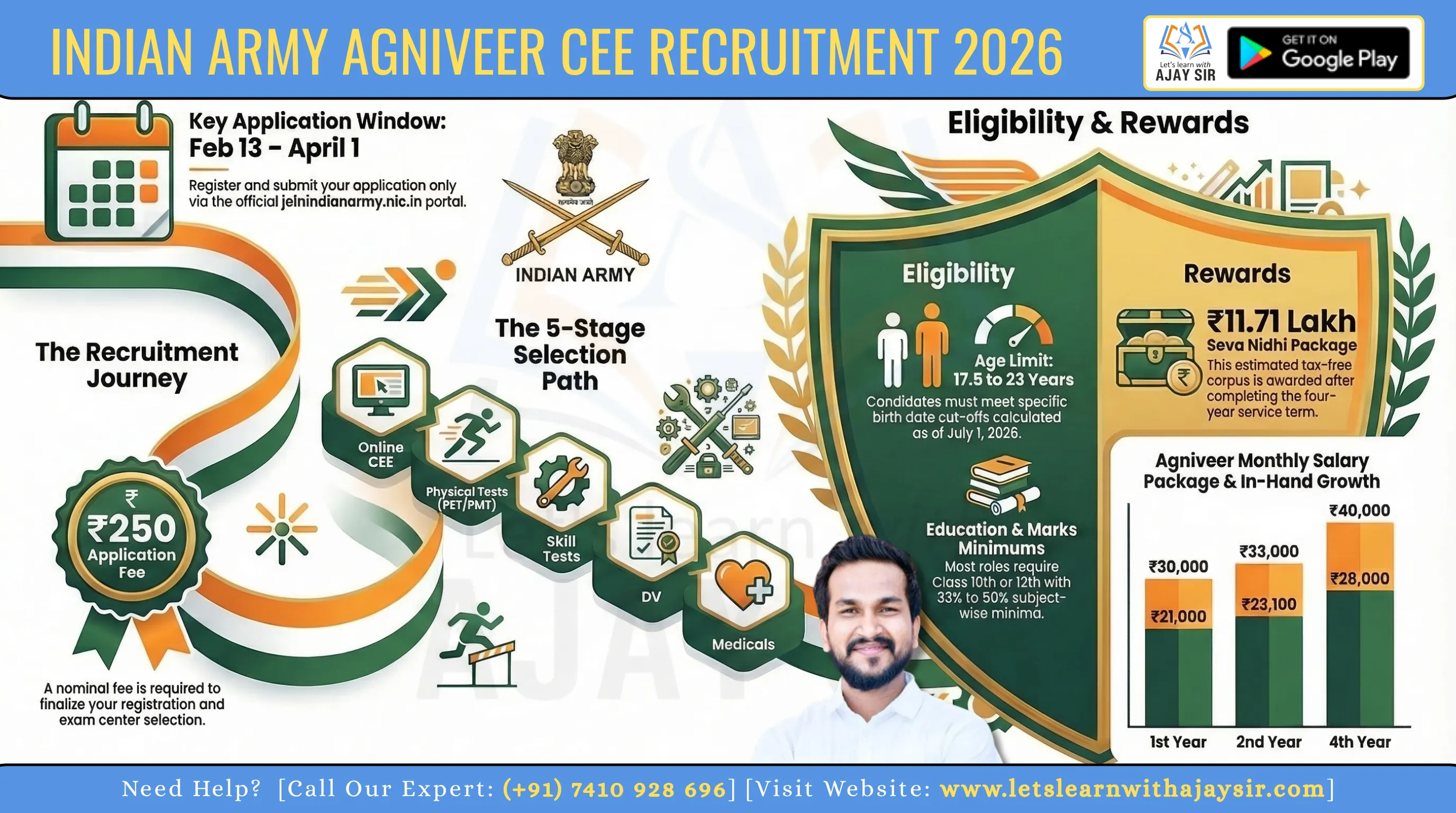
Year 1: ₹30,000 — Year 2: ₹33,000 — Year 3: ₹36,500 — Year 4: ₹40,000.
In‑hand pay and 30% fund contribution breakdown
Your in‑hand pay equals 70% of the package each month. The remaining 30% goes to a corpus that the Government matches.
YEAR | GROSS MONTHLY (₹) | IN‑HAND 70% (₹) | 30% CONTRIBUTION (₹) |
1 | 30,000 | 21,000 | 9,000 |
2 | 33,000 | 23,100 | 9,900 |
3 | 36,500 | 25,550 | 10,950 |
4 | 40,000 | 28,000 | 12,000 |
Seva Nidhi estimate after four years
Estimated corpus: around ₹11.71 lakh after four years. This figure combines your 30% contributions, the equal Government matching and accrued interest as per the source.
"Note: verify the latest pay and benefit information on the official portal; rules and interest rates can change."
This section helps you compare posts and plan for the full four‑year term, not just the initial pay. Use these numbers to draft a simple budget and short‑term savings plan.
Selection Process
Indian Army Agniveer CEE Recruitment 2026: Selection process
Understand the end-to-end selection path so you can focus on the right tasks at the right time. This section maps each stage of the selection process and what you must prepare for next.
CEE (Computer Based Test) in context
The computer-based exam is the first qualifying gate. Your performance here determines if you move to physical stages and skill tests. Treat it as the primary written assessment in the selection flow.
PET / PMT — physical assessment
Physical measurements (height, chest where applicable) and fitness tasks (1.6 km run, pull-ups, obstacles; jumps for women MP) form the next examination stage. These checks confirm you meet role-specific standards.
Typing and trade tests
Certain posts require a typing or trade test after the CBT. If you chose Clerk/SKT or any trade-linked role, practise the relevant skill — speed and accuracy matter for final selection.
Document verification and medical examination
Document verification checks your marksheets, ID proofs and professional certificates against the data you entered. Any mismatch can affect your candidature.
The medical examination is the final clearance. Be truthful about your medical history and follow the exam instructions exactly.
Key point: selection is merit-based across stages — CBT, physical, skill, DV and medical are each critical.
Prepare for every phase; passing one stage alone does not guarantee final selection.
How to Apply
Indian Army Agniveer CEE Recruitment 2026: How to apply online
Begin at the official portal and use the Registration/Login path to start your application. This creates a permanent profile so you can manage your form, fee and admit-card tasks later. If you prefer, keep the portal open and documents ready before you register.
One-time registration
Register using your Aadhaar number or matriculation certificate details. Enter your personal and contact information carefully. Changes to core fields may not be allowed later, so double-check before you submit.
Filling your profile and choosing category
Select the correct category — GD, Technical, Clerk/Store Keeper Technical or Tradesman — based on your marks and subjects, not just preference. Fill educational fields and subject-wise scores accurately to avoid issues at document verification.
Uploading documents
Prepare clear digital files for your photograph, signature and certificates. Use the portal’s size and format rules. Mismatched or blurry uploads cause rejections during verification.
Selecting exam centres and submitting
Choose preferred exam centres with travel in mind for the exam window (01-16 June). Enter physical measurements as stated on your documents, pay the fee and finalise submission.
Download confirmation
After payment and submission, download and save the confirmation page and application number. Keep these safe — you will need them to download your admit card and track status.
Quick checklist: Aadhaar or matric details, scanned photo & signature, marksheets, correct measurements, chosen centres, fee receipt, confirmation page.
Step | Action | Why it matters |
1 | Register on portal | Creates official profile for all later activity |
2 | Fill personal & education details | Mismatches can fail document verification |
3 | Upload photo, signature, certificates | Clear files speed verification |
4 | Select exam centres & pay fee | Reduces travel stress and confirms application |
5 | Download confirmation page | Needed for admit card and future checks |
All Details
Conclusion
Wrap up your preparation by confirming eligibility, gathering documents and planning your physical training schedule.,
Start by choosing the correct post and checking your eligibility — marks, subjects and the age limit as on 01 July. Keep class 10th and higher marksheets, ID and any category certificates ready before you apply.
Apply within the official window: 13 February to 01 April (JCO Religious Teacher until 02 April). The computer-based exam runs from 01 to 16 June. The application fee is ₹250.
Save your confirmation page and application number. Monitor https://joinindianarmy.nic.in for admit-card, result and rally notifications and avoid unofficial agents or paid shortcuts.
Note the Seva Nidhi estimate (~₹11.71 lakh after four years) and treat physical training as essential — running, strength, and obstacle practice are non-negotiable. Submit early, stay organised and check the official notification for every update.
Disclaimer:
All eligible and interested candidates are advised to read the official notification carefully before applying online.
Disclaimer: The examination results and marks published on this website are provided solely for immediate information to candidates and do not constitute a legal document. While every effort has been made to ensure the accuracy and authenticity of the information available on this website, we are not responsible for any inadvertent errors that may occur in the publication of examination results or marks. We shall not be liable for any loss or damage to any individual or entity arising from any deficiency, defect, or inaccuracy in the information provided on this website.


![EMRS PGT [Tier-2] ENGLISH - 2025](https://letslearnwithajaysir.s3.ap-south-1.amazonaws.com/courses/FsnKxIFpiLxbRD418g6vo7AsLy0ge7IP7Iu2fsJY.webp)
![EMRS TGT [Tier-2] ENGLISH - 2025](https://letslearnwithajaysir.s3.ap-south-1.amazonaws.com/courses/BjLXVqVV1SeZKnhYjmPZpz2jQ7r02kS73pGGOLrL.webp)
![KVS/NVS PGT ENGLISH [Tier-2] - 2025](https://letslearnwithajaysir.s3.ap-south-1.amazonaws.com/courses/vqli598KWrKnm4txcsZh5qjMN9UMAX8LvFk9IiF0.webp)
![KVS/NVS TGT ENGLISH [Tier-2] - 2025](https://letslearnwithajaysir.s3.ap-south-1.amazonaws.com/courses/pxC2WhfYKuyaoGqvcTvhTBL2Y44o3TNA0z8NYRB5.webp)