Syllabus & Exam Pattern
1. CUET Syllabus 2026: Exam pattern and marking scheme
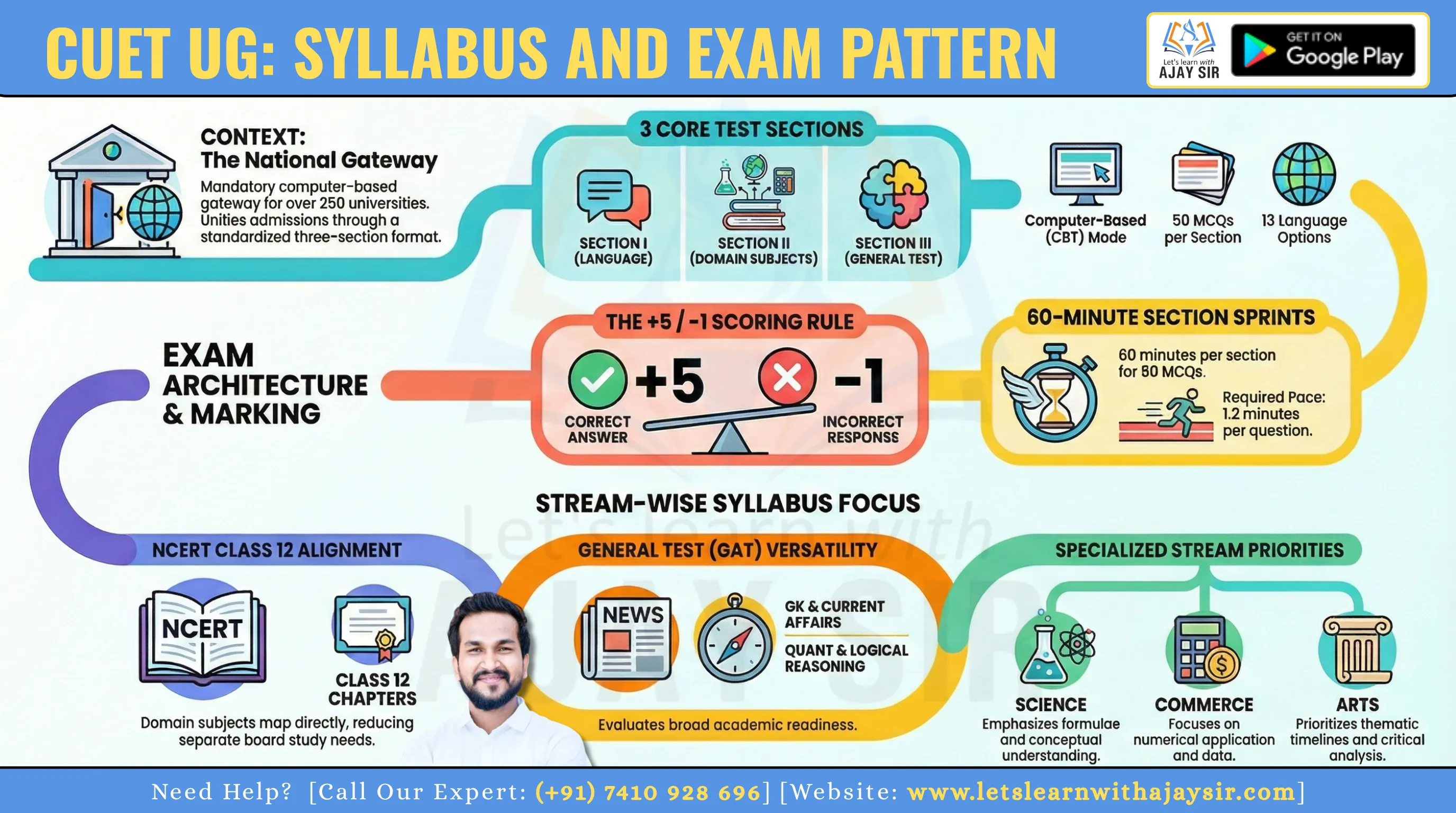
Start by learning how the computerised test is structured; it shapes your whole plan. The exam runs as a Computer‑Based Test in multiple shifts. You will use on‑screen navigation and tools that mirror real testing conditions, so practice with the same interface.
Three core sections make up the paper: Section I (Language), Section II (Domain‑Specific Subjects), and Section III (General Test). Each section normally contains 50 multiple‑choice questions, carries 250 marks, and is allotted 60 minutes.
1.1 Marking, duration, and question format
The marking is straightforward: +5 for a correct answer, −1 for an incorrect one, and 0 for an unattempted item. That scheme rewards accuracy and affects how you approach risky questions.
60 minutes per section equals roughly 1.2 minutes per question — practise pacing with this in mind.
Choose the exam medium from 13 supported languages to maximise comprehension.
Check the official website in your year of attempt to confirm any updates to the pattern or syllabus.
Feature | Value | Why it matters |
Mode | Computer‑Based Test, multiple shifts | Familiarity with the interface reduces on‑day stress |
Questions per section | 50 MCQs | Use this to design realistic mocks |
Marking | +5 / −1 / 0 | Calibrate guesswork to protect the net score |
2. CUET Syllabus 2026
This section gives you a clear, compact view of what the full syllabus covers. Use it as a checklist before you plan subject blocks and mock tests.
The national authority publishes subject-wise lists across three areas: Language tests, Domain‑Specific Subjects aligned with NCERT Class 12, and the General Test covering GK, current affairs, reasoning, quantitative skills, general science, and environment literacy.
Scan the landscape to see which subjects and topics fall under each section and stream.
Note that domain papers map closely to board-level Class 12 content, which reduces repetition in the study.
Trim less relevant topics and double down on high‑weight areas to free time for mock practice.
Streams include Science (physics, chemistry, biology, mathematics), Commerce (accountancy, business studies, economics, maths), and Arts/Humanities (history, political science, geography, psychology, sociology, home science, mass media). Align your chosen subjects with the section structure to avoid overlaps.
Stream | Key focus | Revision tip |
Science | Practical concepts and formulae | Sequence sprints by topic difficulty |
Commerce | Numerical application and data interpretation | Practice past papers and problem sets |
Arts | Concept depth and timelines | Build timelines and thematic notes |
Use this overview to ensure no part of the syllabus is missed before you dive deeper into subject-wise PDFs and targeted revision.
3. CUET Syllabus 2026: How to download
Quick start: Find and download the official subject PDFs in minutes by following the NTA portal route below.
Use the National Testing Agency documents as your single source of truth.
3.1 Step-by-step from the NTA website
Visit the CUET UG official website of the National Testing Agency.
Open the Information or Notices section and choose the syllabus link for your year.
Access the list of subject-wise PDF files shown for all offered subjects.
Click the subject you need and download the free pdf — no registration required.
Print and pin the file to track topics during revision.
3.2 Free subject-wise PDFs and verification
Streams include Science (Physics, Chemistry, Biology, Mathematics, Computer Science), Commerce (Accountancy, Business Studies, Economics, Mathematics) and Arts/Humanities (History, Political Science, Geography, Mass Media, Psychology, Sociology, Home Science).
Cross-check the date/version on each file to ensure you use the latest syllabus release for the year you plan to sit the exam.
Create a simple sample tracker with columns: topic, status, last revision date, and mock link.
If in doubt, default to the National Testing Agency PDF and revisit the website monthly for updates.
Action | Where | Why it matters |
Download PDF | Information → Syllabus on the website | Official content avoids gaps and misalignment |
Verify version | Date/version on the pdf | Ensures you study the current syllabus |
Store & print | Labelled folder and pinned copy | Improves tracking and revision habits |
Share links | Study group or drive | Keeps peers aligned with the official files |
4. Section I: Language Test syllabus and skills assessed
The Language Test checks how well you read, reason, and use words under timed conditions. It is offered in 13 languages, so you can pick an exam medium that suits your comfort and accuracy.
4.1 Included languages and exam medium
Available options include English, Hindi, Assamese, Bengali, Gujarati, Kannada, Malayalam, Marathi, Odia, Punjabi, Tamil, Telugu, and Urdu. Choose the language that helps you read fastest without losing comprehension.
4.2 What’s tested: comprehension, vocabulary, and grammar
Comprehension passages are typically 300–350 words and include factual, narrative, and literary extracts. Questions probe the main idea, tone, inference, and author intent.
Vocabulary items check synonyms, antonyms, collocations, error spotting, and sentence completion. Grammar covers tenses, subject–verb agreement, active/passive, and direct/indirect speech.
4.3 Quick preparation pointers for languages
Practise timed passages daily and set words‑per‑minute goals to boost speed without sacrificing accuracy.
Create a high‑frequency word list and revise with spaced‑repetition flashcards.
Do short mini tests of 10–12 questions to track progress in accuracy and time management.
Use light communication drills — summarise articles aloud to strengthen processing and retention.
Skill | Focus | Daily drill |
Comprehension | Main idea, inference, tone | 1 passage in 15 minutes |
Vocabulary | Synonyms, error spotting | 10 flashcards/day |
Grammar | Tenses, voice, speech | 5 error‑spotting items/day |
5. Section II: Domain-specific subjects mapped to NCERT
Mapping your chosen subjects to the NCERT Class 12 chapters makes revision far more efficient and focused. This section explains how domain papers reflect board content and how to plan a clean study path for your stream.
5.1 Alignment with Class 12 and board curricula
Domain questions come from Class 12 NCERT topics, but the test adds application and reasoning twists. Use NCERT examples and end‑of‑chapter exercises first. They give you the baseline knowledge most universities expect.
5.2 Full list of domain subjects available
Representative subjects include Accountancy, Business Studies, Economics, Mathematics, Physics, Chemistry, Biology, Environmental Science, Agriculture, Computer Science, Geography, History, Political Science, Psychology, Sociology, Home Science and Mass Media.
Map each chosen subject directly to NCERT chapters to streamline board and exam study.
Build a chapter‑wise tracker: completion, weak spots, and follow‑ups.
Sequence your stream plan—science‑heavy, commerce‑focused, or humanities‑led—based on strengths.
Use weekly timed tests that mirror section timing to check retention across subjects.
Avoid overloading with too many subjects; focus on those required by your target courses.
Action | Why it helps | Quick tip |
NCERT first | Ensures core concepts match the board and test | Do chapter exercises before reference books |
Chapter tracker | Shows progress and weak areas | Log last revision date |
Stream sequencing | Fits study load to your strengths | Start exam-day with your strongest domain |
6. Section III: General Test (GAT) — what it covers and why it matters
The General Test measures how well you apply everyday knowledge, numbers, and logic under timed conditions. It blends current affairs, mental ability, quantitative and logical reasoning, with basic science and environmental literacy.
6.1 Theme-wise coverage
Core areas include General Knowledge & Current Affairs, General Mental Ability, Numerical Ability, and Quantitative Reasoning (arithmetic, algebra, geometry, mensuration, statistics).
Logical & Analytical Reasoning adds puzzles, series, and seating arrangements. General Science covers basic physics, chemistry, and biology linked to everyday contexts.
6.2 Why universities value this test
Top colleges such as DU and JNU often make the General Test mandatory for certain undergraduate courses. They use it to assess broad academic readiness beyond any single subject.
Build a daily current affairs habit: short reads and weekly summaries.
Practise timed quantitative drills and mental maths for fast calculations.
Hone reasoning with puzzles, coding‑decoding, and data‑interpretation sets.
Run section‑wise mini tests to track speed and accuracy per topic.
GAT Theme | Focus | Daily drill |
General Knowledge | Current events, static GK | 10‑minute news summary |
Quantitative Reasoning | Arithmetic, algebra, geometry, stats | 20 timed problems/day |
Logical Reasoning | Puzzles, series, arrangements | 15 minutes of puzzles |
General Science | Every day, physics, chemistry, biology | Short topic revision twice a week |
7. Stream-wise mapping: Science, Commerce, and Arts/Humanities
Match subject choices carefully so your preparation supports the degree pathways you want. Use stream mapping to simplify decisions and protect options when you apply to universities.
Science typically includes Physics, Chemistry, Biology, and Mathematics. You can add Computer Science, Environmental Science, Agriculture, or Anthropology for specialised courses.
7.1 Commerce
Focus on Accountancy, Business Studies, Economics, and Mathematics. These subjects meet common prerequisites for business and finance degrees.
7.2 Arts and Humanities
Choose from History, Political Science, Geography, Psychology, Sociology, Home Science, and Mass Media. These help with social sciences, communication, and humanities programmes.
Download each subject’s pdf from the NTA portal to confirm exact chapters before you fix a weekly timetable.
Shortlist target universities early so you know which combinations they favour.
Keep one domain as a backup to stay flexible across course options.
Use stream mapping to balance factual recall, conceptual study, and problem‑solving practice.
Build a cross‑stream communication plan (presentations, short notes) to retain and explain complex ideas better.
Stream | Core subjects | Quick tip |
Science | Physics, Chemistry, Biology, Mathematics | Prioritise core four; add CS or Env Sci if needed |
Commerce | Accountancy, Business Studies, Economics, Mathematics | Practice numerical and case problems weekly |
Arts/Humanities | History, Political Science, Geography, Mass Media | Create timelines and themed summaries |
8. Detailed CUET syllabus for Science students
Use the following topic map to build concise formula sheets, mechanism notes, and practice sets.
8.1 Physics: core topics from Classes 11–12
Focus areas: Electrostatics, Current Electricity, Magnetism, Electromagnetic Induction, EM Waves, Optics, Dual Nature, Atoms & Nuclei, Electronic Devices, and Communication Systems.
Create compact formula sheets for electricity, optics, and modern physics. Run quick derivation drills and timed numerical sets to avoid sign errors.
8.2 Chemistry: physical, organic, and inorganic focus
Split your plan into physical (Solid State, Solutions, Electrochemistry, Chemical Kinetics, Surface Chemistry), inorganic (Isolation of Elements, p‑block, d‑ & f‑block, Coordination Compounds), and organic (Haloalkanes/Haloarenes, Alcohols/Phenols/Ethers, Aldehydes/Ketones/Carboxylic Acids, Nitrogen Compounds, Biomolecules, Polymers, Chemistry in Everyday Life).
Practice calculation problems for physical topics and stepwise mechanisms for organics. Build a short list of named reactions and reagent uses.
8.3 Mathematics: Sections A, B1 and B2 (Applied Maths)
Section A covers foundational items; practise these daily. For B1, choose advanced mathematics (Algebra, Calculus, Probability) if your course needs theory.
Pick B2 (Applied Mathematics) for Financial Mathematics, Index Numbers, Linear Programming, and time‑based data. Prioritise financial maths early to secure marks.
8.4 Biology: from reproduction to ecology
Cover Reproduction, Genetics & Evolution, Biology & Human Welfare, Biotechnology & Its Applications, and Ecology & Environment in sequence. Use diagrams and flow charts for fast recall.
Download each subject’s pdf and tag units by difficulty to set weekly problem volumes.
Mirror the exam pattern with timed section tests and topic-wise questions.
Keep an error log—track recurring mistakes in physics signs and organic steps.
Use interleaved practice (for example, optics + probability) and end each week with a mixed-topic quiz.
Subject | High‑impact task | Weekly goal |
Physics | Formula sheets + 20 timed numericals | 2 topics fully revised |
Chemistry | Mechanism notes + calculation drills | 3 chapters practised |
Mathematics/B2 | Problem sets + applied cases | 4 problem sessions |
9. Detailed CUET syllabus for Arts/Humanities students
Map topics across history, political science, and psychology to build a compact, exam‑ready knowledge base. This section gives you focused ways to turn long narratives and debates into short notes and practice items.
9.1 History: major chapters and study tactics
Cover Harappan archaeology, inscriptions used in political and economic history, Mahabharata social histories, Buddhism (Sanchi), travellers’ accounts, Bhakti‑Sufi movements, Hampi, Ain‑i‑Akbari, Mughal court life, colonial rural society, 1857 representations, and the Making of the Constitution.
Study tip: Build thematic timelines from Harappan cities through to the Constitution for rapid recall. Use inscriptions and chronicles to practise source‑based questions.
9.2 Political Science: domestic arcs and world politics
Focus on Politics in India since Independence—one‑party dominance, nation‑building, planned development, and the shift to coalition politics. For Contemporary World Politics, map the Cold War, the end of bipolarity, and the rise of US dominance.
Summarise key debates (dominance versus coalition eras) to strengthen evaluative answers and comparative essays.
9.3 Psychology: concepts, disorders, and applied skills
Master variations in psychological attributes: self and personality, stress, disorders, therapy, attitudes, social cognition, and influence. Emphasise psychology & life and skill development.
Use case‑based notes for disorders and therapies, and practice short‑note answers for quick pre‑test refreshers.
Alternate reading‑heavy study with lighter recap sessions to keep stamina high.
Attempt mixed‑section questions to simulate transitions between History, Political Science, and Psychology.
Maintain a glossary for recurring concepts (for example, secularism, hegemony, cognition) and run weekly language‑based practice to express arts answers clearly.
Subject | High‑impact task | Weekly goal |
History | Thematic timelines + source practice | 2 themes revised |
Political Science | Debate summaries + comparative charts | 3 milestones mapped |
Psychology | Case notes + disorder‑therapy flashcards | 5 concepts mastered |
10. Detailed CUET syllabus for Commerce students
This commerce-focused section breaks down the core topics you must master for exam-ready performance. It covers business studies, accountancy, and economics with clear tasks, timed drills, and summarised theory to speed revision.
Business studies topics include Business Environment, Planning, Organising, Staffing, Directing, Controlling, Business Finance, and Marketing. Link each management function to short caselets or real Indian business examples to sharpen application skills.
10.1 Business functions and marketing
Connect theory to practice by summarising each function in one paragraph and adding a two‑line caselet. Build quick lists of marketing terms and campaign examples for recall.
10.2 Accountancy practice and analysis
Focus on Not‑for‑Profit Organisations; Partnership Accounts (reconstitution and dissolution); Share and Debenture Capital; Analysis of Financial Statements; and Statement of Changes in Financial Position.
10.3 Economics: micro, macro, and development themes
Cover Micro topics like consumer behaviour and demand; Macro topics such as national income, income‑employment determination, money & banking, and government budget; and Development themes on India’s growth experience.
Create summary sheets for marketing and business finance terminologies for quick revision.
Use topic-tagged question banks to measure progress across subjects and question types.
Run weekly "commerce mix" tests to simulate switching between theory and numerics.
Subject | High‑impact task | Weekly target |
Business studies | Caselets linking functions to firms; marketing term cards | 2 functions + 1 marketing case |
Accountancy | Timed journal-ledger-final accounts; ratio practice | 3 multi-step problems |
Economics | Micro diagrams; macro numericals; policy notes | 2 numericals + 1 essay |

![EMRS PGT [Tier-2] ENGLISH - 2025](https://letslearnwithajaysir.s3.ap-south-1.amazonaws.com/courses/FsnKxIFpiLxbRD418g6vo7AsLy0ge7IP7Iu2fsJY.webp)
![EMRS TGT [Tier-2] ENGLISH - 2025](https://letslearnwithajaysir.s3.ap-south-1.amazonaws.com/courses/BjLXVqVV1SeZKnhYjmPZpz2jQ7r02kS73pGGOLrL.webp)
![KVS/NVS PGT ENGLISH [Tier-2] - 2025](https://letslearnwithajaysir.s3.ap-south-1.amazonaws.com/courses/vqli598KWrKnm4txcsZh5qjMN9UMAX8LvFk9IiF0.webp)
![KVS/NVS TGT ENGLISH [Tier-2] - 2025](https://letslearnwithajaysir.s3.ap-south-1.amazonaws.com/courses/pxC2WhfYKuyaoGqvcTvhTBL2Y44o3TNA0z8NYRB5.webp)