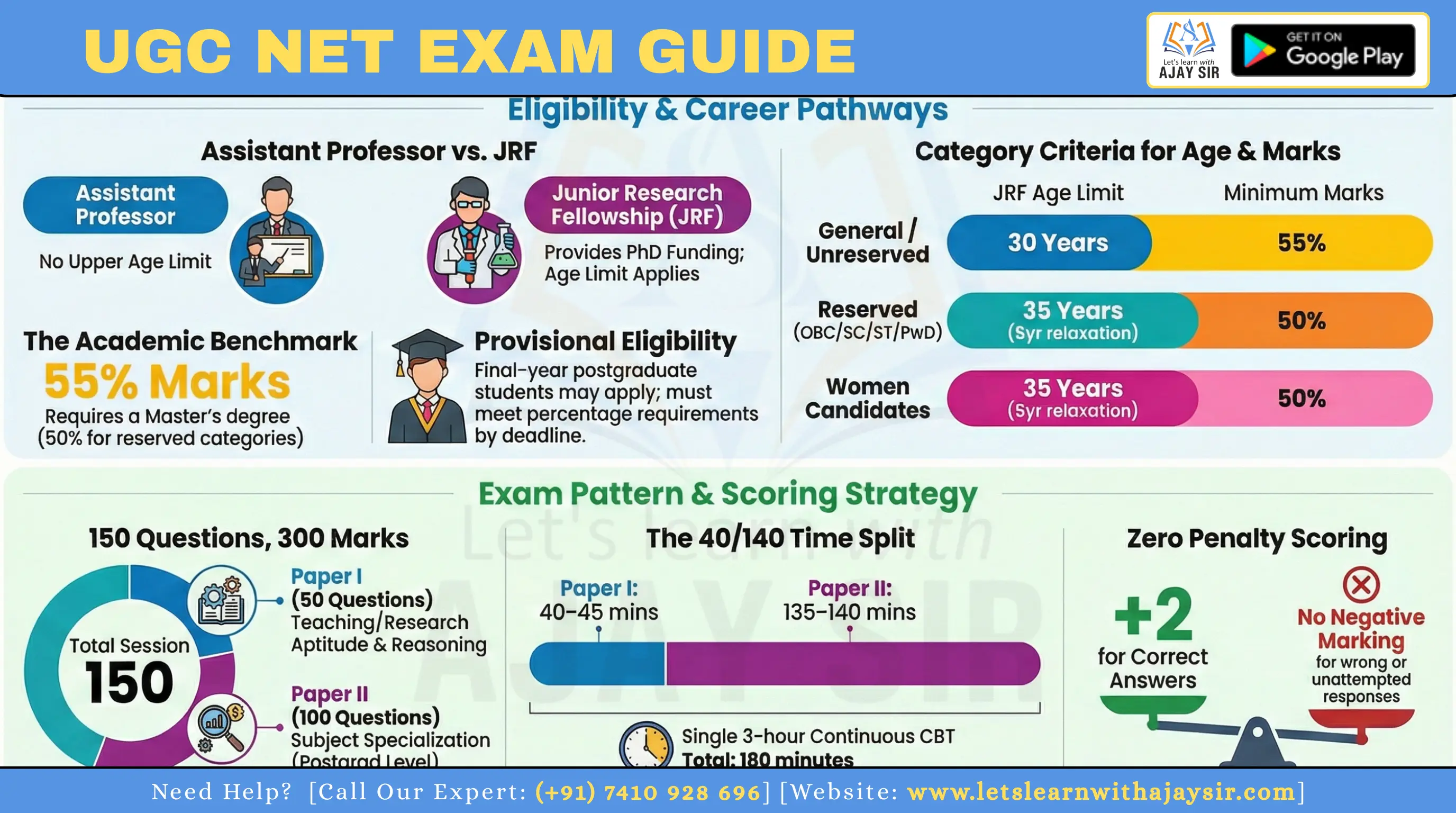
UGC NET: Exam pattern
The exam now runs as one uninterrupted three-hour computer test that combines both papers into a single effort. This revised pattern means you must plan time, stamina and switching strategy before you sit the paper.
Paper I — structure and skills tested
Paper I contains 50 objective questions for 100 marks. It tests teaching and research aptitude, reasoning, comprehension and awareness of higher education.
Focus on speed and concept clarity: these questions check reasoning and classroom readiness more than deep subject knowledge.
Paper II — structure and ranking impact
Paper II has 100 objective questions for 200 marks. This paper decides your subject‑depth standing and largely shapes final rank and fellowship chances.
Unit-wise coverage and application questions carry weight; prioritise core topics from your postgraduate syllabus.
Single continuous three-hour session and stamina planning
Both papers run back-to-back in a single 180‑minute session. That totals 150 questions and 300 marks.
Plan blocks: start with Paper I to warm up, switch to Paper II with preset time checkpoints, and use short mental resets every 30–40 minutes to avoid fatigue.
Bilingual format and interface expectations
The paper is bilingual (English and Hindi). Choose the language you read fastest to avoid misinterpretation and save seconds per question.
On-screen features: clear navigation, marking-for-review and section overview. Use the review flag wisely to avoid re-reading and time loss.
"Visualise the full pattern before the test: 150 questions, 300 marks, 180 minutes — and plan your switches and review time accordingly."
Element | Detail | Advice |
Total questions & marks | 150 questions, 300 marks | Set time targets per block and stick to them |
Paper I | 50 questions — 100 marks | Speed and reasoning; answer confidently |
Paper II | 100 questions — 200 marks | Depth and unit coverage; reserve time for hard topics |
Session & interface | Single continuous 180-minute CBT, bilingual | Use marking-for-review; pick your language; practise on similar mock interface |
UGC NET: Marking scheme, negative marking
When you know the exact reward per correct answer, you can design a smarter attempt strategy. The exam awards +2 marks for every correct response and 0 marks for wrong or unattempted items. The total is 300 marks across both papers.
How the no-negative-marking rule changes attempts
No negative marking means missing a question does not reduce your score. That shifts the balance from avoidance to selective aggression. You should prioritise accuracy, then add educated guesses where elimination helps.
Simple attempt framework
High-confidence first: secure quick correct answers to build marks fast.
Medium-confidence next: use elimination to raise probability and attempt these.
Low-confidence last: attempt only if you can make a reasoned guess quickly.
Scoring illustration:
Attempt type | Questions | Marks gained |
High-confidence | 60 | 120 |
Medium-confidence | 50 | 100 |
Low-confidence | 20 | 40 |
"Because wrong answers do not hurt your total, adding reasoned attempts can raise your marks — but avoid time-wasting blind guesses."
Finally, remember: time, not penalty, is your real limiter. The next section covers timing and how to split minutes between Paper I and Paper II for maximum returns.
UGC NET exam timing and time-splitting for Paper I vs Paper II
Manage the clock as part of your strategy. You have 180 minutes for 150 questions in a single continuous session. That makes time planning a core skill alongside subject knowledge and teaching technique.
Practical pacing benchmark: test a split of 40–45 minutes for Paper I and 135–140 minutes for Paper II in your mocks. Paper I rewards quick reasoning and warms you up. Paper II needs deeper reading and application, so give it the bulk of minutes.
How to run your first pass
Start with Paper I to secure fast, high-confidence marks. Answer quick questions without overthinking, flagging anything doubtful.
Move to Paper II and settle into a steady rhythm. Read questions fully and allocate extra time for calculation or passage-based items linked to research aptitude and specialised topics.
When to switch from accuracy-first to attempt-maximisation
Use the early phase (first 60–70 minutes) as your accuracy-first window. After that, shift to attempt-maximisation: favour educated choices and avoid dwelling on low-return items.
"If a question costs more time than it promises in marks, flag it and move on — revisit flagged items only if time permits."
Decision rule for mark-for-review: flag when you can narrow choices but need 30–60 seconds more to decide.
If a flagged question still needs more than a minute on review, skip it—time is the real penalty.
In mocks, practise the 40/140 split and vary by strength: shift 5–10 minutes one way if Paper I or II suits you better.
Stamina tips: hydrate before the session, take two short mental resets (10–20 seconds of deep breathing) after every 30–40 minutes, and keep your pace calm if a paper starts tricky. This helps you maintain focus for teaching-style and research aptitude questions under pressure.
Element | Recommended time | Why it works |
Total | 180 minutes for 150 questions | Sets clear time-per-question baseline (≈1.2 minutes each) |
Paper I | 40–45 minutes | Fast reasoning and quick wins boost confidence |
Paper II | 135–140 minutes | Allows depth, reading and application for subject questions |
Mark-for-review rule | Flag if decision needs 30–60 seconds more | Prevents time sink and guides effective revisits |
UGC NET: Syllabus overview
Start by treating the official syllabus PDF as a map, not a mandate. The syllabus splits into Paper I (general aptitude) and Paper II (your subject). Use it to outline units, not to attempt everything at once.
How to use the official syllabus PDF without getting overwhelmed
Open the PDF and create a simple list of units for each paper. Mark recurring topics you spot and highlight core headings. This gives you focus and stops you from studying every line equally.
Practical step: extract unit titles into a spreadsheet and assign one or two reliable resources per unit — a standard textbook and a set of practice questions.
Identifying high-weightage topics and revision priorities
Combine the syllabus with past papers and mock-test analytics to spot frequently tested topics. Prioritise those for mastery while keeping broad coverage for low-frequency items.
Convert units → subtopics → resources → practice sets → revision cycles.
Weekly plan: cover 2–3 units, practise a mixed set, and schedule a short weekly revision slot for Paper I.
Use a tracker to log units completed, test scores and recurring errors for targeted revision.
"Coverage gets you familiar; mastery gets you marks — aim for deep mastery in core topics and competent coverage elsewhere."
Step | Action | Why it works |
List units | Extract from official syllabus PDF | Creates a clear scope and avoids overload |
Prioritise | Identify high-weightage topics via past papers | Maximises score impact for your study time |
Track | Log completion, scores and error patterns | Drives focused revision and continuous improvement |
UGC NET: Paper I syllabus
Paper I groups the general skills you must master: teaching aptitude, research aptitude, reasoning and data interpretation, ICT basics and the higher education system. Focus on high-yield topics and short, repeatable practice to convert understanding into fast answers.
Teaching aptitude and evaluation systems
Questions often ask about learner characteristics, teaching approaches and assessment types. Expect items on formative vs summative evaluation and norm‑referenced vs criterion‑referenced testing.
Research aptitude and thesis/article basics
Master research steps, sampling, hypothesis testing, ethics and simple aspects of thesis or article structure. These appear as objective items on methods and ethics.
Reasoning, mathematical reasoning and data interpretation
Build speed with daily short drills on logical puzzles and DI sets. Train mental calculation to avoid time traps and practise quick elimination methods for multi‑choice questions.
ICT, digital learning and higher education policy
Cover e‑learning tools, internet basics and governance tech, plus current higher education policy points in India. Policy questions are predictable and can be easy marks if revised regularly.
Example-style prompts: items may ask you to identify formative assessment features or select the correct sampling method for a small qualitative study.
Scoring buckets: teaching aptitude, research aptitude, reasoning/DI, ICT, higher education policy.
Use short notes and timed practice for each bucket to turn knowledge into reliable answers.
UGC NET: Paper II Syllabus
Picking the right Paper II subject ties directly to your master’s focus and shapes both eligibility and study time. Choose the subject that matches your postgraduate specialisation to avoid document mismatches and needless extra study.
How Paper II aligns with your postgraduate specialisation
Why alignment matters: the paper tests subject depth, not general knowledge. If your master's and subject choice differ, you risk failing verification or facing a steeper learning curve.
Examples of popular subjects and what depth looks like
Common choices include Commerce, English, Economics, Political Science, History, Sociology, Psychology, Management, Computer Science & Applications, and Environmental Science.
Commerce — theory plus application in accounts and finance methods.
English — literary theory, criticism, and close-text analysis.
Computer Science — algorithms, programming concepts and applied systems.
Turn the official syllabus into unit-wise notes
Use a repeatable method: extract units, make one-page summaries, create formula/concept sheets and a short glossary for key terms.
Design quick revision sheets for the final month
Prepare unit highlights, common traps and a "must-not-forget" list per unit. Keep each sheet to one page so revision is fast and focused.
"Finish full syllabus coverage early; then deepen high-weight units using past-year questions and targeted mocks."
Step | Action | Why it helps |
Map units | Extract from official syllabus | Sets clear scope |
Create notes | One-page summaries + glossary | Speeds revision |
Final month | Quick sheets + PYQs | Boosts recall and confidence |
Balance breadth and depth by completing the full syllabus early, then prioritise high-weight topics using mock analysis. This approach keeps you efficient and exam-ready.