• NEED HELP? TALK TO A COUNSELLOR: 7410928696

SSC Stenographer

Category: SSC Exams

Over half a million applicants track this recruitment cycle each year, making timely updates critical for your plan.

This is your all-in-one, updated guide to SSC Stenographer 2026. It is built for first-time and repeat aspirants across India. You’ll find clear notes on what’s confirmed and what remains tentative.

This article previews the next topics: notification date, eligibility, important dates, how to apply, fees, selection process, CBT pattern, skill test rules, syllabus, salary, and a practical plan you can follow.

Quick Overview

SSC Stenographer: Exam Overview

Get a quick, practical summary of the roles on offer and the two-stage selection you’ll face.

What the staff selection commission recruits you for

The Staff Selection Commission runs a national recruitment to fill stenographer grade posts in ministries, departments, and government organizations. You are hired for administrative support work where shorthand and transcription skills matter.

Exam mode and stages you’ll go through: CBT + skill test

The selection uses a computer-based test (CBT) followed by a stenography skill test. The CBT is the main scoring stage and largely decides merit.

The skill test is qualifying in nature: you must pass it to get appointed, but it usually does not add marks to the final ranking.

Official website to track updates: ssc.gov.in

Always check the official website for the notification PDF, application link, city and admit card notices, answer key, objection window, results, and skill test updates. That page is the authoritative source for timelines and changes.

  • Who this exam is for: anyone with or willing to build shorthand + transcription ability.

Decide early: choose Grade C, Grade D, or both based on your age, preference, and career goals.

Application Fee

Application fee (General/OBC) ₹100
Fee exemptions SC/ST, PwD, eligible ESM, female
Correction window fee (if enabled) ~₹200 (confirm on notice)

Eligibility Criteria

SSC Stenographer: Eligibility criteria

Before you fill any form, check the basic rules that decide whether you can apply. This short eligibility summary helps you self-check quickly so you don’t waste time or money on an application you may not qualify for.

Educational qualification

You must have passed Class 12 or its equivalent from a recognized board or university. Keep your original mark sheet and passing certificate ready for document verification.

Age limit

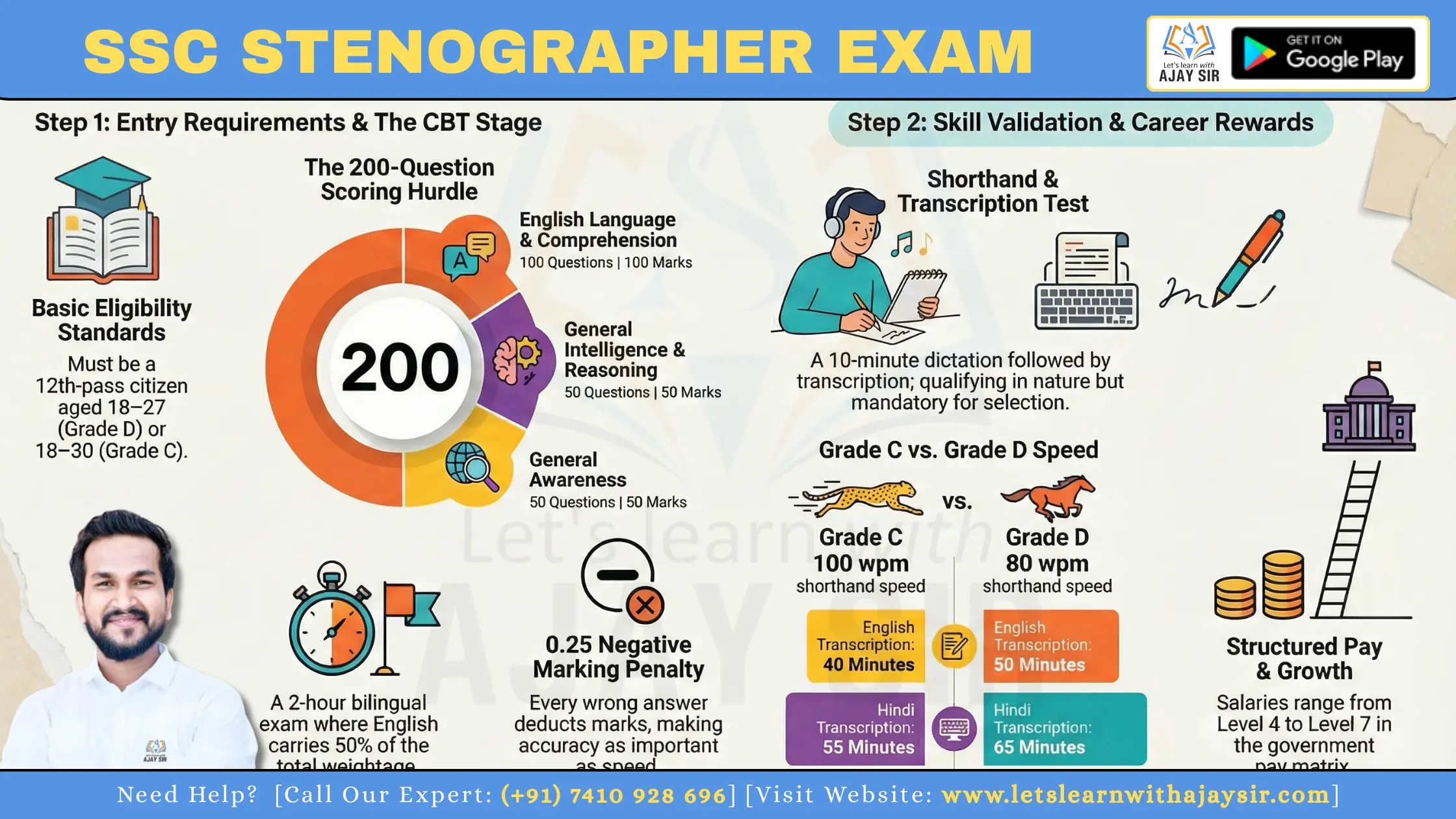
For Grade C posts the age limit is 18–30 years. For Grade D the age limit is 18–27 years. The commission will state the exact cutoff date in the notification, so verify that date when you apply.

Age relaxation rules

  • SC/ST: +5 years; OBC: +3 years.

  • PwD: general relief up to 10–15 years depending on category and parental age exceptions.

  • Ex-servicemen, defense personnel, and central government employees follow standard calculation rules (variable limits such as up to 40/45 years in some cases).

  • Widows, divorced, and judicially separated women often receive specific upper-age relaxations (examples: up to 35/40 years) under existing regulations.

Nationality

You must be a citizen of India, or a subject of Nepal or Bhutan, or an eligible Person of Indian Origin (PIO) with a required certificate. If you are from Nepal, Bhutan, or hold a PIO status, keep the certificate of eligibility ready if asked.

Practical caution: these points are a concise guide. Always rely on the official notification wording for final eligibility decisions and special-case queries before you submit the application.

Vacancy Details

SSC Stenographer: Vacancy trends

Vacancy patterns tell you where hiring pressure will be heaviest and where you can aim for an edge.

Last cycle posted a total of 1,590 vacancies: Grade C — 230 and Grade D — 1,360. This split shows most openings sit in Grade D, so bulk competition and cutoff movement often center there.

Previous vacancy snapshot

Use the numbers as a directional guide, not a guarantee. Vacancy totals shape cutoff pressure and the number of candidates who make the merit list.

Post

Major Category Share

PwD Subcategories

Grade C

UR / OBC / SC / ST / EWS

HH / OH / VH / Other

Grade D

UR / OBC / SC / ST / EWS

HH / OH / VH / Other

Combined

Category-wise reservation applied

PwD allocations within each category

How category distribution usually works

Vacancies are split across UR, OBC, SC, ST, and EWS. Reserved seats reduce open competition in some pools but raise cutoffs within others.

PwD reservations further divide seats into HH, OH, VH, and similar classes. That affects niche competition and your realistic target.

What to do with vacancy trends

  • Compare new numbers with last year to reset your safe-score goal.

  • Aim higher: focus on CBT accuracy because negative marking penalizes guesses.

  • Watch offices: vacancies vary by department and user office, so the final notice matters most.

Bottom line: treat vacancy tables as strategic input. Use them to set score targets, pick which posts to favour, and plan margin for error on test day.

Syllabus

SSC Stenographer: Exam Pattern

Start with the exam structure: three sections, 200 questions, and a strict two-hour clock. You must know how marks split so practice mirrors the real test pressure.

Section breakdown and marks

Section

Questions

Marks

General Intelligence & Reasoning

50

50

General Awareness

50

50

English Language & Comprehension

100

100

Total

200

200

Pacing and attempt strategy

You have two hours for 200 questions. Aim for a first sweep of easy items in each section to secure quick marks.

Do a second pass on moderate questions. Reserve the toughest reasoning puzzles for last to avoid time loss.

Negative marking & language rules

Negative marking: each wrong answer deducts 0.25 marks. That means fewer wild guesses and smarter elimination.

The paper is bilingual in English and Hindi except the English language section, which appears only in English. Plan practice accordingly so your time split matches section weights.

  • Mirror these weights in daily study: longer English sessions, steady GA revision, timed reasoning drills.

  • Use mock computer based tests to build speed and accuracy under real timing.

SSC Stenographer: Qualifying marks and cutoffs

Understand the minimum qualifying percentages so you can plan a realistic target. The commission sets baseline marks you must meet to remain eligible for further rounds.

Official qualifying percentages

Unreserved (UR): 30% of total CBT marks.

OBC / EWS: 25% of total CBT marks.

All other reserved categories: 20% of total CBT marks.

Minimum qualifying vs. cutoff: what’s the difference?

The minimum qualifying mark is an eligibility floor. Hitting it lets your name be considered for merit lists.

The cutoff is a moving target. It depends on vacancies, paper difficulty, and the number of strong candidates. So meeting the floor rarely guarantees selection in a competitive cycle.

  • Aim above minimums: treat qualifying marks as a safety net, not a goal.

  • Account for negative marking: each wrong answer deducts marking 0.25, so careless guesses can drop you below a cutoff band.

  • Use mock tests: push for consistent scores above your target margin rather than one-off high scores.

Category

Minimum Qualifying

Practical target (safe)

UR

30%

45–55%

OBC / EWS

25%

40–50%

Other reserved

20%

35–45%

"Estimate your probable score from the official answer key, then compare with expected cutoffs before drawing conclusions."

After the exam, check the released answer key, estimate your score, and compare with trending cutoffs. This helps you predict selection chances and plan next steps in the selection process.

SSC Stenographer: Skill test details

The skill test is a live performance: you take dictation first, then transcribe under a strict clock. The exam stage checks real shorthand capture and transcription speed, so practice must mimic test conditions.

Dictation duration and speed standards

The dictation runs for 10 minutes for both Grade C and Grade D. You must hit a speed of 100 words per minute for Grade C and 80 words per minute for Grade D. Aim for accuracy before increasing speed.

Transcription time matrix

Grade

English transcription

Hindi transcription

Grade C

40 minutes

55 minutes

Grade D

50 minutes

65 minutes

Note: candidates who use a scribe receive extra time as per commission rules. Time management while transcribing is as important as shorthand capture.

Medium choice and future requirements

If you choose Hindi as your test medium, be prepared to learn English shorthand later if your posting requires it. The reverse is also true: English-medium candidates may need Hindi shorthand on appointment.

Where and how the skill test is conducted

The practical test runs at regional or sub-regional offices and other designated centres. You will get detailed instructions from the concerned regional office by official notice or email—watch those communications closely.

"Treat the skill test as qualifying but non-negotiable: clear it, and your CBT score can convert into an appointment."

  • Practice with timed dictations and transcription drills weekly.

  • Build accuracy first, then raise your words per minute target slowly.

  • Simulate test day: dictation for 10 minutes, then transcribe within the exact allotted time for your grade and medium.

SSC Stenographer: Syllabus for General Intelligence & Reasoning

Sharp logical thinking and quick pattern spotting win you marks in the General Intelligence & Reasoning paper.

What this test measures: your knack for spotting patterns, applying rules, and solving short problems fast under pressure. The exam favors clarity and quick verification over fancy tricks.

Core topics to prioritise

  • Series and sequences — number and letter series.

  • Coding-decoding and analogies.

  • Syllogism, classification, and similarities/differences.

  • Blood relations, direction sense, clock & calendar questions.

  • Basic non-verbal reasoning and simple puzzles.

How problem-solving and decision-making appear

Questions often present short scenarios that test analysis, judgment, and a quick decision. You will face logical deductions, multi-step elimination, and situational reasoning.

Practice tip: learn the standard formats (e.g., single-syllogism, two-step coding) and drill them until recognition is instant.

Study sequence and weekly mini-plan

Start with easy, high-score topics like series and coding. Move to syllogisms and blood relations next. Reserve non-verbal and complex puzzles for later.

  • Daily: 30 minutes timed sets on one topic.

  • Three times a week: mixed-topic 20-question timed mocks.

  • Weekly: error log review and targeted correction drills.

Strategy reminder: because of negative marking, attempt only those reasoning questions you can verify quickly.

Focus

Time per week

Goal

Practice method

Series & Coding

3 hrs

Accuracy 90% in timed sets

10 min drills + error log

Syllogism & Blood relations

2 hrs

Fast diagramming

Stepwise solutions + mock sets

Non-verbal & Puzzles

2 hrs

Pattern recognition under time

Visual practice + weekly mixed test

Mixed mocks

3 hrs

Simulate CBT timing

Full timed papers; review mistakes

SSC Stenographer: Syllabus for General Awareness

A smart General Awareness plan can convert easy facts into quick marks on test day. General awareness often rewards simple, factual recall, so you should prioritise high-yield topics and steady revision.

Current affairs focus areas for the exam season

Track India-specific updates: major government schemes, budget highlights, policy changes, and landmark court rulings. Combine these with global events such as climate agreements, major geopolitical shifts, and notable scientific breakthroughs.

Tip: convert weekly news into one-page summaries you can revise in five minutes.

Static GK buckets to revise systematically

  • History: freedom movement, modern India, basics of ancient and medieval eras.

  • Geography: physical features, rivers, climate zones, and maps of India.

  • Economy: budget terms, inflation, major schemes, and basic macro concepts.

  • Polity: Constitution, fundamental rights, and key institutions.

  • Science: everyday science, recent research, and simple principles.

Sports, awards & important days

Memorise major national and international awards, Olympic and common sports milestones, and important national days. These recur often and are quick to score.

Revision cycle: daily short notes, weekly recap sheet, and a monthly full revision. Use one reliable current affairs source and convert it into your own one-page weekly revision sheet to cut down forgetting and reduce guessing on the test.

SSC Stenographer: Syllabus for English Language & Comprehension

English matters more than you think. The English language section carries 100 marks and can swing your overall CBT rank quickly if you prepare smartly. Focus on accuracy and time management to convert this high-weight part into a scoring advantage.

Grammar and sentence structure topics you’ll be judged on

Key areas: error spotting, sentence improvement, fill-in-the-blanks, active/passive voice, narration, and common usage rules. Practice short drills on each type until recognition is instant.

Vocabulary must-dos: synonyms-antonyms and word usage

Memorize high-frequency synonyms and antonyms, but train with context sentences. The exam tests meaning through usage rather than dictionary forms. Work on collocations and word choice in short sentences.

Reading comprehension practice and para jumbles strategy

For RC, use a question-first scanning method: glance at questions, then read selectively for answers. Time each long passage to improve speed and avoid “almost correct” traps.

For para jumbles, identify the topic sentence, linkers (however, therefore, additionally), and pronoun references. Reconstruct the flow by matching referents and logical connectors rather than guessing.

  • Daily routine: 20–30 minutes of mixed grammar and vocab practice.

  • Weekly drill: 1–2 full RC sets under timed conditions.

  • Result: better English accuracy reduces time pressure across the whole test.

Salary

SSC Stenographer: Salary, Pay levels

Once appointed, you enter a structured pay matrix with allowances and long-term growth tied to performance and seniority. You should expect stable government employment, a predictable hike cycle, and defined promotion routes that reward experience and skill.

Grade C vs Grade D: pay and role differences

Grade C posts usually carry higher responsibility and faster promotion prospects. Grade D roles start lower on the ladder but offer steady progression if you build expertise.

Pay level range and what it signals

Pay Level

Basic Range (₹)

Level 4

25,500 – 81,100

Level 5

29,200 – 92,300

Level 6

35,400 – 1,12,400

Level 7

44,900 – 1,42,400

Allowances, deductions, and take-home outlook

Expect allowances such as DA (dearness allowance) and HRA as per rules. Typical deductions include provident fund and income tax, so gross pay differs from take-home.

Typical job tasks and career advice

Your daily work can include shorthand transcription, drafting notes and communications, record keeping, scheduling, and supporting senior officers. Strong shorthand, professionalism, and consistent performance help you climb the stenographer grade ladder over time.

"Treat skill growth as your ticket to faster promotions and better postings."

Selection Process

SSC Stenographer: Selection Process

Get a clear map of the selection route so you can prioritise study and paperwork correctly.

Computer-Based Test as your scoring stage

The computer based test is the stage that decides rank and most vacancies. Focus on accuracy and time management because raw CBT marks form the final merit list.

Skill test as a qualifying hurdle

The skill test in stenography is qualifying in nature. You must pass the speed and accuracy benchmarks to remain eligible, even if your CBT score is high.

Document verification: what you’ll be asked to prove

During document verification you will need to prove age, education, category/EWS/PwD claims, identity, and fee payment proof. Departments may add specific checks for certain posts, so read instructions carefully.

"Your CBT score wins the place; the skill test and documents keep it valid."

  • Prepare originals and attested copies early.

  • Ensure names and dates match across documents and application.

  • Keep your application printout and fee receipt handy.

Stage

Purpose

What you must do

Computer based test

Score & ranking

Maximise accuracy; manage time

Skill test

Qualifying

Hit speed & transcription standards

Document verification

Eligibility confirmation

Present originals and proof

How to Apply

SSC Stenographer: How to apply online

Follow this concise guide to complete the online application form without missing crucial choices like test centre or skill test language.

Where to apply: use the official website (ssc.gov.in) on desktop for full control, or the My SSC mobile application for quick uploads. Both accept applications; choose the one you trust for stable uploads.

One-Time Registration and login essentials

Create One-Time Registration (OTR) first. Enter name, date of birth, and contact details exactly as on your documents. You’ll get a registration ID and password—keep them safe for future logins and edits.

Choosing exam centres and skill test medium

Pick up to three realistic exam centre preferences near you. Choosing locations you can reach easily lowers last-minute stress.

Select your skill test medium carefully: English or Hindi. This choice is important for transcription practice and later scheduling.

Photo and signature specifications

Follow file rules to avoid rejection. The photo and signature must be JPG and meet size and pixel limits. Preview uploads before you move on.

Item

Format

Dimensions

Size

Photograph

JPG

100 × 120 px

>4 KB and <12 KB

Signature

JPG

40 × 60 px

>1 KB and <12 KB

Application portal

Web / App

N/A

Download/print submitted PDF

Final submission checklist

  • Preview all fields for spelling and category accuracy.

  • Pay fee if applicable, then click final submit.

  • Download and print the submitted application PDF for your records and the admit card stage.

  • Avoid these mistakes: mismatched name/DOB, wrong category, blurry images, or forgetting to save the confirmation.

All Details

Conclusion

Finish strong: a clear checklist helps you move from study mode to application and test day with confidence.

First, track updates on the official website, save the notification PDF, and note the expected April notification and the tentative August–September CBT window. Second, confirm your eligibility and complete the application form early to avoid last‑minute errors.

Third, start a balanced routine: timed CBT practice, daily GA and English revision, plus regular skill test dictation drills. Keep your admit card, application printout, and ID documents organised.

The selection process is straightforward but strict: the CBT score decides rank, the skill test is qualifying, and document checks must match. Keep checking the portal, treat every mock like the real exam, and download your admit card on time.

FAQs

The notification outlines vacancies, eligibility, exam pattern, dates, fee details, and selection stages. Watch the official portal around April for the official release and read the PDF fully to note important timelines and instructions.

The selection commission recruits candidates for Grade C and Grade D stenography posts across ministries and departments. You’ll be placed in clerical and stenographic roles depending on the grade.

You’ll go through a Computer-Based Test (CBT) that determines merit and then a qualifying skill test in shorthand and transcription. Shortlisted candidates attend document verification and final appointment procedures.

Use the commission’s official website to get authentic announcements, exam dates, admit cards, answer keys, and results. Bookmark it and check often around expected release windows.

The apply-online window typically opens in April–May. The CBT is usually held in an August–September window. Exact dates will appear in the notification and admit card announcements.

Admit cards are generally issued about a week before the CBT. If a correction period is provided, it lets you fix limited application details for a fee or free, as per the notification—so act quickly if you spot errors.

The previous cycle listed about 1,590 vacancies (Grade C 230; Grade D 1,360). Higher vacancies improve selection chances, but category-wise distribution and cutoffs determine your actual opportunity.

Vacancies are split across UR, OBC, SC, ST, EWS, and PwD categories with reservation rules applied. Your category affects cutoffs and seat allocation during final selection.

You must have completed Class 12 or an equivalent qualification from a recognized board. Verify any specific educational clauses in the notification before applying.

Typical age limits are 18–30 for Grade C and 18–27 for Grade D. Relaxations apply for reserved categories—check the notification for exact upper-age extensions and proof requirements.

Categories such as SC/ST, OBC, PwD, ex-servicemen, and other government-specified groups receive age relaxations. The notification lists specific durations and documentation needed to claim them.

Indian citizens are eligible, and candidates from Nepal, Bhutan, and certain persons of Indian origin may qualify under defined conditions. Check nationality clauses in the notification for exact eligibility.

Apply via the commission’s portal or its mobile app. Complete One-Time Registration (if required), fill personal and education details, upload scanned photo and signature per specs, choose centers and language, pay fee, and save/print the confirmation.

Keep a valid email, mobile number, scanned photo, signature, Class 12 certificate, and ID proof handy. Use the One-Time Registration details or create a new account to start the application.

Yes—you select preferred exam centers and the skill test medium (English or Hindi) during application. Make choices carefully since changes may not be allowed later.

Follow the file size, format, and dimension limits specified in the notification. Use a clear passport-style photo and a neat signature on white background to avoid rejection at the document stage.

Verify personal data, educational details, scanned uploads, exam center and language choice, and fee payment status. Download and keep the application PDF or printout for future reference.

The standard fee is usually ₹100 for General and OBC candidates. Fee exemptions often apply to SC, ST, PwD, ex-servicemen, and female candidates as per rules—confirm current exemptions in the notification.

If a correction window is provided, the notification will state whether corrections are free or if a nominal fee applies. Act quickly if a window opens to avoid additional charges.

The CBT tests General Intelligence & Reasoning, General Awareness, and English Language & Comprehension. Each section has objective questions; check the official pattern for marks and question count.

The test duration is typically two hours. Allocate time per section, attempt easier questions first, and reserve time to review marked answers to minimize negative marking impact.

Yes, there’s a 0.25-mark penalty for each wrong answer. Avoid random guessing; use elimination methods to improve accuracy under negative marking rules.

The paper is available in English and Hindi, with the English language section always in English. Verify any subject-specific language exceptions in the notification.

Typical qualifying marks are around 30% for UR, 25% for OBC/EWS, and 20% for SC/ST/Others. Cutoffs depend on vacancies, exam difficulty, and category performance, so aim higher than the minimum.

Dictation is usually 10 minutes. Speed requirements are commonly 100 words per minute for the higher grade and 80 wpm for the lower grade. Transcription time varies for English and Hindi—check the notification for the exact matrix.

Choosing Hindi for the skill test may require you to learn English shorthand skills later for certain postings, and vice versa. The notification and posting rules explain medium-specific deployment norms.

Skill test details are shared via admit cards and official notices on the commission’s portal. Keep your registered contact details active for SMS and email alerts.

Focus on series, coding-decoding, syllogism, blood relations, directions, logical puzzles, and basic arithmetic reasoning. These areas frequently appear in the general intelligence section.

Cover national and international current events, government schemes, economic basics, major appointments, sports results, awards, and static topics like history, geography, polity, and science.

Grammar, sentence correction, vocabulary (synonyms/antonyms), reading comprehension, para jumbles, and idioms are core. Practice grammar drills, increase reading, and solve previous year papers for speed and accuracy.

The skill test is qualifying—your CBT score decides merit. You must meet shorthand speed and transcription accuracy thresholds in the skill test to qualify for final selection.

Carry your admit card, application printout, Class 12 mark sheet, date-of-birth proof, category certificate (if applicable), photo ID, and any other documents listed in the notification during document verification.

Pay differs by grade with allowances. Roles offer steady government pay with progression through levels and transfer opportunities across ministries. Check pay scale tables in the notification for precise figures.

Build a weekly timetable covering theory, practice, and mock tests. Allocate time for stenography drills daily, solve previous year papers, and take regular full-length mocks to track speed and accuracy.

Avoid excessive guessing, neglecting general awareness, skipping stenography practice, and last-minute topic cramming. On exam day, reach early, follow instructions, and manage time strictly to reduce avoidable errors.

The commission releases provisional answer keys and opens an objections portal for a limited time. After evaluating objections, final keys and results are declared. Shortlisted candidates proceed to the skill test and document verification.

Welcome to Let's Learn with Ajay Sir — Your trusted platform for mastering English Grammar and Literature. We are dedicated to providing high-quality educational content, insightful articles, interactive quizzes, and the latest exam updates to empower learners at every level. Join us on this enriching journey toward academic excellence and lifelong learning.