• NEED HELP? TALK TO A COUNSELLOR: 7410928696

SSC MTS

Category: SSC Exams

You’ll find clear timing, eligibility rules, syllabus outlines, and a practical study plan on this page. Treat the official portal at ssc.gov.in as the final authority, and use this guide to map your next steps with confidence.


Expect a step-by-step roadmap ahead: how to apply, answer keys, cut-offs, and salary. Note that the MTS post is CBT-based plus document verification, while Havaldar adds physical tests — so your prep will change accordingly.

Key Takeaways

  • Find official dates at ssc.gov.in and plan around the calendar.

  • Get eligibility, syllabus, and exam pattern on this page to build a study plan.

  • Compare study resources and mock tests before buying courses.

  • Remember: MTS is CBT + DV; Havaldar includes PET/PST.

  • Use the confirmed CBT as a timeline benchmark.

Quick Overview

SSC MTS: Exam overview

If you want a steady central job after 10th grade, this national recruitment route is one of the most direct options. The staff selection commission hires for Group-C, non-gazetted, non-ministerial roles across ministries and departments.


What the staff selection commission recruits you for

The recruitment covers routine support roles and basic office duties. Typical multi-tasking staff work includes peon, daftary, chowkidar, mali, and other support tasks that keep government offices running.

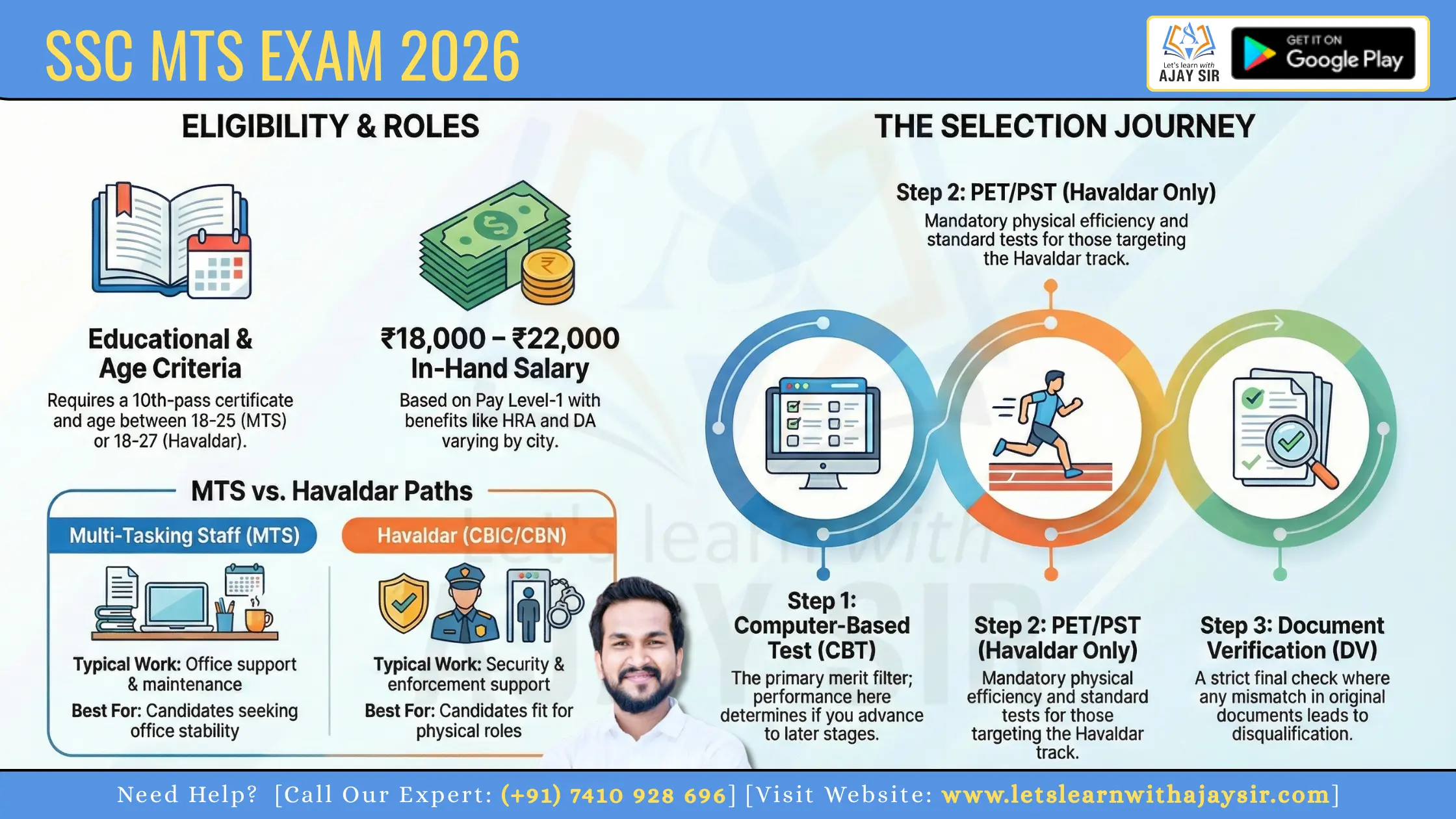
Posts covered: Multi-Tasking Staff (Non-Technical) and Havaldar (CBIC & CBN)

The list of posts splits into two streams. One is the multi-tasking staff track for general central service jobs.


The other is the staff havaldar stream posted mainly in cbic cbn units. Havaldar vacancies include later physical tests, so fitness matters.

  • CBT is common to both streams; PET/PST applies only to Havaldar.

  • Vacancies and department allocations vary by region — check the notification PDF for exact posts.

  • Choose your target post early and shape prep around cut-offs and your strengths.

Feature

Multi-Tasking Staff

Havaldar (CBIC/CBN)

Typical work

Office support, errands, maintenance

Security duties, enforcement support

Selection stages

CBT → Document Verification

CBT → PET/PST → DV

Who it's best for

10th-pass candidates seeking stability

Those fit for physical tests and enforcement roles

Why apply

Nationwide posts, steady Pay Level-1 start

Structured career path within tax & customs wings

Application Fee

General, OBC, and EWS candidates ₹100
SC/ST, women (all), PwBD, eligible ex-servicemen Fee exemptions
Payment modes BHIM UPI, Net Banking, Debit cards (Visa/MasterCard/Maestro/RuPay)

Eligibility Criteria

SSC MTS: Eligibility criteria

Before you hit submit, confirm you meet the basic eligibility checklist so your application does not get rejected. This short self-check saves time and stops last-minute surprises during document verification.


Educational qualification

You need a Matriculation / 10th-pass certificate or an equivalent. Distance education counts only if the board or university is UGC/DEB recognized.

Nationality and citizenship

Candidates can be citizens of India, Nepal, Bhutan, or persons of Indian origin from specified countries. Keep original ID proof ready for document verification.

Age bands for posts

The typical age is 18–25 years for general multi-tasking posts and 18–27 years for Havaldar and select posts. Always check the official cut-off date in the notification for exact age calculation.

Reserved categories: age relaxation snapshot

Category

Typical Relaxation

Notes

SC / ST

5 years

Standard central rules apply

OBC

3 years

Non-creamy layer criteria may apply

PwBD

10–15 years

Varies with disability type

Ex-Servicemen

3 years after service

Proof of service required

Syllabus

SSC MTS: Syllabus

Prioritize topics that repeat in previous year papers to get fast, reliable gains. Start by listing high-frequency areas in each subject and rank them by scoring speed and common occurrence.


Numerical quick wins

Focus on percentages, ratio & proportion, profit & loss, simple & compound interest, averages, time-work, and basic geometry. Practice data interpretation sets until you can read charts in a minute.

Reasoning and traps

Tackle analogy, series, coding-decoding, directions, puzzles, and non-verbal items next. Learn standard patterns so you avoid time-consuming traps on test day.

General Awareness: static vs current

Split GA into static (history, geography, civics, science at 10th level) and daily current affairs. Spend 10–15 minutes daily on current affairs and two short sessions weekly on static GK.

English approach

Cover core grammar rules, basic vocab, synonyms/antonyms, and short RC practice. Keep exercises simple and timed to match exam pace.


Salary

SSC MTS: Salary, Pay matrix

Knowing the honest in-hand range prevents surprises when you first get the salary slip. Salary follows Pay Level-1, so you get a predictable base and clear annual increments.


Pay Level-1 overview and typical in-hand range

The basic pay sits in Pay Level-1. After allowances, your in-hand salary usually falls between ₹18,000 and ₹22,000, depending on posting city and category.

Remember: this range reflects DA and HRA plus standard central benefits.

Allowances that change your take-home by city

Location matters. HRA bands and city compensatory allowances shift your take-home pay notably.

  • Pay matrix components: basic pay, DA, HRA, and other allowances.

  • Big-city posts raise HRA; small-town postings lower housing pay but cut living costs.

  • Long-term value: steady increments, pension benefits, and job security that many private roles lack.

Element

Impact

Example

Basic (Pay Level-1)

Fixed monthly base

Determines pension and increments

HRA / DA

Variable by city

Changes ₹1,500–₹4,000+ in-hand

Benefits

Non-salary value

Medical, leave, retirement

Selection Process

SSC MTS: Selection Process

Computer-Based Test

The computer-based test is the core screening step for all candidates. Your CBT score largely decides whether you advance to later stages.

Work on speed and accuracy because merit lists use your CBT performance as the main filter.


PET/PST only for staff havaldar (CBIC & CBN)

If you target the staff havaldar track (CBIC & CBN), note that PET/PST is mandatory and qualifying in nature.

Do not opt for this stream unless you can meet the physical benchmarks; the physical test eliminates many otherwise strong candidates.


Document verification and common disqualifiers

Document verification is strict: every claim on your form must match originals. Age, education, category, and identity proofs are checked carefully.

False claims, mismatched names or missing certificates can lead to instant disqualification at DV. Keep neat, verifiable copies ready.

Normalization and cut-offs

Normalization adjusts scores across shifts so differences in difficulty are balanced. Focus on accuracy rather than guessing; correct attempts matter more than raw attempts.

Cut-offs vary by category and region. Track trends, but avoid overfitting your study plan to last cycle’s marks—aim for a safe margin above typical cut-offs.

  • Selection flow (exact order): CBT → PET/PST (staff havaldar only) → Document Verification → Final Merit.

  • CBT sets the merit baseline; PET/PST is qualifying for havaldar posts.

  • Prepare originals for DV and train for normalization effects by practicing timed, accurate mock tests.

How to Apply

SSC MTS Exam 2026: How to apply Online

Use the official website to begin and keep your ID documents handy. Follow each step slowly and double-check entries as you go.

One-Time Registration basics and Aadhaar option

OTR is a one-time investment: create it once and future forms become faster. You can use Aadhaar for instant authentication or select an alternate ID if you prefer.

Part-II: photo, signature, and centre choices

Part-II is the risk zone where most rejections happen. Capture a live photo and upload a clear signature in JPEG (10–20 KB; 6.0 cm x 2.0 cm).

Select three preferred exam centre options carefully. Choose nearby centres first, then add fallback locations to reduce travel risk.

Choose CBT language wisely

Pick the CBT language you read fastest and understand clearly. This choice affects speed and accuracy on exam day, so prioritize comprehension over familiarity.


Final-submit checklist

  1. Preview the full application form and confirm category/relaxation codes.

  2. Ensure fee status shows paid and download the PDF receipt.

  3. Save your registration number and password for admit card and answer key access.

  4. Keep originals for document verification and a screenshot of the submitted form.

Step

What to do

Why it matters

OTR

Create profile; authenticate with Aadhaar or alternate ID

Saves time for future application form fills

Part-II uploads

Live photo + signature (10–20 KB JPEG)

Prevents rejection during document checks

Exam centre selection

Choose 3 centres: local, nearby, fallback

Reduces travel issues and slot denial

Final submit

Preview, pay fee, download PDF

Proof of submission and fee confirmation

All Details

SSC MTS Exam 2026: Admit card, exam center

Treat the admit card like your travel ticket: download it as soon as regional links on the official website or your login portal go live. The mts admit card usually appears only 3–4 days before the exam date, so check early and save a PDF copy.

Exam-day checklist and reporting tips

Carry the printed admit card and one valid original photo ID that matches the admit card details. Also bring two recent passport-size photos if the instructions ask for them.

  • Before you leave: confirm shift time, check the centre address on Google Maps, and validate ID expiry.

  • On arrival: reach at least 60–90 minutes early to clear biometric and verification queues.

Prohibited items: follow instructions on electronic devices, watches, and bags to avoid denial of entry.

Answer key, result, and cut-off flow after the exam

Once the paper ends, you enter the post-exam timeline where keys, challenges, and results converge. Knowing the sequence helps you avoid fake dates and wasted fees.

Provisional answer key: estimate your score

The commission releases a provisional answer key soon after the exam. Use it to mark your answers and calculate a raw score.

Challenge window basics

A short challenge window (often 1–2 days) opens next. You can object to specific questions with evidence and pay the prescribed fee per challenge.

Result PDFs and cut-off publication

Final keys follow review, then results appear as PDFs on the official website. Results list roll numbers; cut-offs publish category-wise in the same or a linked PDF.

Conclusion

Your next move is simple: watch the official website for the notification, complete One-Time Registration, and sharpen timed practice with two-session mocks.

Confirm key decisions: pick between the multi-tasking and havaldar tracks based on fitness and paperwork, choose the CBT language that boosts your accuracy, and verify your eligibility criteria before you apply.

Prioritize fundamentals: build topic basics, drill past-year questions, and run full-length mocks to build stamina. Always validate application fee rules, admit card timing, and exam pattern in the official PDF to avoid conflicting summaries.

Use previous year papers and cut-offs as planning tools, not guarantees. If you follow the timeline, choose the right resources, and track performance weekly, you’ll give yourself a strong shot at ssc mts 2026.

FAQs

The official notification is published on the recruitment board’s website. Check ssc.gov.in for the PDF, which lists vacancies, dates, eligibility, and application steps.

The drive fills Multi-Tasking Staff (non-technical) and Havaldar posts for CBIC & CBN. You must meet the educational and nationality criteria—typically matriculation or equivalent—and the age limits for each post. Verify details in the notification before applying.

The application window commonly opens in June–July with the computer-based tests planned between September and November. Exact dates vary by cycle, so align your schedule with the published timeline and watch for admit card releases and shift allocations.

Use One-Time Registration (OTR), fill Part II carefully with a live photo and signature, select your preferred exam center and CBT language, and follow the final-submit checklist. Double-check name, DOB, and fee payment status before submitting to avoid rejection.

A standard fee applies to unreserved categories; reserved categories such as SC, ST, women, PwBD, and eligible ex-servicemen usually get exemptions. Pay via the accepted online modes and retain the transaction proof to confirm successful payment.

Selection starts with a computer-based test used for screening. Havaldar candidates (CBIC & CBN) may face additional PET/PST stages. Shortlisted candidates undergo document verification; any discrepancy can lead to disqualification. Normalization and cut-offs determine final merit.

The exam uses a two-session structure you must attend. Each session has fixed time and marks, with negative marking for incorrect answers. Check the pattern in the notification so you can plan time management and section attempts.

Havaldar applicants face physical tests like walking, cycling, and measurements for height, chest, and weight. Prepare a fitness plan early so you can balance physical training with CBT preparation and meet qualifying benchmarks.

Multiple regional languages are typically available alongside English. Choose the language in which you can read questions fastest and answer accurately; switching languages mid-prep can affect performance, so settle your choice during application.

Admit cards are issued ahead of the CBT and are downloadable from the official portal. Carry the printed admit card, valid photo ID, and any documents specified in the notification. Arrive at the center early and follow reporting-time instructions.

After the exam, download the provisional answer key to estimate your raw score. If you find errors, use the challenge window to submit representations with proof. Authorities review challenges before publishing final keys and results.

Entry-level posts fall under Pay Level-1 with an approximate in-hand range of ₹18,000–₹22,000, depending on location and allowances. Other benefits and HRA vary by posting and state, so review the pay matrix details in the notification.

Build a phased plan: foundation, intensive practice with mock tests, and a final sprint focused on weak areas. Use previous year question papers, sectional mocks, and concise revision notes. Track your score trends and tweak strategy based on performance data.

Frequent errors include wrong name/DOB entry, incomplete Part II with incorrect photo/signature, missed fee payment, and ignoring age or nationality rules. Cross-check each field against your documents and submit early to correct any showstopper issues.

Vacancy trends and regional reallocation influence competition in each state and cadre. A rise in vacancies in a region improves your chance; reduced seats heighten competition. Monitor vacancy lists in the notification and plan target scores accordingly.

Scores are normalized across shifts to account for difficulty variations, and cut-offs are set per category and region. Your final merit depends on normalized marks and category cut-offs. Use previous-year cut-offs to set realistic target scores.

Welcome to Let's Learn with Ajay Sir — Your trusted platform for mastering English Grammar and Literature. We are dedicated to providing high-quality educational content, insightful articles, interactive quizzes, and the latest exam updates to empower learners at every level. Join us on this enriching journey toward academic excellence and lifelong learning.