• NEED HELP? TALK TO A COUNSELLOR: 7410928696

SSC JE Civil

Category: SSC Exams

This guide gives you a clear, step-by-step route to tackle the upcoming recruitment drive. You will learn what the exam tests are, who runs them, and why a junior engineer post is a practical path to stable central government employment in India.

Inside, you’ll find the full exam pattern, a syllabus-first study plan and a realistic preparation roadmap. Practical tips on accuracy, negative marking and mock tests will help you plan your time and efforts without last-minute panic.

Key Takeaways

  • You’ll get an ultimate guide to the SSC JE Civil Exam 2026 with clear steps for preparation.

  • Understand the role, the conducting body and why it matters for stable government work.

  • See how Paper 1 and Paper 2 combine to decide final selection, so you can balance focus.

  • A syllabus-led approach maps every hour of your engineering study to tested topics.

  • Learn to attempt strategy adjustments for negative marking and safe score planning.

Quick Overview

SSC JE Civil: Overview

Knowing who runs the test and what the role requires makes your preparation practical and focused. The Staff Selection Commission organises the technical selection to fill junior engineering posts across central ministries and departments.

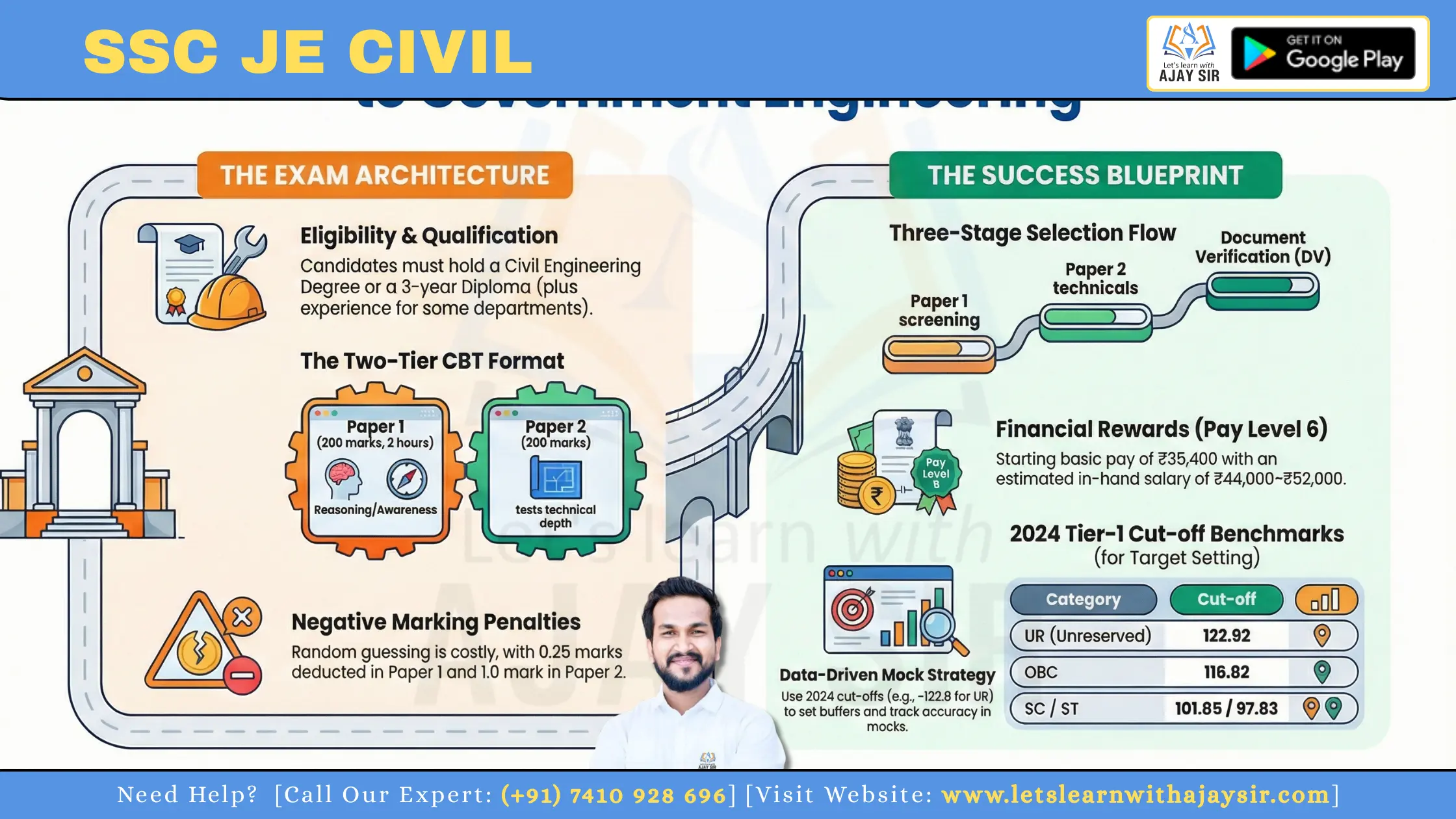
What the role is: You apply for a Group B (Non-Gazetted) technical position at Pay Level 6. Day-to-day work mixes field and office duties, depending on department needs.

  • Who runs it: The Staff Selection Commission (selection commission) manages notifications, applications and results for this national examination.

  • Role focus: As a civil stream engineer you may handle planning, execution, maintenance and site coordination.

  • Typical placements: Expect postings in CPWD, CWC, MES, BRO and similar organisations — each offers different office-to-site balances.

This recruitment matters if you seek a steady technical career with structured pay, benefits and clear promotion paths. Track official updates so you match eligibility and departmental expectations before you apply to the SSC 2026 exam or sit the SSC exam.

Eligibility Criteria

SSC JE Civil: Eligibility Criteria

Before you fill any form, confirm you meet the core eligibility criteria so your application is not rejected.

Nationality rules you must meet

You must normally be a citizen of India or a subject of Nepal or Bhutan. In some cases a person of Indian origin who migrated from specified countries with intent to settle permanently is allowed.

"Confirm your nationality proof before applying to avoid disqualification later."

Age limits and why they differ

The usual upper age limit is up to 30 years for many posts. Certain posts, such as some departmental roles, allow up to 32 years — this depends on the post and department.

Age relaxation by category

  • SC/ST: 5 years relaxation

  • OBC: 3 years relaxation

  • PwD: 10 years (combined relaxations apply where allowed)

  • Ex‑servicemen: relaxation as per government rules

Educational qualification required

Most posts accept a three‑year diploma in civil or a degree in civil engineering from a recognised institute. Some department posts accept a diploma plus two years' experience instead of a degree.

Department

Common requirement

Notes

BRO

Degree or Diploma + experience

Experience sometimes mandatory

CPWD

Three‑year diploma

Upper age may be 32 for certain posts

CWC / MES / NTRO

Diploma or degree

Check notification for exact criteria

Check the official notification carefully so your documents match the stated criteria and recognised board or institute requirements.

Vacancy Details

SSC JE Civil: Vacancies

Knowing recent vacancy trends helps you set a realistic target score and plan your attempt strategy.

Use the 2025 benchmark of about 1,731 posts as a working assumption. Final numbers are only in the official notification, so treat this as guidance rather than fact.

Past vacancy snapshot (all streams)

Year

Vacancies

Impact on selection

Strategy hint

2021

1,150

Lower seats; cut-offs tend to rise

Prioritise accuracy over guesses

2022

2,798

Higher intake; slightly relaxed cut-offs

Maximise safe attempts

2023

1,324

Moderate competition

Balance speed and depth

2024–2025

1,765 / 1,731

Stable benchmark across the year

Target consistent marks with clean accuracy

Department signals and cut-offs

Departments such as BRO, CPWD, CWC, MES and others change their participation each year. Higher departmental demand increases seat variety and posting options.

Fewer vacancies push cut-offs up. Aim to increase accuracy when seats drop, and widen attempts when vacancies rise. That balance shapes your selection probability and final marks target.

Syllabus

SSC JE Civil: Exam pattern (Paper 1 and Paper 2)

A clear breakdown of both papers shows where marks are won and where careless errors cost you most.

Paper 1 is a 2‑hour CBT worth 200 marks. It contains three blocks: 50 reasoning questions (50 marks), 50 general awareness questions (50 marks) and 100 general engineering questions focused on civil & structural topics (100 marks).

Paper 2 is also 2 hours but contains 100 technical questions for 300 marks. This paper requires deeper conceptual clarity rather than quick formula recall.

Duration, number of questions and marks distribution

Both papers give you two hours. You face a large number of items in short time, so practise full‑length mocks to match pace and pressure.

Negative marking rules and attempts strategy

Negative marking: Paper 1 penalises 0.25 marks per wrong answer; Paper 2 penalises 1 mark per wrong answer. That makes random guessing costly in the second paper.

"Prioritise safe attempts: answer highs‑confidence items first, flag moderate ones, and skip risky guesses."

  • Plan section‑wise time: finish reasoning and GA quickly, save more time for technical questions.

  • In mocks, track attempted versus correct ratio to refine your attempts‑vs‑accuracy rule.

SSC JE Civil: Syllabus [Paper 1]

Start with a clear map of Paper 1 topics so you know where quick marks live and where deeper practice pays off. Paper 1 has two main subjects: General Intelligence & Reasoning, and General Awareness.

General Intelligence & Reasoning covers verbal and non‑verbal patterns. Focus on analogies, classification, series, coding‑decoding, blood relations, spatial visualisation, and basic analytical problem solving.

General Awareness: smart coverage

Balance current affairs with static topics. Study polity, history, geography, economy and general science alongside monthly news updates. Make short notes for events, dates and key schemes.

How to prioritise topics for maximum scoring

  • Begin with repeated reasoning patterns; these are quick wins.

  • Allocate daily slots for current affairs and one static subject per week.

  • Create revision cards for GA facts so you avoid rereading long notes.

  • Use timed practice to convert reasoning accuracy into marks.

"A small, well‑structured Paper 1 base can tip your overall rank by a few crucial marks."

Section

High‑yield topics

Study tip

Weekly plan

Reasoning

Series, coding, analogies, puzzles

Practice sets + error log

3 short sessions

General Awareness

Polity, economy, science, current affairs

Revision cards + monthly review

Daily 20 mins

Revision

Mixed tests, previous papers

Timed mocks; focus on accuracy

2 full mocks weekly

Salary

SSC JE Civil: Salary

A clear salary snapshot shows how base pay and allowances build your monthly take-home. The pay band for this central post sits at Pay Level 6 (7th CPC), with a starting basic pay of ₹35,400.

Pay Level 6 (7th CPC): pay scale and starting basic pay

The official pay matrix range runs from ₹35,400 to ₹1,12,400. This range maps long‑term growth through increments and promotions under the staff selection commission framework.

In-hand salary estimate and key allowances: DA, HRA, TA

Your typical in-hand salary often falls between ₹44,000 and ₹52,000, depending on posting and allowances. Major components are:

  • DA — roughly 50% of basic (subject to revision).

  • HRA — 9%, 18% or 27% based on city class.

  • TA — travel allowances as per department norms.

Component

Rate / Slab

Indicative amount

Basic pay

Pay Level 6

₹35,400

DA + HRA

~50% + 9/18/27%

Varies by city (adds ₹8k–₹14k)

Estimated in-hand

After deductions

₹44,000–₹52,000

Why the role is valued: stability, benefits, and career growth

This junior engineer post offers more than a monthly salary. You gain central‑government stability, clear promotion paths and useful allowances that grow over the year.

"Final pay and allowances follow government orders; always verify details from the official SSC 2026 notification."

Selection Process

SSC JE Civil: Selection Process

A clear view of the selection flow ensures you focus on both speed and technical depth. The typical route has three main stages: Paper 1 (CBT screening and scoring), Paper 2 (technical CBT), and document checks. Some departments add a medical test before the final appointment.

Paper 1: qualifying and scoring implications

Paper 1 serves as both a filter and a score-builder. You must clear cut-offs and aim for a safe score. Good accuracy here reduces pressure in the next round.

Paper 2: technical depth and higher stakes

Paper 2 tests detailed engineering topics. Strong performance can sharply improve your rank, so treat it as a high‑weight stage rather than a formality.

Document verification: what gets checked and common mistakes

  • Core documents: date of birth, degree/diploma, category certificate, photo ID and application copy.

  • Common mismatches: name spellings, incorrect caste proof or old certificates.

  • Keep originals and attested copies ready to avoid last‑minute issues.

Medical examination: when it may apply

Certain posts require medical standards. If needed, the test follows verification. Expect department‑specific forms and timelines.

"Final merit is based on combined marks; consistent performance across both papers usually beats a single strong showing."

Stage

What decides merit

Tip

Paper 1

Score + cut‑off

Prioritise accuracy

Paper 2

Technical marks

Revise core topics

Verification & medical

Document & fitness clearance

Prepare originals

All Details

SSC JE Civil: Mock tests and previous year papers

Mocks and past papers are your practice lab — they expose weak spots and shape timing under pressure.

When to start mock tests and how often to take them

Begin with short, topic‑wise tests as soon as you finish a chapter. These quick checks lock concepts and show common mistakes early.

After a full syllabus pass, move to full‑length CBT mocks. Start with one per week, then increase to two or three weekly as the real exam approaches. This steady ramp prevents burnout and builds stamina.

Mock analysis method: accuracy, time per section, and error log

Analyse every test — not just score. Track accuracy, time spent per section and question types you missed. That gives a clear action plan for the next week.

Create a written error log. Note the exact reason for each wrong answer: concept gap, careless slip, time pressure, or misread question. Review this log weekly and convert recurring errors into focused drills.

Using previous year question papers to identify repeat concepts

Use past papers to map repeating concepts and common traps. Mark questions that recur in pattern or idea, then add them to a compact "PYQ notebook" for quick revision.

This notebook becomes a high‑value revision asset for technical depth and helps you practise attempted strategies with negative marking in mind.

Stage

Action

Frequency

Topic practice

Short tests after each chapter

2–3 per week

Full syllabus

Full CBT mock with exam timing

1 per week (increase later)

Analysis

Error log + time per section review

After every mock

PYQ notebook

Collect repeat questions and traps

Ongoing; review weekly

"Treat every mock as data — analyse it, act on it, then retest."

SSC JE Civil: Cut-off trends

Cut-off data shows where competition clusters, so you can aim for a safe buffer rather than a risky target.

Use recent Tier‑1 numbers as a benchmark, not a guarantee. The 2024 thresholds for the civil stream give a clear view of category spread:

Category

Tier‑1 cut‑off (2024)

UR

122.92909

OBC

116.82650

EWS

109.20412

SC

101.85006

ST

97.83364

How to set a practical target

Factor in negative marking when you plan. Aim for a buffer of 4–8 marks above your category benchmark to survive small shifts in difficulty or vacancies.

Practical targets: set a minimum (close to last cut‑off), a safe zone (benchmark + buffer) and an aggressive goal (top‑percentile score). Track these in mocks.

Vacancies, category and final selection

When vacancies rise, cut‑offs often ease; when vacancies fall, cut‑offs climb. Keep an eye on the official vacancy count and adjust your safe zone accordingly.

Remember: departmental allocation and reservation rules can change final selection even when marks are similar. So your strategy must blend accuracy, section balance and a steady mock trend.

"Aim for consistency across mocks — steady marks beat one‑off high scores."

  • Use the 2024 numbers to set your mock targets.

  • Track whether errors come from GA, reasoning or technical sections.

  • Raise your buffer if mock volatility is high or vacancies look limited.

SSC JE Civil: Admit card and exam day guidelines

Knowing exactly where to download your admit card and what to carry saves travel and stress. Use the official regional website links to get the PDF. Follow the download process early and save a clear printed copy.

Where and how to download

Log in with your registration details on the official portal. If the file fails, try a different browser or check the website for downtime notices. Keep your application number and password ready to avoid delays.

Documents and identity checks

  • Must carry: printed admit card and original photo ID (Aadhaar, PAN, Voter ID or Passport).

  • Bring a photocopy of ID if requested and any additional papers the notification lists in your application.

  • Candidates will face strict identity verification — ensure name and photo match exactly.

Time management for the CBT format

Plan section order before you start. Set time caps per block and skip lengthy technical items to revisit later. This attempt discipline reduces rushed errors and misreads under negative marking.

"Check centre address, reporting time and shift on the admit card a day before travel."

SSC JE Civil: How to check Result

Result PDFs are published on the official website and list qualified roll numbers, category cut‑offs and shortlisting notes. Read the file carefully so you know where you stand and what the next deadline is.

Paper 1 outcome: shortlist rules and next actions

Open the PDF and use find/search to locate your roll number quickly. Check the category cut‑off row to confirm qualification to the next round.

Remember: Paper 1 shortlisting only grants you a slot for Paper 2; your Paper 1 marks still count towards final merit in most cycles.

  • Note any footnotes in the PDF about tie‑breaks or region‑wise lists.

  • If shortlisted, increase technical mock frequency and refine weak topics.

  • Start organising documents listed in the official notification immediately.

Final result and merit list: how combined marks decide selection

The final merit is based on combined marks from both papers. Strong Paper 2 performance can change rank, so do not rely on Paper 1 alone.

After the final list, you will receive instructions for document verification and allocation. Follow official timelines precisely to avoid forfeiting your selection.

  • Keep originals and attested copies ready.

  • Watch regional notices for DV dates and reporting instructions.

  • Double‑check name spellings and certificate validity before attending verification.

"Missing document verification dates or carrying incomplete certificates can cost your selection even after clearing both papers."

Conclusion

Close the guide by turning broad goals into concrete steps you can start this week.

Action checklist: track the March notification on the official website, align your timeline to the May–June paper window and keep documents ready for the application and verification stages.

Master the syllabus, respect the exam pattern and practise timed sets so negative marking does not cost you vital marks. Use past questions and mocks to sharpen accuracy and speed.

Think end‑to‑end: Paper 1 scoring, Paper 2 technical depth, and document checks in the final selection process. Rely on the selection commission updates on the website, not rumours.

Next steps: finalise resources, set weekly targets, start PYQ practice early and increase full‑length CBT tests steadily. Stay consistent and your effort will convert into selection.

FAQs

The recruitment is a national-level selection for technical Group B posts in government departments. It matters because it offers a steady government career, clear promotion pathways and benefits such as pension-linked pay and allowances. If you want a technical role with long-term stability, this is a key opportunity.

The Staff Selection Commission publishes the notification on its website. You should regularly check ssc.gov.in for the PDF, which details vacancies, eligibility, exam pattern, syllabus and important dates.

The notification is expected in March 2026, with the online application window typically open for around a month thereafter. Keep an eye on the official calendar to confirm exact dates.

You must meet nationality requirements, be within the specified age limits, and hold the required educational qualification — usually a diploma or degree in the relevant engineering stream. Some posts need specific experience or department-wise conditions.

Age limits differ by post; many roles cap at 30 years while others allow up to 32. Standard category-wise relaxations apply for SC/ST, OBC, persons with disabilities and ex-servicemen as per government rules.

Selection normally has Paper 1 (objective) and Paper 2 (descriptive/technical). Paper 1 screens candidates and influences shortlisting; Paper 2 assesses deeper technical knowledge. After written stages, document verification and, where applicable, a medical exam are conducted.

Paper 1 typically includes General Intelligence & Reasoning, General Awareness, and a technical section for the relevant engineering stream. The format is objective, with negative marking for wrong answers.

Paper 2 focuses on civil and structural engineering topics at diploma/degree level. It checks detailed technical concepts, problem-solving and application of engineering principles relevant to the post.

Negative marking applies in both papers — a small penalty in Paper 1 (typically 0.25 mark per wrong answer) and a larger penalty in Paper 2 (about 1 mark per wrong answer for some formats). Prioritise accuracy over blind attempts and use time to avoid guesswork.

For reasoning, focus on verbal and non-verbal puzzles, syllogisms, series, and coding-decoding. In general awareness, concentrate on recent national events, basic polity, geography, economic concepts and everyday science. These areas are high-yield and quick to revise.

Build a topic-by-topic checklist from the official syllabus PDF. Cover core areas such as structural analysis, strength of materials, concrete and steel design, water resources and surveying. Use formula sheets, solve typical problems and revise high-yield subtopics frequently.

Combine standard textbooks for concept clarity with concise, exam-focused notes and previous year papers. Choose material that mirrors the question style and difficulty level of past papers to optimise practice.

Start mocks once you have covered the syllabus basics. Regularly take full-length tests to build stamina and time management. Increase frequency in the last 6–8 weeks and review each mock with an error log to fix weak areas.

Higher vacancy numbers generally lower the cut-off, while fewer posts push it up. Consider past vacancy trends and category-wise cut-offs to set a realistic target score that accounts for negative marking.

You should have your identity proof, educational certificates, caste or disability certificates (if applicable), age proof and any experience documents. Ensure originals and properly attested copies to avoid rejection at verification.

Results are published on the official site. Paper 1 results shortlist candidates for Paper 2 as per category-wise cut-offs. After Paper 2 and verification, a final merit list decides appointments.

Posts usually fall under Pay Level 6 of the 7th Central Pay Commission, with starting basic pay and allowances such as dearness allowance, house rent allowance and transport allowance affecting in-hand salary. Exact figures vary by posting location and allowances.

Download your admit card as soon as it’s available and verify details. Carry required identity proofs, arrive early, and follow CBT time management — allocate time per section and attempt high-confidence questions first.

Use a stage-based plan: foundation learning, steady practice, focused revision and mock test cycles. Create a weekly timetable with short, consistent study blocks and reserve weekends for full-length tests and longer revision sessions.

Welcome to Let's Learn with Ajay Sir — Your trusted platform for mastering English Grammar and Literature. We are dedicated to providing high-quality educational content, insightful articles, interactive quizzes, and the latest exam updates to empower learners at every level. Join us on this enriching journey toward academic excellence and lifelong learning.