• NEED HELP? TALK TO A COUNSELLOR: 7410928696

SSC CPO

Category: SSC Exams

You’ll learn what to expect from the SSC CPO 2026 notification, how to check eligibility, and which syllabus and exam pattern matter most. This guide shows a practical roadmap you can use right away.

Who this guide is for: you want a police career in Delhi Police, CAPFs, or CISF, and need a focused plan for the SSC CPO path.

Key Takeaways

  • Expect notification around May and Paper-I in Oct–Nov; confirm on ssc.gov.in.

  • Check eligibility, documents, and avoid upload mistakes when you apply.

  • Study the syllabus and exam pattern for the online CBT papers.

  • Prepare for negative marking and schedule PST/PET fitness work early.

  • This guide gives step-by-step actions you can follow for the cpo 2026 cycle.

Quick Overview

SSC CPO Exam 2026: At a Glance

The staff selection commission runs this recruitment as a national-level examination for entry into policing posts after graduation. Check the official website for every update and the latest details so you file correctly and on time.

Who recruits and what posts you can get

You compete for Sub-Inspector roles in Delhi Police, Sub-Inspector (GD) in CAPFs like BSF and CRPF, and Assistant Sub-Inspector in CISF. These posts give operational duties, authority, and steady promotion paths.

Application Fee

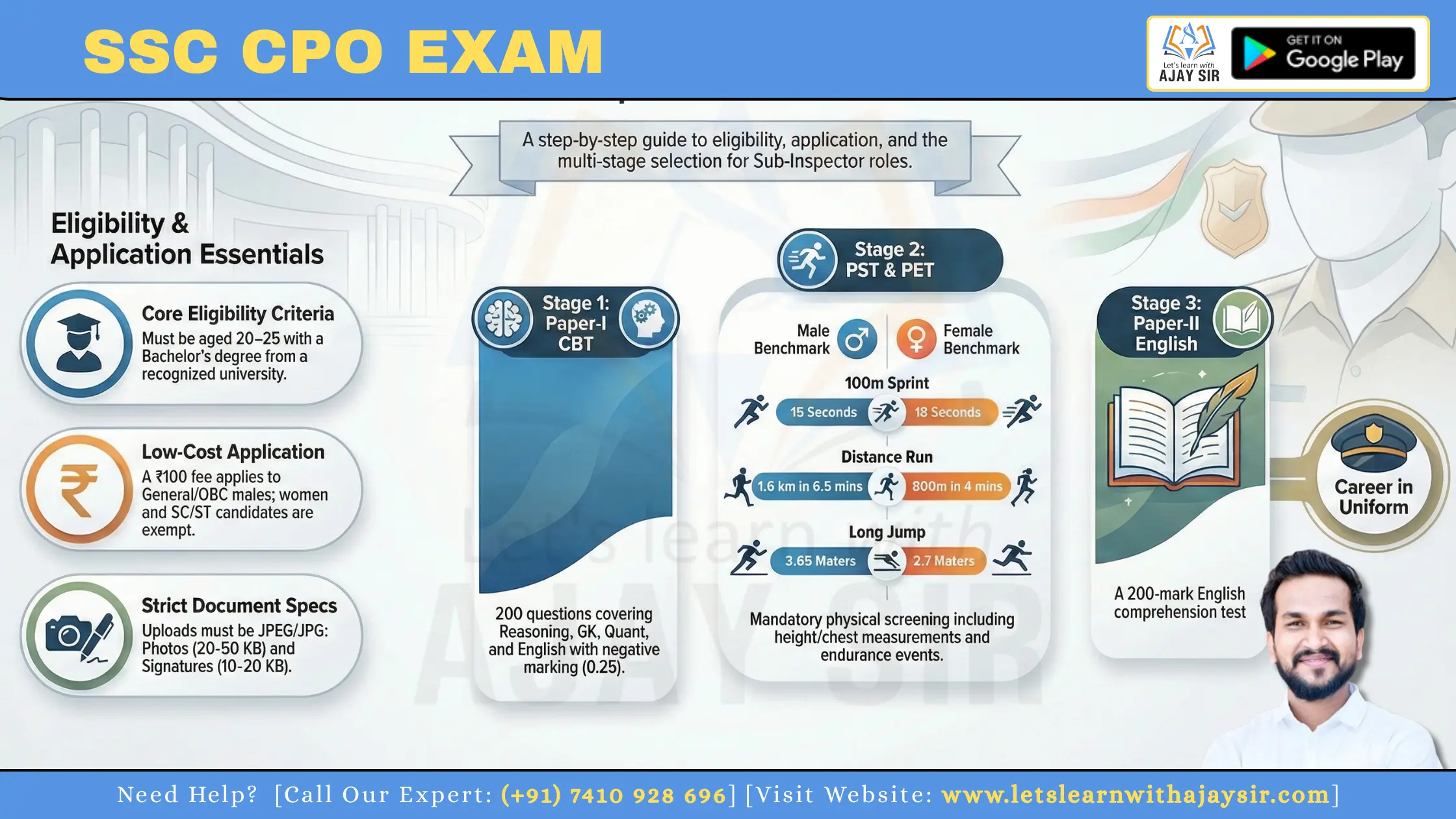
Application fee ₹100 (General/OBC males)
Typical exemptions Women, SC/ST, Ex-Servicemen
Payment modes UPI, net banking, credit/debit card
Timing tip Pay 24–48 hrs before last date

Eligibility Criteria

SSC CPO: Eligibility Criteria

Before you apply, confirm that you meet every eligibility point—nationality, age, and education—so you don't waste time or fees.

Nationality rules for Indian, Nepalese, and Bhutanese candidates

You must be an Indian citizen to apply directly. Candidates who are subjects of Nepal or Bhutan may be allowed only if you obtain a Government of India Certificate of Eligibility.

Keep the original certificate ready for document verification. Without it, your selection can be canceled even if you clear the examination.

Age limit baseline and reference date

The usual age range is 20 to 25 years. The exact date used to calculate age is set in the official notification, so check that reference date the moment the PDF is live.

Age relaxations for reserved categories will appear in the notification. Verify how the commission computes your age against the specified reference date.

Educational qualification and common edge cases

You need a bachelor’s degree from a recognized university or an equivalent qualification. Open and distance learning (ODL) degrees are accepted when recognized by the UGC.

If your degree is from a foreign university, you may need an equivalence certificate. If you're awaiting final year results, read the notification to see if conditional eligibility is permitted.

Quick eligibility proof checklist

  • Photo ID and proof of nationality (passport, voter ID).

  • Birth certificate or school leaving certificate to verify age.

  • Degree certificate or provisional certificate; ODL proof if applicable.

  • Certificate of Eligibility for Nepal/Bhutan candidates.

Criteria

What to keep ready

Why it matters

Nationality

Passport / Certificate of Eligibility

Validates right to appear in the selection

Age

Birth proof with the notified reference date

Determines application eligibility

Education

Degree / Provisional / Equivalence

Allows you to sit for the examination

SSC CPO: Age Relaxation Rules

Know exactly which categories get extra years so you can calculate your maximum eligible age quickly. The following breakdown helps you match your category to the correct upper-age benefit and avoid errors during the application process. Always keep documentary proof ready.

Standard category relaxations

Category

Relaxation (upper-age)

Notes

SC / ST

5 years

Provide caste certificate at verification

OBC

3 years

Non-creamy layer proof may be required

Ex-Servicemen

Up to 3 years*

*After deducting military service length from age; not a flat addition

Special-case relaxations and departmental rules

Widows, divorced women, and women judicially separated may get higher upper-age limits: UR up to 35 and SC/ST up to 40, where applicable. You must check whether this applies to your chosen post and supply legal documents.

For departmental candidates in Delhi Police, relaxations apply only with at least three years of regular service: UR up to 30, OBC up to 33, and SC/ST up to 35. Confirm service rules and proof requirements.

  • Tip: candidates must verify these details in the official notification before finalising the application.

  • Keep category and service certificates handy for document verification to avoid disqualification.

    SSC CPO: Physical Standards and PET/PST Requirements

    The PST (body measurements) checks height, chest, and weight, while the PET (physical efficiency test) measures speed, endurance, and explosive power. Both steps are qualifying; failing either disqualifies you even if you do well on the written examination.

    Height, chest, and weight overview

    Expect minimum height and chest standards that vary by gender and category. Exact numbers and any relaxations appear in the official PDF, so verify those details before you apply.

    PET events for male candidates and typical benchmarks

    Common events and sample targets you can train to are:

    • 100 m sprint — 16 seconds

    • 1.6 km run — 6.5 minutes

    • Long jump — 3.65 m

    • High jump — 1.2 m

    • Shot put — 4.5 m

    PET events for female candidates and typical benchmarks

    Typical female tests and sample benchmarks include:

    • 100 m sprint — 18 seconds

    • 800 m run — 4 minutes

    • Long jump — 2.7 m

    • High jump — 0.9 m

    Vision standards and medical fitness expectations

    Vision examples used by examiners include near vision N6/N9 and distant vision 6/6 and 6/9 without correction. These are indicative; the detailed medical examination (DME) assesses overall medical suitability beyond the PST/PET. DME checks chronic conditions, ENT, orthopedics, and general health.

    Training mindset and practical advice

    Start early and progress gradually. Aim to exceed benchmark targets so you reduce last-minute stress. Build a balanced routine: sprint drills, distance runs, plyometrics, and strength work for throws and jumps. Rest, nutrition, and injury prevention multiply your gains.

    Stage

    What it checks

    Why it matters

    PST

    Height, chest, weight

    Baseline eligibility for physical posts

    PET

    Speed, endurance, jumps, throws

    Qualifies you to move to medical stage

    DME

    Full medical fitness

    Final medical suitability for service

    Vacancy Details

    SSC CPO: Vacancy Details

    The commission releases vacancies only with the notification because those figures drive cut-offs and your priority choices. You can’t finalise a target strategy until you see the official counts.

    Past cycles and what they indicate

    Recent cycles showed large swings: one year had 3073 openings and another listed 4187. That trend points to a likely range of 3000+ vacancies this year but competition remains high.

    SSC CPO Exam 2026: Posts Details

    This section lists every post you can compete for and explains how preference choices shape your final posting.

    Sub-Inspector in Delhi Police (Executive)

    Role: The sub -inspector (Executive) in Delhi Police handles urban policing, investigations, and community duties. You will work in city beats, traffic units, or local investigation teams.

    Sub-Inspector (GD) in CAPFs

    Role: The sub -inspector (GD) posts include BSF, CISF, CRPF, ITBP, and SSB. These forces focus on border security, internal deployment, and specialized guarding duties. CAPF work often involves longer deployments and field postings compared with city police.

    Assistant Sub-Inspector (Executive) in CISF

    Role: ASI (Executive) in CISF manages security at airports, seaports, and industrial sites. The job mixes desk and field work and can include shift patterns and static guard duties.

    How preferences work: You usually choose post codes during document verification. The selection process assigns you based on your merit rank and the order you listed. That choice is binding, so treat it as final when filling preferences.

    Post

    Typical setting

    Key difference

    Sub -inspector (Delhi Police)

    Urban, local policing

    City duties and investigation focus

    Sub -inspector (GD) - CAPFs

    Borders, camps, field

    Frequent deployments; varied terrain

    ASI (Executive) - CISF

    Critical sites (airports, ports)

    Shift-based security; static posts


    Syllabus

    SSC CPO: Exam Pattern for Paper I

    Think of Paper I as four short exams in one session — each demands a different skill and a steady plan. The full paper has 200 questions for 200 marks, split evenly into four sections.

    General Intelligence and Reasoning

    This section tests logical ability, puzzles, series, and visual reasoning. Practice short, timed sets to build speed and spotting shortcuts.

    General Knowledge and General Awareness

    Expect static GK and current affairs focused on India. Prioritize national polity, awards, geography, and recent national events for best ROI.

    Quantitative Aptitude

    Questions range from arithmetic to basic algebra and geometry. Accuracy matters: tough problems can cost you time under the sectional timer.

    English Comprehension

    Focus on reading speed, grammar, and error spotting. This section rewards clear understanding and quick elimination of wrong choices.

    Marking scheme, sectional timing, and accuracy strategy

    Key rules: 200 Qs, 200 marks; 50 Qs per section; total time 2 hours. A sectional timer typically gives ~30 minutes per section. Wrong answer penalty: 0.25 marks per wrong response.

    Accuracy beats blind attempts — every wrong answer reduces your net score.

    • Attempt only questions you can solve reliably; avoid guesswork that risks negative marking.

    • Use mock tests to set a repeatable attempt plan: planned attempts per section, buffer time, and review slots.

    • Train pacing so you don't get stuck on one hard quant set; move on and return if time permits.

    Section

    Questions

    Marks

    Suggested time

    Reasoning

    50

    50

    30 minutes

    General Awareness

    50

    50

    30 minutes

    Quantitative Aptitude

    50

    50

    30 minutes

    English Comprehension

    50

    50

    30 minutes

    Use regular mock tests to track timing leaks and accuracy. Repeat the same attempt plan in every practice test until it becomes second nature.

    SSC CPO: Exam Pattern for Paper II

    Paper II is an objective, English-only test that can shift your final rank. It has 200 questions for 200 marks and lasts 2 hours. All items are MCQs, so you must manage speed and accuracy together.

    Questions, marks, duration, and negative marking

    The exam pattern is simple: 200 questions = 200 marks; time allowed = 120 minutes. Each wrong answer deducts 0.25 marks. Educated guessing must be controlled because repeated small penalties lower your net score.

    Why Paper II often becomes a rank-decider

    Many candidates attempt high numbers of questions in this paper. Small differences in accuracy create large rank swings. Clean attempts and disciplined time use often beat high but error-prone attempts.

    How to practice: previous year papers and mocks

    Use previous year question sets to learn recurring grammar traps, common vocabulary, and comprehension patterns. In mocks, track error types: grammar rules, vocabulary, and inference mistakes. Fix each category with focused drills.

    "Treat Paper II as precision work: fewer, accurate attempts beat many careless ones."

    Feature

    Detail

    Why it matters

    Structure

    200 Qs / 200 marks / 2 hrs

    Plan stamina and reading speed

    Marking

    -0.25 per wrong

    Limits blind guessing

    Practice

    Previous year papers + targeted mocks

    Reveals repeat patterns and weak spots


    SSC CPO: Syllabus Breakdown 

    Start by mapping Paper‑I areas—Reasoning, General Knowledge, Quant, and English—onto daily blocks. Use previous year papers and mocks to spot which topics repeat and carry more weight.

    Reasoning: prioritize speed and pattern recognition

    High-priority topics: series, analogy, coding‑decoding, syllogism, seating arrangement, and basic non‑verbal. Practice short timed sets of 10–15 questions to build speed.

    Train with puzzle drills and track time per question. Mark types that slow you down and focus on shortcut techniques.

    GK and current affairs: India‑focused coverage

    Balance static GK (constitution, polity, geography, awards) with monthly current affairs summaries. Maintain a one‑page sheet of 50 repeat facts from previous year papers and update it every month.

    Quant: high‑ROI topics and common traps

    Concentrate on percentages, ratio, profit & loss, SI/CI basics, time‑work, time‑distance, algebra, and data interpretation. Avoid getting stuck on long calculations; learn quick approximations and elimination tricks.

    English: Paper I vs Paper II approach

    For Paper I, build grammar accuracy and vocabulary with short daily drills. For Paper II, increase reading volume and full-length comprehension practice using previous year passages and focused mocks.

    Revision map to retain formulas, rules, and facts

    Create three compact revision aids: a quant formula sheet, a grammar rule sheet, and a GK facts list. Review each sheet twice weekly and test recall in short timed quizzes.

    Area

    Focus

    Weekly practice

    Reasoning

    Series, puzzles, syllogism

    5 short timed sets + 1 puzzle session

    General Knowledge

    Static facts + monthly current affairs

    Daily 20‑minute update + weekly revision

    Quantitative Aptitude

    Percent, ratio, DI, algebra

    Daily problem set + formula review

    English

    Grammar, vocab, comprehension

    Alternate day grammar drills + 2 comprehensions/week


    Salary

    SSC CPO: Salary and Job Profile

    Where you serve—city, border, or critical site—shapes both your monthly salary and on-duty role.

    Pay Level 6 and what affects take-home pay

    The basic pay band is Pay Level 6: ₹35,400–₹1,12,400. Your actual in-hand pay varies by Dearness Allowance (DA), House Rent Allowance (HRA), city classification, and force-specific perks.

    Transfers, hard‑area compensations, and tax rules also change monthly net pay.

    Role differences: delhi police, CAPFs, CISF

    In Delhi Police you’ll handle urban law, investigations, and community duties. CAPFs involve long deployments and field operations. CISF work centers on static security at airports, ports, and industrial sites.

    Allowances and benefits that typically apply

    • DA & HRA: major components of take-home pay.

    • TA/DA for travel and risk/hazard pay where applicable.

    • Dress, ration, and medical benefits; pension and gratuity later.

    These roles offer steady growth, defined promotions, and job stability that many candidates value long term.

    Aspect

    What to expect

    Impact

    Basic pay

    Pay Level 6 (₹35,400–₹1,12,400)

    Base for all allowances

    Posting

    City / Field / Critical sites

    Affects HRA, hardship pay

    Perks

    DA, HRA, TA, uniform/medical

    Raises in-hand and long-term benefits

    For final details, consult the staff selection commission notice for the year and confirm force-specific rules, fitness, and posting needs before you accept any offer.

    Selection Process

    SSC CPO: Selection Process

    Start by mapping the entire selection process so you always know which stage comes next and how to split your preparation time. This end-to-end view helps you balance written tests and fitness work simultaneously.

    Paper I CBT and what it tests

    The first exam tests Reasoning, General Knowledge/Current Affairs, Quantitative Aptitude, and English. Paper I acts as the main filter: a high score lets you move forward; a low score stops you early.

    PST/PET as a qualifying stage

    PST/PET is qualifying but critical. If you fail the physical tests, your written performance won’t count. Train for both standards and timing to avoid surprises.

    Paper II CBT focus area

    Paper II centers on English Language and Comprehension. This exam often decides final ranks, so sharpen reading, grammar, and writing accuracy.

    Detailed Medical Examination and document checks

    The DME validates medical fitness and scans records. Document verification confirms your age, category, and education.

    Tip: common delays arise from mismatched certificates, unclear photo ID, or pending degree proofs—prepare originals and copies in advance.

    Stage

    What it checks

    Impact

    Paper I

    Knowledge & aptitude

    Primary shortlist

    PST/PET

    Physical eligibility

    Qualifying — mandatory

    DME & Docs

    Medical fitness & records

    Final selection clearance


    How to Apply

    SSC CPO: How to Apply Online

    Use the official website to complete the entire process and keep calm as you work through each step.

    One-Time Registration on the SSC portal

    Begin with One-Time Registration (OTR). Create a login using a valid email and phone number, and note your registration ID. This saves time later and avoids login issues when traffic peaks.

    Filling the online application form and choosing exam centers

    Log in, open the application form, and enter personal and educational details carefully. Upload your photograph and signature in the asked format before moving to the next page.

    Choose exam centers wisely: pick nearby centers where travel is easy. That reduces stress on exam day and lowers the chance of missing the slot.

    Final submission, confirmation, and printing your form

    Review every field and preview your application form. Pay the fee if applicable, submit, and capture the registration/application number immediately.

    • No-mistakes checklist: verify name and DOB match your ID, pick correct category, confirm educational records, and double-check centre choices.

    • After submission, save a PDF of the confirmation page and payment receipt.

    • Keep copies handy for document verification and future reference.

    Step

    Action

    Why it matters

    OTR

    Create and save registration ID

    Prevents login issues during high traffic

    Preview & Pay

    Check details and complete payment

    Ensures successful submission

    Save Confirmation

    Download/print form and receipt

    Needed at document verification


    All Details

    SSC CPO: Photo and Signature Specifications

    Uploading correct images saves time and prevents rejection. Before you start the application form, prepare a clear recent photograph and a neat digital signature in the right format and size. Follow the portal rules closely to avoid last-minute compression errors or failed uploads.

    Accepted formats and size ranges for signature

    Format: JPEG / JPG only.

    Typical size: 10–20 KB for the signature image. Compress carefully so strokes stay legible.

    Photograph rules you should follow to avoid rejection

    Format: JPEG / JPG only. Typical size: 20–50 KB and taken within the last three months.

    Use a plain light background, face the camera directly, and avoid heavy accessories or tinted lenses. Blurry, dark, or outdated photos are common causes of rejection.

    Conclusion

    Finish strong: anchor every move to the official notification on ssc.gov.in as your single source of truth for dates, vacancies, fee rules, and the selection process.

    Follow the plan: track the notification, complete your online application correctly, and balance study for Paper I and Paper II with steady PST/PET and medical readiness.

    Quick checklist you can act on today: confirm eligibility, start previous year practice, add a regular mock routine, and build baseline fitness.

    Keep one rule firm: blend exam pattern awareness with consistent revision and strict negative-marking discipline. If you stay consistent and watch official dates, you can convert this national exam into a real police career outcome.

    FAQs

    The recruiting body is the Staff Selection Commission and the official PDF and updates appear on the SSC website ssc.gov.in. Always download the notification from that site and verify dates, eligibility, vacancy details, and application instructions before you apply.

    You’ll compete for Sub-Inspector (Executive) posts in Delhi Police, Sub-Inspector (GD) posts in CAPFs such as BSF, CISF, CRPF, ITBP, SSB, and Assistant Sub-Inspector (Executive) in CISF. During document verification you’ll submit preferences that determine force-wise allocation.

    Track the apply-online opening and last date, Paper I and Paper II windows, and timelines for admit card release, provisional answer key, and final result. Mark these on your calendar as soon as you download the official notification.

    The notification gives the age limit baseline and the reference date for calculation. Age relaxations for SC/ST, OBC, Ex-Servicemen, and other categories are listed in the document. Refer to the official rules to confirm applicable relaxations for your case.

    The notification and annexures specify height, chest, and weight norms plus PET events. Typical male and female benchmarks and vision standards are included. Prepare with targeted fitness training and get familiar with measurement and event formats.

    Complete One-Time Registration on the SSC portal, fill the online application carefully, choose exam centers in order of preference, upload photos and signatures per specs, pay the fee (if applicable), and print the confirmation page after final submission.

    The notification specifies the fee amount for general and OBC candidates and lists categories exempt from payment, such as SC/ST and certain others. It also states accepted online payment modes and the last date to remit fees — pay before the deadline to avoid rejection.

    The PDF details accepted formats (usually JPG/JPEG), pixel dimensions, and file size ranges for photographs and signatures. Follow the exact guidelines — incorrect files commonly cause application rejection or delays.

    The process starts with Paper I CBT, followed by PST/PET qualifying stages, Paper II CBT for those who qualify, and then a detailed medical exam and document verification. Each stage has minimum qualifying standards and merit-based advancement rules.

    Paper I is a CBT that tests General Intelligence & Reasoning, General Knowledge & Awareness, Quantitative Aptitude, and English Comprehension. The notification defines the number of questions, marks, time, and negative marking scheme — plan accuracy and sectional time management accordingly.

    Paper II focuses on English language and comprehension. It usually influences final ranking for select posts, so strong reading, grammar, and comprehension skills help you retain or improve your position in merit lists.

    Selected candidates typically join at Pay Level 6 (details in the notification) with allowances that affect take-home pay. Duties differ across Delhi Police, CAPFs, and CISF; the job often includes field postings, law enforcement tasks, and career progression opportunities.

    Welcome to Let's Learn with Ajay Sir — Your trusted platform for mastering English Grammar and Literature. We are dedicated to providing high-quality educational content, insightful articles, interactive quizzes, and the latest exam updates to empower learners at every level. Join us on this enriching journey toward academic excellence and lifelong learning.