• NEED HELP? TALK TO A COUNSELLOR: 7410928696

SSC CHSL

Category: SSC Exams

Over 2.5 million candidates check the official portal within days of a calendar release, turning a single PDF into a nationwide planning sprint.

This guide is organized so you can jump to dates, application steps, cut-offs, or salary details without wading through rumors. You’ll learn what the CHSL exam structure means for a 12th-pass aspirant aiming for stable Group C jobs across India.

Key Takeaways

  • Trust official sources—primary updates appear on ssc.gov.in.

  • Know the two-tier flow: Tier 1 screens; Tier 2 and skill tests decide final merit.

  • Check eligibility and avoid common application mistakes before you apply.

  • Prioritize timed mock tests and PYQs to build speed and accuracy.

  • Track the exam calendar release dates to catch notifications early.

Quick Overview

SSC CHSL: Overview

The Staff Selection Commission Combined Higher Secondary Level Exam recruits candidates for Group C posts at the higher secondary level. It runs once a year and reaches candidates nationwide.

What it stands for and who conducts it

The full name spells out the target: combined higher secondary entry for central services. The selection commission manages the process—notification, admit card, answer key, and results—so you always watch the official portal.

Posts you can target

You can apply for roles like lower divisional clerk, junior secretariat assistant, and data entry operator posts, including DEO Grade A. Post preference matters during allocation, so rank choices carefully.

Exam mode, frequency, and languages

The exam is a national-level, online CBT held yearly. You can choose English or Hindi as your paper language. Pick the language that keeps your pace and accuracy steady during timed sections.

Why this is a top 12th-pass government exam

This exam suits higher secondary level candidates who want steady pay, clear promotion paths, and transfers across departments. Competition is tough; focused practice beats collecting too many books.

Feature

Details

Who it suits

Tip

Exam type

Online CBT, national-level

12th-pass candidates

Practice full-length mock tests

Conducting body

Staff Selection Commission

All applicants

Follow official portal for updates

Key posts

LDC, JSA, DEO, DEO Grade A

Clerical & data roles

Prioritize post preference wisely

Languages

English, Hindi

Regional candidates

Choose the language you read fastest

Application Fee

General/Unreserved applicants ₹100
SC/ST, PwBD, ex‑servicemen, and women candidates Fee exemptions
Payment Modes UPI, debit/credit cards, and net banking

Eligibility Criteria

SSC CHSL: Eligibility Criteria

Confirming your eligibility early saves stress and keeps your documents organized. Match your profile to the official rules before applying so you avoid last-minute surprises at verification.

Nationality rules you must meet

You must be an Indian citizen, or a subject of Nepal or Bhutan. Persons of Indian Origin who migrated from specified countries may also apply but must provide migration and residence proof.

Educational qualification for LDC/JSA vs DEO posts

For most clerical posts you need to be higher secondary (12th pass) from a recognized board.

Data entry operator / entry operator: DEO and DEO Grade A usually require 12th pass too, but some departments insist on a Science stream with Mathematics at Class 12.

Special requirement for DEO in specific departments

If you target a data entry operator post in specified ministries, you must show Class 12 Science with Mathematics. This is checked at document verification, so keep originals ready.

Age limit you need to fit into

The basic age range is 18–27 years. The commission calculates age using the cut-off date listed in the official notification; use that date to confirm your SSC CHSL age eligibility.

Age relaxation categories and what they mean for you

  • SC/ST: +5 years

  • OBC (Non‑Creamy Layer): +3 years

  • PwD: varies (commonly up to 10/13/15 years depending on category)

  • Ex‑servicemen and J&K domicile: specified relaxations apply

"Match every claim with the proper certificate before you submit — that one step avoids most disqualifications."

Requirement

Typical rule

What you must do

Nationality

Indian/Nepal/Bhutan/PIO

Keep passport/migration proof

Education

12th pass; DEO may need Science+Maths

Upload mark sheet and certificate

Age

18–27 yrs; relaxations apply

Provide DOB proof and category certificates

Vacancy Details

SSC CHSL: Vacancy 

Vacancy trends give a clearer view of competition than headlines about "easy" or "hard" exams. Early updates list the total seats as TBA because department-wise requisitions and post allocations are finalized close to the official notification.

Why numbers show as TBA first

Post-wise details arrive after ministries confirm needs. That delay explains the TBA tag in preliminary notices.

Using the previous cycle as a reference

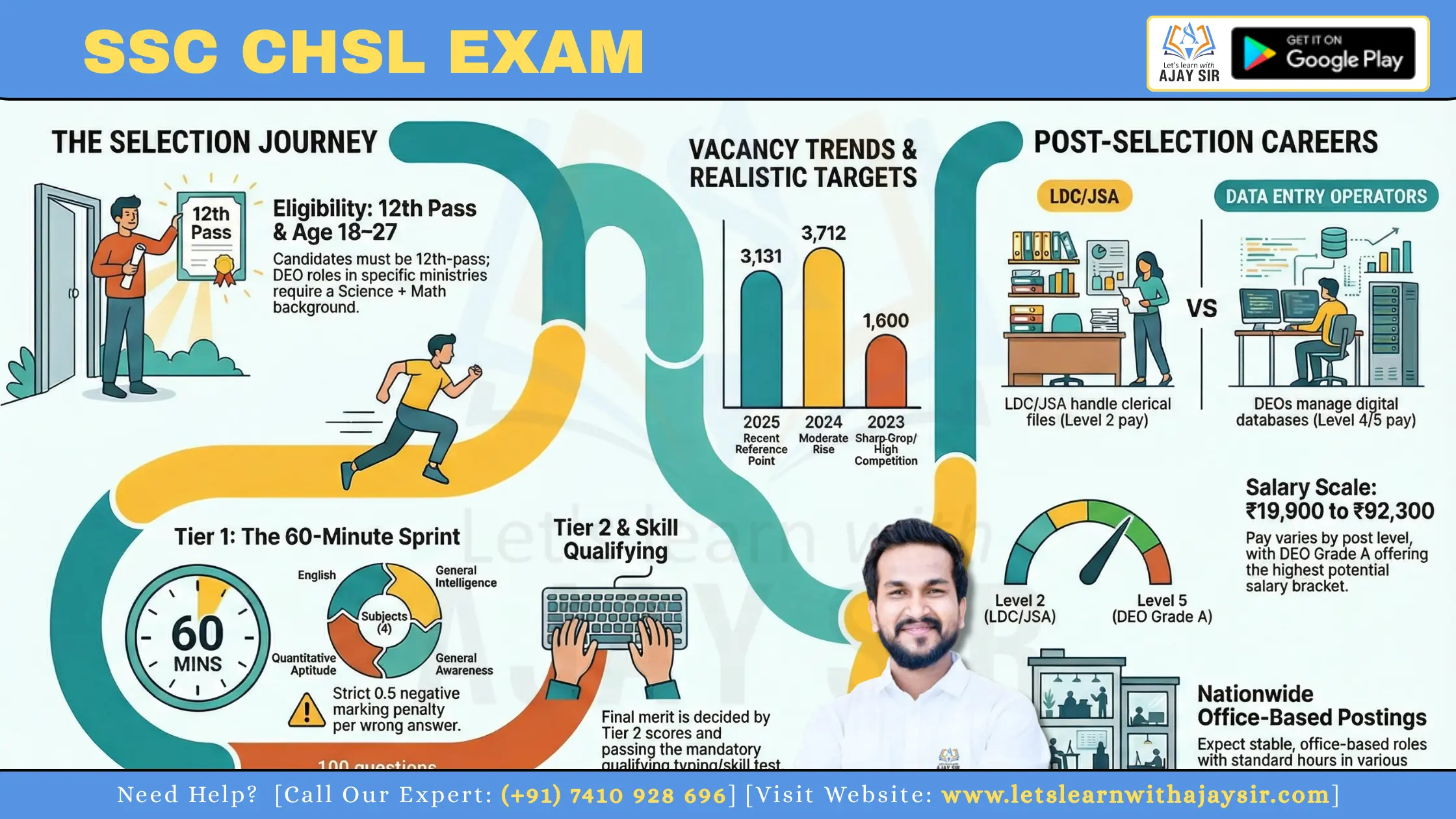
Use the 2025 total of 3,131 vacancies as a practical benchmark when you plan. It helps set realistic score targets and attempt strategy.

How vacancy volume shifts cut-offs and pressure

Fewer seats usually raise cut-offs; more seats can ease them slightly. Candidate volume matters more than seat count, so prepare without relying on rumors.

  • Final vacancy numbers appear in the official notification PDF and follow-up notices.

  • Set score targets based on accuracy and timed attempts, not vacancy guesses.

Year

Total vacancies

Trend note

What it means for you

2025

3,131

Recent reference point

Use for realistic goal-setting

2024

3,712

Moderate rise

Cut-offs may vary by year

2023

1,600

Sharp drop

Higher competition

2022

4,726

Large intake

Possible lower cut-offs

2021

4,893

Stable high

Better chances if you score well

2020

5,789

Elevated vacancies

More openings across posts

2019

6,789

Peak in this range

Lower pressure historically

Syllabus

SSC CHSL: Exam pattern for Tier 1 and Tier 2

Below you’ll find how the CHSL exam pattern is structured for each stage and what matters most when you practice.

Tier 1: layout, marks, and timing

Tier 1 contains 100 objective questions worth 200 marks total. You have 60 minutes to complete four sections: English, General Intelligence/Reasoning, Quantitative Aptitude, and General Awareness.

Each section has 25 questions. The strict 60‑minute clock means you must time yourself on full-length tests to build real pacing.

Tier 1 negative marking and attempt strategy

Every wrong answer in Tier 1 costs 0.5 marks. This half-mark penalty changes how you guess.

  • Skip low-confidence options to protect accuracy.

  • Attempt high-probability guesses only after quick elimination.

  • Use sectional timing: keep a 10–15 minutes buffer for review if possible.

Tier 2: modules and scoring basics

Tier 2 has objective modules across Mathematical Abilities, Reasoning, English, and General Awareness. Sections 1–3 usually carry negative marking of 1 mark for each wrong answer, so accuracy is more costly here.

Treat Tier 2 as a mix of concept clarity and speed. It decides final merit more than Tier 1 for many posts, so focus on depth and timed practice.

Computer Knowledge and skill/typing test

The Computer Knowledge module matters most if you aim for DEO or similar roles. It checks practical software and basic IT awareness.

The skill test or typing test is qualifying. You must clear it even if your MCQ scores are strong. Evaluation follows official rules and can be precise to decimal points in scoring for timed/accuracy metrics.

"Practice like the test: match timing, respect penalties, and treat the skill test as a separate qualifying gate."

Stage

Questions / Marks

Time

Key penalty

Tier 1

100 Q / 200 marks

60 minutes

-0.5 per wrong

Tier 2

Objective modules (Math, Reasoning, English, GK)

As per session schedule

-1 per wrong in Sections 1–3

Computer Knowledge

Module-based questions

Included in Tier 2 session

No separate negative rule beyond module norms

Skill / Typing Test

Qualifying only

Timed practical test

Must be cleared; scoring can affect final eligibility

SSC CHSL: Syllabus

Start by mapping the exact subject list so every study hour converts into marks. Follow the official subjects and avoid side topics that waste time.

Tier 1 subjects to prioritise

Tier 1 tests four areas: English Language, General Intelligence, Quantitative Aptitude, and General Awareness. Build a balanced plan so no single section becomes a cutoff risk.

Tip: daily short drills in English comprehension and reasoning boost accuracy more than long, unfocused sessions.

Tier 2 modules and focus

Tier 2 moves deeper: Mathematical Abilities, Reasoning and General Intelligence, English Language and Comprehension, General Awareness, and Computer Knowledge.

Math and reasoning need stronger concept clarity and speed. Treat them like problem sets you time daily.

Aligning syllabus with mocks and PYQs

Use mock tests and previous year questions to convert coverage into marks. Follow a weekly loop: attempt → analyse → revise → retest.

  • Follow the official subject list so you only study what the exam tests.

  • Integrate short daily computer drills if you aim for data entry roles.

  • Focus GA on high‑yield static facts plus two weekly current affairs review sessions.

Area

Primary action

Weekly goal

English

Comprehension + grammar drills

5 passages

Quant/Math

Concept practice + timed sets

10 problem sets

Reasoning

Pattern practice

30 mins daily

Salary

SSC CHSL: Salary and Job profile

Once you clear the selection, pay bands and role duties give you a clear view of daily life and career steps.

Salary ranges and how pay differs by post

Lower divisional clerk / Junior Secretariat Assistant: pay band ₹19,900–₹63,200 (Level 2).

Data entry operator / Entry operator: typical CHSL salary ranges from ₹25,500–₹81,100 (Level 4) and up to ₹29,200–₹92,300 (Level 5) for some posts.

Typical responsibilities

LDC/JSA work is clerical: file handling, drafting simple letters, and routine office coordination. You will support supervisors and manage records.

DEO roles focus on structured data entry, maintaining databases, and ensuring accuracy in digital records. Good typing and basic IT skills matter here.

Posting expectations and work environment

Posts can be anywhere in India. Expect office-based roles with standard hours and predictable workloads rather than field duties.

"Match your post preference to your strengths: choose clerical work if you like admin tasks; choose data roles if you prefer computer-based work."

Role

Pay Range

Core duties

Posting

Lower divisional clerk / JSA

₹19,900–₹63,200

File work, drafting, receipts, coordination

Across India; office-based

Data entry operator (DEO)

₹25,500–₹81,100 (Level-4); ₹29,200–₹92,300 (Level-5)

Typing, database updates, record maintenance

Department-specific; may require relocation

DEO Grade A

₹25,500–₹81,100

Higher responsibility in data management

Often urban offices with IT systems

Selection Process

SSC CHSL: Selection Process

The CHSL selection process runs in clear phases: Tier 1 → Tier 2 → Document Verification. Each stage has its own cut-off and you must clear every stage to move on.

Note: the skill or typing test is qualifying. A weak performance there can stop final selection even if your written scores are strong.

"Match your target to last cycle’s cut-off, then add a safety margin—aim higher to account for normalization and shift variance."

Stage

What decides shortlisting

What you must do

Tier 1

Raw score with -0.5 negative marking; cut-off applied

Focus accuracy and speed; clear qualifying %

Tier 2

Deeper scoring; higher weight for merit

Keep Tier 2 prep ongoing while attempting Tier 1

Document Verification

Eligibility verification; final merit confirms post allotment

Carry originals and valid proofs

Strategy tip: aim above last year’s cut-off range, protect accuracy under negative marking, and maintain Tier 2 readiness. That approach helps you pass each level of the CHSL selection process and improves chances during final merit and post allocation.

How to Apply

SSC CHSL: How to Apply online

A clean, accurate application is the first step toward a smooth exam journey. Start on time and use official channels so you avoid fake portals and delays.

Where to apply

Apply only via the official website or the MySSC mobile app. These two routes are the authorised portals for the CHSL application process.

One-time registration essentials and common mistakes

Complete the one-time registration (OTR) carefully. Make sure your name, date of birth, and contact details match your certificates exactly.

  • Avoid mismatched DOB or wrong category selection.

  • Use clear, recent photos and a legible signature to prevent rejection.

  • Choose exam centres sensibly; early applicants get better options.

Documents to keep ready

Before you start, gather a passport photo, scanned signature, Aadhaar or other valid photo ID, and your 10th/12th certificates.

Candidates must also have category or PwBD proofs ready if applicable.

How to download and save your submitted application copy

After payment and final submit, use the confirmation page to download SSC CHSL application copy and payment receipt. Save the PDF and note your registration number, email, and phone used.

Step

Action

Why it matters

Register OTR

Enter accurate personal details

Used for admit card and login

Upload files

Photo, signature, ID, certificates

Prevents rejection at verification

Download copy

Save PDF and receipt

Proof for future queries

All Details

SSC CHSL Exam Notification

The SSC Exam Calendar was published on January 9, 2026, and the expected CHSL notification month is April 2026.

Where to read the official notification first

Always check the official website to download the official notification PDF. The notification PDF is released on ssc.gov.in. Bookmark that page and set alerts so you get the notice the moment it goes live.


SSC CHSL: Exam centers and admit card details

Picking the right centre and having the correct admit card are small steps that prevent big problems on your exam day. Read these practical rules so you arrive calm, on time, and fully prepared.

How to choose exam centre preferences while applying

You can select three exam centre preferences during application. Apply early—early submission improves your chance of getting a preferred centre.

Pick centres based on travel time, transport reliability, and past allotment patterns. Once the commission allocates a centre, you generally cannot change it, so choose sensibly.

When admit cards are typically released and where to download

Admit cards usually appear at least a week before the exam date. Download your admit card from the official website or the regional portals linked from the main site.

Check the admit card details immediately. If anything looks wrong, contact the regional helpdesk listed on the portal without delay.

ID proof and exam-day checklist to avoid last-minute issues

Candidates must carry the printed admit card, a valid photo ID with DOB, and two recent passport-size photographs.

SSC CHSL: Answer key, question paper, and result

Knowing what comes next after the paper helps you turn uncertainty into simple steps. The commission posts the question paper and a provisional answer key on the official website shortly after exams. Save these files right away.

Estimate your score fast

Match your answers to the provisional key to get a raw score. Remember to apply negative marking when you calculate; this gives a realistic estimate of where you stand.

Challenge process and fee

If you spot an error, you can raise an objection during the challenge window. Each challenge costs ₹100, so pick only well‑supported items.

Result PDF and shortlist checks

Final results published as PDF lists on the official website. You don’t need a login to view the CHSL result PDF; use your roll or registration number to confirm if you’re shortlisted.

Normalization and next steps

When exams run in multiple shifts, normalization adjusts marks to equalize difficulty. That can change your estimated score.

Stage

What you get

Fee

Action for you

Provisional key

Question paper + answers

Free

Estimate raw score

Challenge window

Submit objections

₹100 per challenge

Challenge only valid disputes

Final key

Reviewed answers

Free

Recalculate score

Result PDF

Shortlist list by roll no.

Free

Check roll/registration number

SSC CHSL: Cut off, Qualifying marks

Find the official cut-offs early and you can shape a realistic target for every tier exam. The selection commission publishes cut-off lists with result PDFs on ssc.gov.in and on regional portals. Download the result notice to see both the provisional and final cut-off sheets.

Where cut-offs appear and when

Cut-offs are released alongside result notifications on the official site and regional SSC pages. Expect them the same day results go live, so check the PDF linked to the merit list.

Qualifying marks you should target

Understand the difference: qualifying marks are minimum percentage thresholds; cut-off marks are the actual scores used to shortlist candidates.

  • UR: 30% qualifying mark

  • OBC/EWS: 25% qualifying mark

Others: 20% qualifying mark


Conclusion

Close this guide with a clear three‑step action plan to keep your preparation focused and measurable.

Do these now: track the April official notification on ssc.gov.in, validate your eligibility, and begin Tier 1 + Tier 2 prep in parallel.

Follow the priority: concept building → previous year questions → full mocks → analysis. Respect high‑impact rules: negative marking, short correction windows, and the qualifying skill/typing modules.

Monitor the site for the notification PDF, application link, fee deadlines, admit card release, provisional answer key, result PDF, and cut-offs.

Success looks like disciplined execution: accurate attempts, steady weekly routines, and consistent revision until final selection in SSC CHSL 2026.

Important Links

SSC Official Website Visit

FAQs

The combined higher secondary level exam is conducted by the Staff Selection Commission, a central government body that recruits for various lower division clerk, junior secretariat assistant, and data entry operator posts across departments.

You can apply for Lower Divisional Clerk (LDC), Junior Secretariat Assistant (JSA), Data Entry Operator (DEO) and DEO Grade A roles. Each post has its own skill-test or typing requirements, so pick the post that matches your strengths.

The exam is primarily computer-based for Tier 1 and Tier 2. It’s usually held annually. Question papers are available in multiple languages as listed in the official notification; check the notice for your preferred medium.

It targets candidates with higher secondary qualifications and offers stable central government jobs, clear promotion paths, decent pay scales, and nationwide postings—making it a popular option after class 12.

The notification month varies each year; you should rely on the Staff Selection Commission’s official website and the annual calendar for the exact PDF and updates.

Use the annual calendar to note application windows, exam months, and result timelines. Backward-plan study blocks, mock tests, and document readiness to align with those dates.

Tier 1 is generally scheduled a few weeks to months after the application window closes. Exact dates are in the official notification and the admit card announcement.

Application windows often span two to four weeks. You’ll see the exact start and last dates in the notification; apply early to avoid last-minute server issues.

You must be an Indian citizen or otherwise meet nationality criteria specified in the official notification, such as certain categories of subjects or domicile as allowed by law

LDC and JSA typically require higher secondary (12th) pass from a recognized board. DEO posts also require 12th pass but may ask for specific computer knowledge or a diploma in computer applications for some departments.

Yes. Some departments require a speed test on data entry software, a basic computer course certificate, or prior experience. Check the post-wise details in the notification.

The notification specifies minimum and maximum age limits for each post. Typically, age ranges align with administrative service rules; verify the exact limits and calculation date in the official document.

Apply via the Staff Selection Commission’s official website and the MySSC mobile app when available. Use the official portal to submit forms, fees, and updates securely.

Complete one-time registration with accurate personal details, scanned documents, and a reliable email/phone. Avoid mismatched names, incorrect DOB, and poor-quality scanned files to prevent rejection.

Keep your class 12 certificate, photo, signature, ID proof, and caste/medical certificates (if applicable) ready. Having them in the required size and format speeds up the process.

Tier 1 typically includes sections like General Intelligence & Reasoning, English Language, Quantitative Aptitude, and General Awareness. The notification lists total questions, marks per section, and exam duration.

Carry the printed admit card, a government-issued photo ID (Aadhar, passport, driver’s license), and required stationery. Arrive early and follow the dress and item rules listed in the admit card instructions.

After the exam, compare your responses with the official answer key to calculate raw scores. Apply the negative marking rule to estimate your net score and get a realistic idea of your standing.

The commission usually allows candidates to raise objections against answer keys within a specified window for a fee per question. The notification and answer-key page specify the objection fee and procedure.

Results and merit lists are published as PDFs on the official website. Search for your roll number or name in the PDF; follow the instructions for further stages if you’re shortlisted.

Normalization adjusts scores across different shifts to account for varying difficulty levels. Your raw marks may be converted to a normalized score for fair ranking.

Cut-offs are published on the official website alongside results or shortly after. They vary by post, category, and year; check the notification and result announcements for exact timing.

Target marks above previous-year cut-offs for your category to increase selection chances. Earlier cycle cut-offs give a good reference; aim comfortably higher to account for competition.

The typical stages are Tier 1 CBT, Tier 2 CBT (if applicable), skill/typing test for qualifying posts, and document verification before final appointment.

Pay ranges depend on pay commissions and grade pay; lower division clerks and junior assistants usually fall into comparable pay bands, while DEO pay may vary by department and grade.

LDC and JSA roles include record keeping, file management, and clerical tasks. DEO roles focus on data entry, database maintenance, and basic computer operations.

Posting can be anywhere in India depending on department needs. Work environments are generally office-based with standard government working hours and transfer/posting norms.

Welcome to Let's Learn with Ajay Sir — Your trusted platform for mastering English Grammar and Literature. We are dedicated to providing high-quality educational content, insightful articles, interactive quizzes, and the latest exam updates to empower learners at every level. Join us on this enriching journey toward academic excellence and lifelong learning.