Syllabus
SSC CGL: Exam pattern
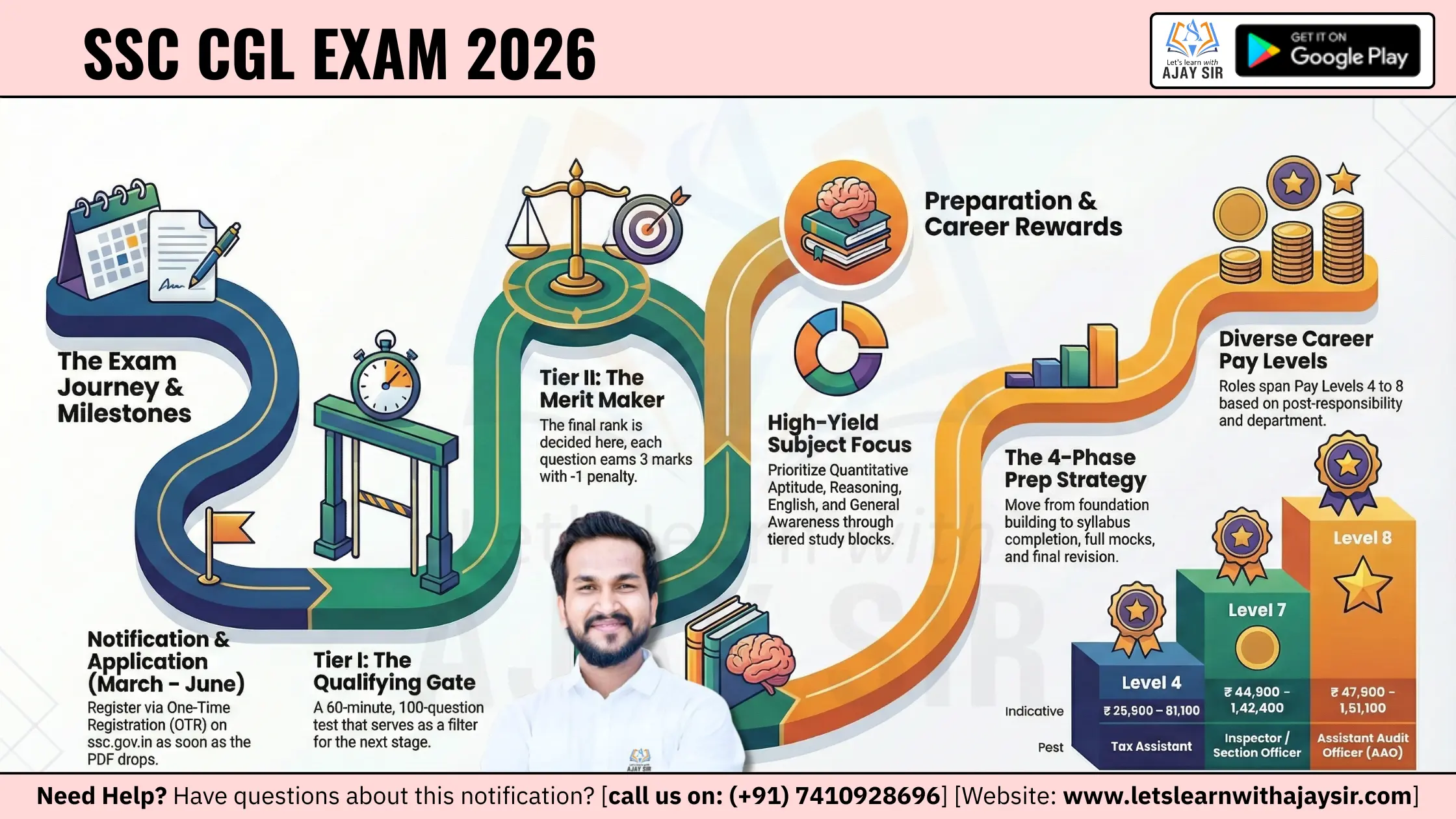
Knowing how many questions and how marks are distributed gives you a strong exam-day edge. The overall exam pattern splits into a fast, high-volume Tier I and a more detailed Tier II, where marks decide merit.
Tier I: subjects, questions, and time strategy
Tier I is 100 questions to solve in 60 minutes in CBT format. You must balance speed and accuracy under tight time pressure.
Focus on quick wins: answer easier questions first, flag medium ones, and leave only hard items for the last pass. Use timed sectional drills in prep to hit the target pace.

Tier II Paper-I: section breakdown and scoring
Paper-I (merit) contains four main modules. Each question carries 3 marks.
Section | Questions | Marks per question |
Mathematical Abilities | 30 | 3 |
Reasoning | 30 | 3 |
English Language | 45 | 3 |
General Awareness | 25 | 3 |
Computer Knowledge is also present as 20 questions in some sittings, and DEST is a qualifying skill test for certain posts.
Paper-II and Paper-III: role-specific notes
Paper-II (Statistics) applies only if you target JSO roles. Decide early so you can allocate study time for statistical theory and practice questions.
Paper-III (Finance & Economics) is for AAO and accounts-focused posts. If you pick that track, shift some prep to accounting principles and applied economics.
Negative marking and accuracy targets
Tier II uses -1 for each wrong answer. With 3 marks per correct response, aim for 75–80% accuracy in mocks.
"Work pace, section order, and disciplined guessing will raise your net marks more than raw speed."

SSC CGL: Syllabus
Start by mapping the syllabus into tiers, so you know which topics repeat and which need deeper study. This saves you time and keeps your study focused.

General Intelligence and Reasoning
High-yield areas: classification, analogy, series, coding‑decoding, and non‑verbal reasoning. Practice timed sets to build speed and pattern recognition.
Quantitative Aptitude and Mathematical Abilities
Prioritize basics first: percentages, ratios, simple interest, and data interpretation (DI). Then layer in mensuration, algebra, geometry, and trigonometry for Tier II depth.
English Language and Comprehension
Mix grammar drills with daily reading. Focus on error spotting, vocabulary in context, and comprehension practice to improve accuracy and reading speed.
General Awareness
Split GK into static topics (history, geography, culture, science) and current affairs. Cover roughly the last six to nine months for current events and revise with weekly notes.
Computer Knowledge (Tier II)
Cover MS Office basics, hardware, networking, and cybersecurity fundamentals. This module is qualifying but easy to score with focused revision.
"Map the tiers, practice the high-yield topics, then use mocks to convert weak areas into strengths."