• NEED HELP? TALK TO A COUNSELLOR: 7410928696

SBI PO

Category: Banking Exams

Did you know: over one million applications are expected for this national recruitment test, making it one of the most competitive entry routes into Indian banking.

This guide is written for you — a serious candidate who wants a clear, step‑by‑step roadmap. You will find a simple plan that shows what to do at each stage, why it matters for your score, and how to avoid common mistakes.

We break down the multi‑stage structure — Prelims, Mains and interview‑related stages — and explain how your preparation must change for each phase. You will also get the essentials up front: eligibility checks, application tips, test pattern details and important dates to watch.

Practical advice covers centre selection, document uploads and mock planning so your application and prep stay error‑free. We close with clear, plain explanations of salary, benefits and career growth so you can decide if this path fits your goals in banking.

Key Takeaways

  • You’ll get a clear, stage‑wise roadmap for success.

  • Understand how Prelims, Mains and interview stages differ.

  • Check eligibility and apply correctly to avoid surprises.

  • Follow practical tips on centres, documents and mocks.

  • See salary and career growth explained in simple terms.

Quick Overview

SBI PO: overview for you

Start here: a clear snapshot of the probationary officer role and why it matters for your career in banking.

What the probationary officer role means

What the Probationary Officer role means at State Bank of India

The post is a managerial-track position where you learn operations, credit and branch leadership. During the two‑year probation period you train, rotate across functions and build skills that shape your officer career.

Why the sbi exam attracts lakhs of candidates every year

Job stability, national prestige and a structured training system draw candidates in large numbers each year. Starting basic pay and allowances make the role financially appealing too.

Key highlights at a glance

Below are the essential facts you should note before you plan.

  • Organisation: State Bank of India

  • Post: Probationary Officer

  • Application: Online; Exam level: National

  • Probation period: 2 years; Job location: Across India

  • Starting basic pay: ₹48,480

Feature

Detail

What it means for you

Mode

Online national test

Prepare for computer‑based timing and accuracy

Mobility

Posting across India

Expect transfers; develop flexibility and planning

Career path

Managerial track

Focus on communication, leadership and problem‑solving

Selection focus

Mains + interview stages

Work on subject depth and interpersonal skills

Application Fee

Application fee [General / EWS / OBC] ₹750
Fee exemption [SC / ST / PwD] Nil
Payment modes Debit/Credit/NetBanking

Eligibility Criteria

SBI eligibility criteria for SBI PO 2026

Start with a quick eligibility check to confirm you meet the basic academic and age requirements. Follow this checklist before you begin the application process so you don’t waste time on a form you cannot submit.

Educational qualification

You need a graduation degree in any discipline from a recognised university or an equivalent qualification. Final‑year or final‑semester students may apply, provided they can produce proof of graduation by the interview stage.

Nationality and certificates

You must be an Indian citizen or fall under permitted categories (Nepal, Bhutan, certain Tibetan refugees or PIOs). Candidates from some categories must obtain a Government of India eligibility certificate before applying.

Age limit and date‑of‑birth window

The standard age limit is 21–30 years. For reference, a typical DOB window is 2 April 1995 to 1 April 2004. Confirm the final dates in the official notification so you do not miscalculate your eligibility by days.

Category‑wise age relaxation

Upper age relaxations typically apply as follows:

  • OBC‑NCL: +3 years

  • SC/ST: +5 years

  • PwBD: UR/EWS +10, OBC +13, SC/ST +15 years

  • Ex‑servicemen: +5 years in certain cases

Number of attempts

Normal attempt rules often are: UR and EWS — four attempts; OBC and some PwBD variants — seven attempts; SC/ST — no limit. Note an important detail: appearing only in prelims does not count as an attempt, but appearing in mains does.

Quick eligibility self‑audit: graduation proof, correct DOB, category certificate (if applicable), and attempt count. If all match, proceed with confidence.

Vacancy Details

SBI PO vacancy 2026: what to expect

Expect vacancy numbers to shape how fiercely you must prepare this recruitment cycle. Vacancy estimates set the scene for competition and shortlist ratios. Treat published numbers as authoritative only once the official notification appears.

Expected range for vacancies

The likely range discussed by analysts is 400–500 vacancies, to be confirmed in the notification. This gives you a realistic benchmark for planning the intensity of your revision and mock schedule.

How regular vs backlog vacancies affect cut-offs

Regular and backlog vacancies split category-wise. Backlog seats can tighten cut-offs in specific reserved categories, because more candidates in those groups compete for the same slots.

What last year’s volume suggests about competition

Last year’s total was 541 (500 regular + 41 backlog). That higher tally eased some pressure, but you must not assume a repeat. Cut-offs move with vacancy count, test difficulty and candidate performance.

Practical takeaways:

  • Focus on maximising marks rather than betting on predictions.

  • Check the notification PDF’s vacancy tables and read category splits carefully before applying.

  • Use vacancy range to set realistic goals for prelims-to‑mains and mains‑to‑interview ratios.

Item

2025 reference

Expected 2026 range

What you should do

Total vacancies

541 (500 regular + 41 backlog)

400–500 (estimated)

Plan for stiffer competition; keep score targets high

Reserved categories impact

Backlog altered category-wise seat counts

Similar effect if backlog appears again

Read category splits in the notification; adjust target cut-offs

Shortlisting ratios

Varied by stage and vacancy

Will depend on final vacancy table in notification

Prepare for tight prelims shortlisting; focus on speed and accuracy

Syllabus

SBI PO prelims exam pattern and marking scheme

Get a clear breakdown of sections, timings and penalties to refine your attempt plan. Knowing the exact structure helps you practise with purpose and avoid surprises on test day.

Sections, questions, marks and timings

The prelims paper has 100 questions for 100 marks to be completed in 60 minutes. There are three timed sections with strict 20‑minute windows.

  • English Language: 40 questions, 40 marks, 20 minutes.

  • Quantitative Aptitude: 30 questions, 30 marks, 20 minutes.

  • Reasoning Ability: 30 questions, 30 marks, 20 minutes.

Negative marking and attempt strategy

For each wrong answer you lose 0.25 marks. There is no penalty for unattempted questions, so guessing risks losing net marks.

Adjust your attempt strategy:

  • Respect sectional timers; practise full 20‑minute blocks for each part.

  • Prioritise accuracy in Quant and reasoning puzzles; avoid wild guesses.

  • Use English speed to secure easy marks quickly and build confidence.

Item

Detail

Why it matters

Total

100 Q / 100 marks / 60 min

Practice both speed and accuracy

Sectional timing

Three sections × 20 min each

Limits time shifting; train per section

Negative marking

-0.25 per wrong answer

Influences guess strategy and cut-offs

Tip for candidates: treat the prelims exam as qualifying. Focus on clearing sectional and overall cut‑offs comfortably to preserve momentum for mains preparation.

SBI PO mains exam pattern: objective + descriptive

The mains stage is where depth, timing and polished answers decide who progresses to the final shortlist. You face an objective paper followed by a descriptive test. Both parts matter: objective marks are heavy, and the descriptive section is qualifying but carries separate marks.

Objective paper breakdown

The objective test totals 170 questions for 200 marks across 3 hours. Sections have fixed timings and sectional cut-offs.

  • Reasoning & Computer Aptitude: 40 Q / 60 marks / 50 minutes

  • Data Analysis & Interpretation: 30 Q / 60 marks / 45 minutes

  • General Awareness / Economy / Banking: 60 Q / 60 marks / 45 minutes

  • English Language: 40 Q / 20 marks / 40 minutes

Descriptive paper tasks

The descriptive test is 50 marks and lasts 30 minutes. Typical tasks are:

  • Email drafting with a professional tone

  • Banking‑style report writing and data interpretation

  • Precis writing to show concise thought

  • Situation analysis requiring structured recommendations

Write as a banking professional: be clear, formal and solution‑oriented to score well here.

Sectional timing and cut-off expectations you should prepare for

Strict sectional timers mean you cannot reallocate unused time between parts. Practise each block under timed conditions to build stamina and accuracy.

Sectional cut‑offs apply to both objective and descriptive parts. One weak section can dent your overall ranking, so balance depth with speed across topics.

Aspect

Detail

Why it matters

Objective total

170 Q / 200 marks / 3 hours

Major weight in merit; practise full tests

Descriptive

50 marks / 30 minutes

Checks communication; must be clear and professional

Sectional rules

Fixed time per section

Train by section to avoid surprise

Practical tip: build a study plan that mirrors this exam pattern. Alternate DI practice, reasoning puzzles and current‑affairs revision, and schedule weekly descriptive writing to keep your skills balanced.

SBI PO syllabus 2026: what to study (and what to prioritise)

Prioritise high‑frequency areas first; they offer the best return on study time. Map the syllabus into two lanes: speed topics you must master for prelims and depth topics for mains.

Prelims focus

Build speed and accuracy in Quant, Reasoning and English. Target common question types that repeat across the last few years.

Train in 20‑minute blocks and use short topic tests to track improvement.

Mains depth

Expand your study to General Awareness with banking and economy focus, and to Computer aptitude. These sections demand concept clarity and updated facts.

Descriptive routine

Practice one timed email or report each week. Focus on structure, formal tone and concise recommendations. Mark yourself for clarity and word economy.

Current affairs for banking

Create a daily‑brief + weekly summary + monthly revision loop. Use previous year trends to spot repeat themes, then reinforce them in mocks.

  • Connect study to tests: link syllabus items to mock failures and amend your plan.

  • Use past trends: they guide priority, not prediction.

Area

Action

Why it matters

Prelims

Speed drills

Clears sectional cut‑offs

Mains

Deep revision + GA

Majority of final marks

Descriptive

Weekly practice

Builds polished communication

Salary

Salary, benefits and career growth as an SBI Probationary Officer

Your pay and benefits shape the early years of a banking career, so knowing the salary structure helps you plan. Below is a clear snapshot of starting pay, typical in‑hand figures and the main allowances that make up total compensation.

Starting basic pay and pay scale

Starting basic pay: ₹48,480. The official pay scale moves with scheduled increments across mid‑career stages, raising the basic salary over time.

Expected in‑hand salary and CTC

You can expect an indicative in‑hand salary of around ₹80,000–₹82,000 per month, varying by posting and HRA. Metro CTC figures reported range near ₹18.67–₹20.43 lakh per year for Mumbai postings.

Allowances and perks

  • DA: dearness allowance, linked to inflation adjustments.

  • HRA / lease rental: city‑based component that shifts by location.

  • CCA, medical: city compensatory allowance and health cover.

  • Retirement benefits: PF / NPS and other statutory contributions.

Probation period and early career

The probation lasts two years. During this time you’ll undergo training, job rotations and performance reviews. Expect a steep learning curve and steady responsibility growth.

Item

Detail

Why it matters

Basic pay

₹48,480

Base for all calculations and increments

In‑hand

≈₹80,000–₹82,000 / month

Practical monthly take‑home varies by city

CTC (Metro)

~₹18.67–₹20.43 lakh / year

Useful for salary comparisons and planning

Selection Process

SBI PO Exam 2026 selection process explained

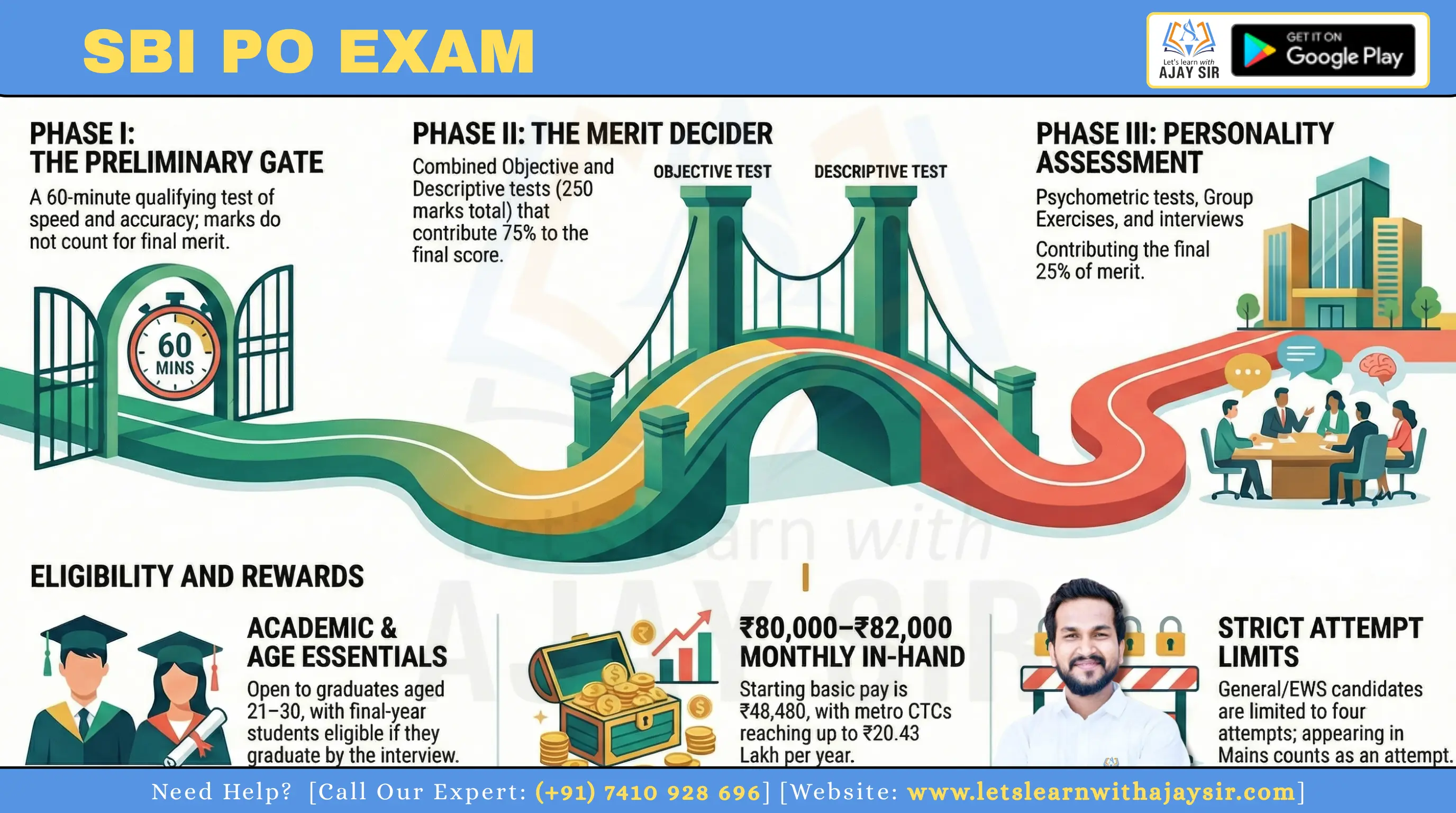
Knowing the selection stages gives you a clear map of where to focus effort and when. The selection process has three distinct phases. Each phase tests a different skill set so you can plan targeted practice.

Phase I — prelims and shortlisting

Prelims is a qualifying test. Its primary purpose is to screen large numbers of candidates quickly.

Prelims marks usually are not counted in the final merit. Your aim here is accuracy and speed to clear sectional and overall cut‑offs.

Phase II — mains objective and descriptive

The mains exam is the merit‑decider. It combines an objective paper with a descriptive test.

Objective assesses depth across reasoning, quant and general awareness. The descriptive part checks clarity of thought, structure and professional tone.

Phase III — psychometric test, group exercise and interview

The psychometric test is generally qualifying and screens personality fit. It is followed by a Group Exercise (20 marks) and an Interview (30 marks).

Panels focus on communication, problem solving and leadership potential. Practise spoken answers and group discussion skills early.

Final merit calculation

Final merit commonly weights Phase II and Phase III. A typical normalisation gives 75 marks to mains and 25 marks to Phase III.

In short: focus on mains for marks, but build descriptive and interview practice into your routine to secure the 25% that can decide selection.

Phase

Role

Marks / impact

Phase I

Qualifying / shortlisting

Not in final merit

Phase II

Objective + descriptive

Major contributor (≈75%)

Phase III

Psychometric, GE, Interview

Assessment component (≈25%)

  • Tip: treat prelims as a gate; practise speed but prioritise mains‑level depth.

  • Build descriptive writing and interview readiness from week one — they are easier to polish with time.

How to Apply

How to apply SBI PO online via the official website

Applying online is straightforward if you prepare first. Use the Careers section on the official website and follow a simple, step‑by‑step flow. Read each screen slowly and keep your documents and details ready to avoid errors.

Step‑by‑step process on the portal

  1. Go to www.sbi.co.in → Careers → Current Openings → Recruitment for Probationary Officer → Apply Online.

  2. Register with an active mobile number and email; verify via OTP.

  3. Fill personal, educational and category details carefully.

  4. Upload scanned photo, signature and supporting documents as specified.

  5. Pay the application fee online and submit the form.

  6. Download and save the confirmation PDF and fee receipt for future reference.

Documents to upload and common format expectations

Photo: recent passport‑style, clear face, light background, JPEG/PNG, within size limits.

Signature: black ink on white paper, scanned, correct dimensions and file size.

Other documents: degree certificate, category certificate (if applicable) and ID proof. Keep PDFs or image files ready and named clearly.

Common form‑filling mistakes that can cost your candidature

  • Wrong category selection or mismatch in name/DOB between ID and application.

  • Blurry or incorrectly cropped photo and signature; wrong file formats or oversized uploads.

  • Incomplete education details or incorrect contact number/email causing missed OTPs.

  • Not saving the confirmation PDF; losing proof complicates later verification.

Step

What to check

Why it matters

Registration

Active mobile & email

OTPs and future communications rely on this

Uploads

Photo, signature, certificates

Clear scans prevent rejection at verification

Payment & Submit

Fee paid and confirmation saved

Proof needed for admit card and queries

Tip: candidates must use only the official sbi portal to apply sbi. Avoid third‑party “apply now” links and double‑check every field before final submission.

All Details

Exam centres and your city preferences

Pick exam centres with practicality in mind: commute time, transport options and local accommodation matter more than prestige.

During the online application you will choose centre preferences for both prelims and mains. Put nearer cities at the top so you reduce travel risk on test day. Plan for traffic, public transport schedules and where you will stay if needed.

Choosing centres during your application

When you fill the form on the official website, list realistic options in order. If you live near several testing cities, rank them by travel time and convenience rather than by popularity.

  • Tip: choose at least one local centre as first preference.

  • Keep backup cities that are easy to reach if your top choice fills up.

  • Save screenshots of your submitted preferences for reference.

What happens if your preferred centre is full

If seats at a chosen city are unavailable, the authority may allot you an alternate centre. Centre‑change requests are usually not accepted later, so flexibility helps.

To reduce centre stress: apply early, keep documents ready and confirm travel plans only after your admit card is issued. Remember, candidates must be ready for allocation changes as part of the selection process.

Action

Why it matters

Practical step

Early application

Higher chance of preferred centre

Submit form soon after notification

Local preference

Less travel stress

Rank nearest city first

Admit card check

Final centre confirmation

Plan commute only after download

Pre-exam training: who gets it and how it helps

Pre-exam training gives eligible candidates a concise, hands‑on session to familiarise them with the test interface and final‑day routine. It is aimed at improving comfort with the computer system and removing last‑minute doubts.

Who is eligible and typical timing

Free training is commonly offered to SC/ST and Religious Minority applicants under reserved categories. Sessions are usually held about five days before the exam, so watch official announcements closely each year.

Major training centre locations

Training hubs are spread across regions. Typical centres include Agartala, Ahmedabad, Bangalore, Chennai, Mumbai, Hyderabad, Kolkata, Patna, Guwahati and Pune.

Region

Example centres

What to expect

East

Agartala, Patna, Guwahati

Local language help and interface demos

West

Ahmedabad, Pune, Mumbai

Time management drills

South & North

Bangalore, Chennai, Hyderabad, Kolkata

Mock runs and doubt clearing

  • You’ll learn what pre‑exam training is, who it suits, and how it can boost confidence.

  • Use the session for basic practice, interface comfort, time management and quick doubt resolution.

  • Carry identity and category proof to avoid last‑minute disqualification from a booked slot.

Admit card, result, cut-off and answer key expectations

Before test day you need certainty about downloads, timelines and how results are published. This short section explains where to get your admit card, how results appear stage‑wise, why cut‑offs change and how to treat answer keys from coaching centres.

Downloading your admit card using login credentials

Download the admit card from the official website using your registration number and password or date of birth. Check name spelling, centre, date and reporting time immediately after download.

If details are wrong, contact the helpdesk listed on the portal and keep screenshots of your submitted form and the error for proof. Save a PDF copy and an additional printed copy to carry on test day.

Result stages: prelims, mains, psychometric test and interview

Results are released stage‑wise. You will see separate links or PDFs for prelims, mains and the psychometric test with interview outcomes. Track each announcement from the notification and open the specific result link for your roll number.

Final lists combine mains performance with interview and group exercise marks to produce the merit order.

Cut-off release timing and why it varies by category

Cut‑offs are normally published with or shortly after results. They vary by category because of vacancy distribution, test difficulty and candidate performance.

Practical tip: compare cut‑offs across similar past cycles to set realistic target marks, but use the current notification and vacancy table for final planning.

Answer key reality check: official vs unofficial keys

The authority rarely publishes an official answer key. Unofficial keys from coaching institutes appear quickly, but treat them as estimates.

"Use unofficial keys only to assess trends; they are not final and sometimes miss marking schemes or multiple‑correct interpretations."

Wait for final result notifications before challenging any outcome. Keep all admit cards, receipts and identity documents safe until the process is complete.

  • Always download admit cards from the official website using your login details.

  • Monitor stage‑wise result links to avoid confusion.

  • Expect cut‑offs to change by category and difficulty.

  • Treat unofficial answer keys as provisional; rely on final result PDFs.

    Conclusion

    Finish strong: keep a simple action list—watch the sbi notification on the official site, confirm your eligibility early, and ready your documents for a smooth application.

    Remember: the prelims stage is for shortlisting, but the mains and Phase III decide final merit. Shape your preparation around that fact and use mocks to build speed and accuracy.

    Focus on consistent practice, track vacancies and cut‑offs from the notification, and avoid rumours. Keep your aim clear: steady progress in marks, not short‑term shortcuts.

    One last note: a realistic view of salary and career in banking keeps you motivated. With disciplined study and smart practice you can compete strongly for an officer role at State Bank. Monitor the notification and act early.

    FAQs

    Welcome to Let's Learn with Ajay Sir — Your trusted platform for mastering English Grammar and Literature. We are dedicated to providing high-quality educational content, insightful articles, interactive quizzes, and the latest exam updates to empower learners at every level. Join us on this enriching journey toward academic excellence and lifelong learning.