• NEED HELP? TALK TO A COUNSELLOR: 7410928696

SBI Clerk

Category: Banking Exams

This Ultimate Guide sets clear expectations so you know what you’ll learn: notification updates, dates, eligibility, pattern, syllabus, application steps, preparation tips, cut-offs, results and salary for the junior associate role.

Start early. When thousands compete across India, early planning gives you a clear edge. Treat the guide as your checklist — use it before applying, during study, and when results arrive.

We preview the selection journey briefly: Prelims → Mains → Language Proficiency Test. That way you see the full roadmap before diving deeper.

Quick Overview

What the SBI Clerk exam is and why it matters for your banking career

Landing a clerical post in a top public bank opens a steady, visible career path for many graduates. The sbi clerk exam is the annual selection that recruits junior associate staff who handle core branch duties. This clerical cadre is the entry point into a long-term banking profession with defined growth routes.

Junior Associate role: what you actually do in a branch

As a junior associate (customer support & sales) you will assist customers with deposits, withdrawals and transfers. You handle account queries, support service requests and keep day-to-day branch operations running smoothly.

In short: you are the face of the branch — welcoming customers, resolving basic issues and ensuring transactions are accurate and timely.

Why the selection is so competitive in India

The role is prized for its stability, brand value of the state bank and clear promotional ladders. That makes the process sought-after by many candidates across the country.

High applicant numbers, limited state-wise vacancies and the trust tied to a national bank intensify competition. Approach preparation as the start of a reliable career, not just an examination hurdle. This mindset helps you build the skills employers value: accuracy, service orientation and steady discipline.

Eligibility Criteria

SBI Clerk eligibility criteria 2026: age limit, education and nationality

Before you start studying, check the eligibility rules so you do not waste months on an ineligible application. This short guide helps you self-check the core eligibility criteria quickly and clearly.

Educational qualification and final-year applicants

You need a graduation degree in any discipline to apply. Final-year or final-semester candidates may apply provisionally.

Candidates must produce proof of passing at document verification or before joining. Keep mark sheets and degree certificates ready to avoid delays.

Age limit and category-wise relaxation

The general age range is 20–28 years. Relaxation applies by category: OBC +3 years, SC/ST +5 years, and PwBD up to 10–15 years depending on category.

Ex-servicemen get service period +3 years (subject to caps). Widows and divorced women have specific relaxations; trained apprentices receive defined leniency. Always verify your exact sub-rule.

Nationality and PIO/Nepal/Bhutan rules

Indian citizens qualify. Persons from Nepal and Bhutan, Tibetan refugees (arrival before 1 Jan 1962) and persons of Indian origin with a government certificate may be eligible.

When applicable, you must provide the required certificate at verification.

Number of attempts

There is no fixed attempt limit. The effective number of attempts is controlled by your age window and category relaxations. Plan accordingly to make the most of your eligible years.

"Check the notice for exact documentary proof and age-relaxation tables before you apply."

Requirement

Core rule

What to supply

Notes

Education

Graduation in any discipline

Degree/marksheet

Final-year provisional allowed

Age

20–28 years

Birth certificate/ID

Category relaxations apply

Nationality

Indian/eligible PIO/Nepal/Bhutan

Relevant certificate

Tibetan refugees: arrival before 1962

Attempts

No fixed limit

Limited by age window

Quick tip: run a fast self-check against these criteria before you invest heavily in preparation. If you meet the rules, plan your study schedule with confidence as an aspiring associate.

Vacancy Details

SBI Clerk vacancy 2026: what to expect and how past trends guide you

Knowing past vacancy patterns helps you plan where to aim and when to pivot. Vacancy refers to the total posts the bank intends to fill in a cycle; the final number stays TBA until the notification appears.

Reading the trend sensibly

Look at past years to spot patterns, not to predict exact totals. One large year does not guarantee another.

Regular versus backlog

Regular posts are new openings. Backlog posts fill deferred vacancies. Backlog can raise competition in some categories and alter cut-offs.

Pick preferences using state data

State/UT-wise tables in the notification help you choose preferences. If you are flexible on location, use the vacancies list as a tool to improve your chances.

  • Tip: final allocation depends on your mains score and listed preferences.

  • Use the vacancy table to set realistic score targets and language choices.

Year

Total vacancies

Notes

2024

14,191

High intake year

2023

8,773

Moderate intake

2022

5,486

Lower intake

2025

6,589 (5,180 regular / 1,409 backlog)

Includes backlog breakdown

"Treat the vacancy list as a strategy map, not a promise."

Syllabus

SBI Clerk Prelims exam pattern 2026: sections, marks, timing and negative marking

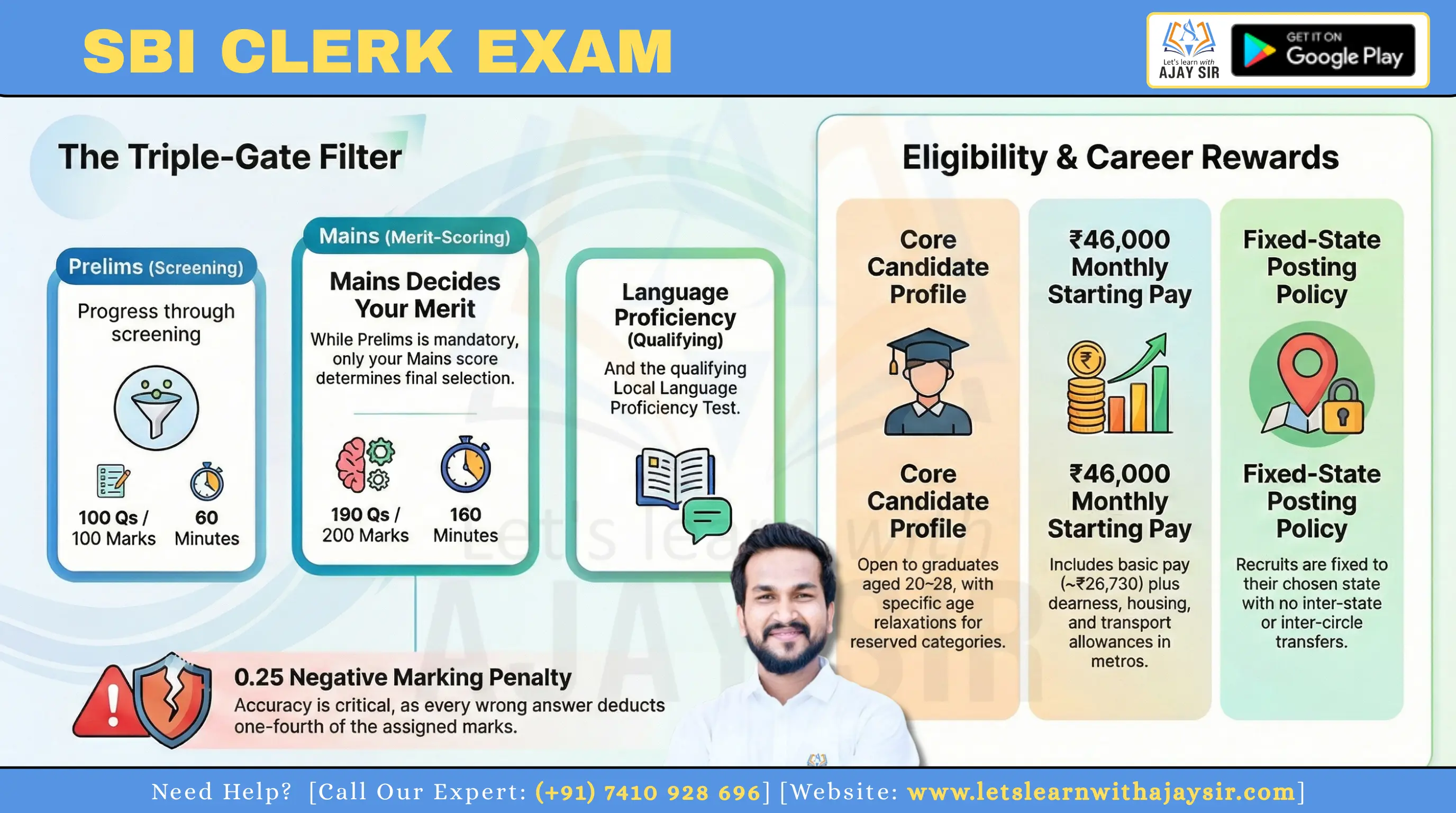
Understanding the exam pattern helps you plan attempts and protect your score. The prelims has 100 questions for 100 marks and lasts 60 minutes. Sections split into three equal time blocks of 20 minutes each.

English Language: common question types and quick practice

English carries 30 questions and you should aim to finish in 20 minutes. Expect reading comprehension, cloze tests, error spotting and para jumbles.

Daily practice: short RC passages, targeted grammar drills and timed para-jumble practice will build steady speed.

Numerical Ability: scoring areas and time traps

Numerical Ability has 35 questions and covers simplification, number series and basic arithmetic. Prioritise quick-win topics like simplification and percentage problems.

Watch out for lengthy caselets and DI-style traps. If a set will take too long, skip and return only if time allows.

Reasoning Ability: puzzles, accuracy and pacing

Reasoning also has 35 questions. Puzzles and seating/arrangement problems dominate this section.

Build accuracy first, then add speed. Negative marking of 0.25 for each wrong answer means random guessing reduces your net marks.

"Time-slice each 20-minute block and stick to planned attempts to avoid last-minute rushes."

  • Strategy tip: attempt high-confidence questions early in each section.

  • There are no prescribed sectional minimums, but overall cut-offs are set by the bank.

  • Track attempted vs unattempted questions to manage risk under negative marking.

SBI Clerk Mains exam pattern 2026: structure, weightage and smart section order

The mains paper is where your long-term preparation truly converts into a selection score. This stage carries 190 questions for 200 marks and lasts 2 hours 40 minutes. It is the scoring round that decides final merit, so you must plan attempts by strength and time.

Section layout:

  • General/Financial Awareness — 50 marks, 35 minutes

  • General English — 40 marks, 35 minutes

  • Quantitative Aptitude — 50 marks, 45 minutes

  • Reasoning & Computer Aptitude — 60 marks, 45 minutes

Choose a smart section order

Fixed timings mean you cannot shift time between sections. Instead, pick an order mentally: start with your strongest section to build confidence and secure high-value marks early.

General & financial awareness — quick coverage method

Cover current affairs daily: RBI releases, policy changes and key banking terms. Use weekly capsules and a monthly summary to lock facts before the mains.

General English — high-return practice

Focus on reading comprehension, vocabulary-in-context and error spotting. Ten minutes daily of short RCs plus targeted grammar drills compounds into steady gains.

Quantitative aptitude — DI and arithmetic balance

Expect a mix of data interpretation and arithmetic. If a DI set threatens to consume time, skip and solve quicker arithmetic questions first to protect overall marks.

Reasoning & computer aptitude — what to prioritise

Target seating, puzzles and syllogisms early in this section; they yield reliable returns. For computer topics, revise basics like MS Office, networking terms and simple logic questions.

Practical tip: plan section entry by strength, practise time-bound full tests and keep a short revision list for GA updates before the mains.

SBI Clerk 2026 syllabus: topic-by-topic checklist for Prelims and Mains

Turn the full syllabus into a weekly checklist so you always know what to revise next. Treat each item as a small milestone: tick it, test it, then revisit it in later cycles.

Reasoning covers puzzles, seating arrangements, syllogism, inequalities, sequencing, series and input-output. Focus on accuracy for puzzles and speed for series.

Quantitative aptitude includes simplification/approximation, number series, DI, percentages, ratio, profit & loss, time and work, and speed-distance. Practice DI sets of varied formats to handle mains-level complexity.

English language covers reading comprehension, cloze tests, error spotting, fillers and para jumbles. Work short RCs daily and do focused drills for error types rather than rote rules.

How the syllabus scales up: mains sets are denser, multi-concept and time-pressed. Prelims tests basics and speed; mains tests depth and application.

"Use the checklist to convert broad topics into repeatable weekly targets."

  • Make a weekly loop: learn → practise → mock → revise.

  • Mark topics as Done, Weak or Pending to plan revision slots.

  • Use previous year questions to gauge question style and difficulty.

Area

Core topics

Prelims focus

Mains focus

Reasoning

Puzzles, seating, syllogism, inequalities, series

Speed & accuracy on single concepts

Complex puzzles; multiple-concept sets

Quantitative

Simplification, DI, percentages, time & work, series

Basic calculation and quick DI

Lengthy DI, mixed arithmetic, accuracy under time

English

RC, cloze, error spotting, para jumbles, fillers

Quick RCs and grammar accuracy

Longer RCs and inference-heavy passages

Practical tip: assign two small topics per weekday and one mock on weekends. Rotate weak items into the next week so nothing stays forgotten.

Salary

SBI Clerk salary 2026, allowances and growth path after joining

A practical salary breakdown shows what the advertised figure means for your bank balance each month. Starting emoluments are roughly ₹46,000 per month inclusive of DA and allowances, but actual in-hand pay varies by city and housing status.

Pay scale vs in-hand: what “around Rs. 46,000” includes

The headline sum generally covers: basic pay, dearness allowance (DA), house rent allowance (HRA), transport and other allowances.

Basic pay for graduates often starts near ₹26,730. DA and HRA inflate the gross to the ~₹46,000 range in many metro postings.

Probation period and performance expectations

Probation commonly lasts six months. During this time you must show accuracy, punctuality and rapid learning of core banking processes.

Poor performance can extend probation or delay confirmation. Client handling and transaction accuracy are key metrics.

Promotions, departmental exams and long-term progression

Promotion routes include internal selection and departmental exams that can move you into officer grades over the years. Regular increments follow the pay scale and years of service.

Why this role is a strong option: security, benefits and balance

Working for a large public bank brings job security, standard benefits and predictable hours compared with many private roles. These factors suit candidates seeking stability and steady growth.

Tip: view the starter salary as a base; focus on annual increments and departmental chances to gauge long-term earnings.

Component

Typical value

Effect on gross

Notes

Basic pay

~₹26,730

Foundation of salary

Determines many allowances

Dearness allowance (DA)

Variable

Raises gross pay

Linked to inflation revisions

House Rent Allowance (HRA)

City-based

Major component for metros

Higher in metro postings

Other allowances & increments

Transport/medical & yearly raises

Pushes gross towards ₹46,000

Increases with years and promotions

Selection Process

SBI Clerk 2026 selection process: Prelims, Mains and Language Proficiency Test

Understanding which rounds screen and which decide merit will sharpen your preparation. The full selection process has three parts: Prelims, Mains and the Local Language Proficiency Test (LPT/LLPT).

What is qualifying vs what decides your final selection

The Prelims is a screening stage. You must clear minimum marks to reach the next round, but its score does not enter the final merit.

The Mains is the scoring stage. Your mains marks determine the merit list and final selection.

Language Proficiency Test: what is assessed and how to prepare

The language test checks reading, writing and basic spoken understanding of the local language where you apply. It is qualifying in nature.

Daily short practice sessions—reading local news, writing a short paragraph and speaking aloud for five minutes—will improve fluency quickly.

Important rule: no interview and no inter-circle/inter-state transfer

There is no interview. Your objective performance and language compliance decide your fate, so focus on paper-based rounds.

Also note: recruits are generally fixed to the chosen state/UT. There is no inter-circle or inter-state transfer, so pick preferences carefully.

Bonus marks for trained apprentices: who benefits and how it is applied

Former trained apprentices may receive bonus marks equal to 2.5% of the maximum mains score (typically 5 marks out of 200). This benefit is applied only where the rules list trained-apprentice credit.

"Treat bonus marks as helpful, not decisive—your mains score still controls final selection."

  • Practical tip: treat Prelims and language as gates; aim for high mains performance.

  • Plan state preferences with the no-transfer rule in mind.

How to Apply

How to apply online for SBI Clerk 2026 without mistakes

Follow a calm, step-by-step application path so you complete every field correctly when the notification appears. Start early and work from a saved checklist to avoid rushed errors.

Documents to keep ready: photo, signature and key details

Keep a passport-style photograph and a clear scanned signature in the required size. Have your identity proof, graduation certificate and exact dates ready.

Match names, birth date and category exactly with your certificates to meet eligibility rules and avoid verification problems.

Application fee and payment rules

Apply via the careers portal at www.sbi.co.in (Careers). Fees are ₹750 for General/OBC/EWS and Nil for SC/ST/PWD. Payment is online only.

Fees once paid are not refunded and cannot be reserved for another application. After submission, edits are typically not allowed—so double-check before you pay.

Common form-filling errors that can cost you your candidature

  • Wrong name spelling or order vs ID.

  • Incorrect category or state/UT choice.

  • Blurry photo/signature uploads and mismatched dates.

  • Duplicate payments caused by slow gateways.

"Preview every page, save the final receipt and keep a local copy of your submitted form."

Apply early to beat heavy site traffic and give yourself time to correct any payment failures. This reduces stress for all candidates and helps your application proceed smoothly through the process.

All Details

Exam medium and SBI Clerk exam centres 2026: how to choose correctly

Choosing the right medium and test city reduces last-minute stress and protects your score. The paper is offered bilingually or trilingually depending on the State/UT. That means English and Hindi are standard; a regional language is added where applicable.

Bilingual and trilingual options by State/UT

Pick the medium that matches your study habit and local language skills. For example, Gujarat papers may include English, Hindi and Gujarati. Karnataka often adds Kannada; Kerala uses Malayalam; West Bengal includes Bengali. Choose the regional option only if you read and write it comfortably.

Why this matters: switching language late can cost time, cause misreading and lower accuracy. Match your mock-test language to your final choice.

Why Prelims and Mains centres differ

Prelims centres are more numerous to accommodate large candidate pools. Mains centres are fewer, usually at major hubs. That means you may travel for mains even if your prelims centre was local.

How to pick a centre smartly:

  • Prioritise connectivity and travel time, not just distance.

  • Choose a city where you can arrive early and stay calm.

  • Apply early—centre allocation depends on availability and early choices improve chances.

"Plan ID proofs, admit-card printouts and arrival time well before the date to avoid last-minute delays."

State/UT

Regional language included

Practical tip

Gujarat

Gujarati

Use Gujarati only if you read RCs comfortably

Karnataka

Kannada

Check Mains centre distance; hubs may be Bengaluru

Kerala

Malayalam

Prefer Malayalam for faster comprehension

West Bengal

Bengali

Align mock tests to chosen language

Final reminder: centre allocation can change, so keep travel plans flexible. Carry original ID and printed admit card on the day of the examination.

Result, cut-off and exam analysis: how you’ll know where you stand

When result day arrives, a clear process helps you interpret scores and next steps. You will see separate listings for Prelims and Mains and a clear statement of qualification status.

How results and cut-offs are published

The bank posts Prelims and Mains results on its careers portal with category-wise, often state-wise, cut-offs. Alongside the merit you will find shortlisted roll numbers and the qualifying marks per category.

"Save the PDF or take screenshots immediately; links and pages may change during the cycle."

Use previous cut-offs to set realistic targets

State-wise cut-offs vary a lot. For example, Prelims 2024 (General) showed Karnataka 72.5, Andhra Pradesh 68.75, Delhi 67, Uttar Pradesh 61.75, Maharashtra 44.75 and Bihar 47.25.

Use such years as a benchmark, but adjust for difficulty, vacancy count and competition each cycle.

Prelims trends and practical score planning

Recent prelims exam analysis called the paper Easy-to-Moderate, with English RC ~8 questions, DI sets and multiple puzzle types in reasoning. That raises the value of speed and error control.

  • Aim a safety margin: target 5–8 marks above your state’s last known cut-off in mocks.

  • Compare your mock marks to that margin and tighten weak areas.

  • Prioritise high-frequency topics from exam analysis instead of chasing low-yield areas.


    Conclusion

    Finish strong: treat each step — application, study blocks, tests and result tracking — as a scheduled task so you move forward with purpose.

    Recap: watch the sbi clerk 2026 timeline, confirm eligibility, apply carefully and follow a phased preparation plan with daily targets and weekly mocks.

    Key tactic: Prelims qualifies you; Mains decides the final outcome. Focus effort where marks count and protect accuracy under timed pressure.

    Use the syllabus checklist, regular mock analysis and state-wise targeting to keep progress steady. Track errors and adapt your revision each week.

    Rely only on official updates for dates, vacancies and rules. Treat other schedules as tentative and plan a small buffer.

    Start early, practise with discipline and revisit these sections as a working checklist before you apply, before each exam and when the result is posted.

    FAQs

    Welcome to Let's Learn with Ajay Sir — Your trusted platform for mastering English Grammar and Literature. We are dedicated to providing high-quality educational content, insightful articles, interactive quizzes, and the latest exam updates to empower learners at every level. Join us on this enriching journey toward academic excellence and lifelong learning.