All Details
MPTET: qualifying marks, pass criteria and certificate validity
Understanding the pass rules helps you shape a focused study plan and score reliably in the test. Use the benchmarks below to set clear weekly targets and check your mock scores against the required standards.
Category-wise pass benchmarks
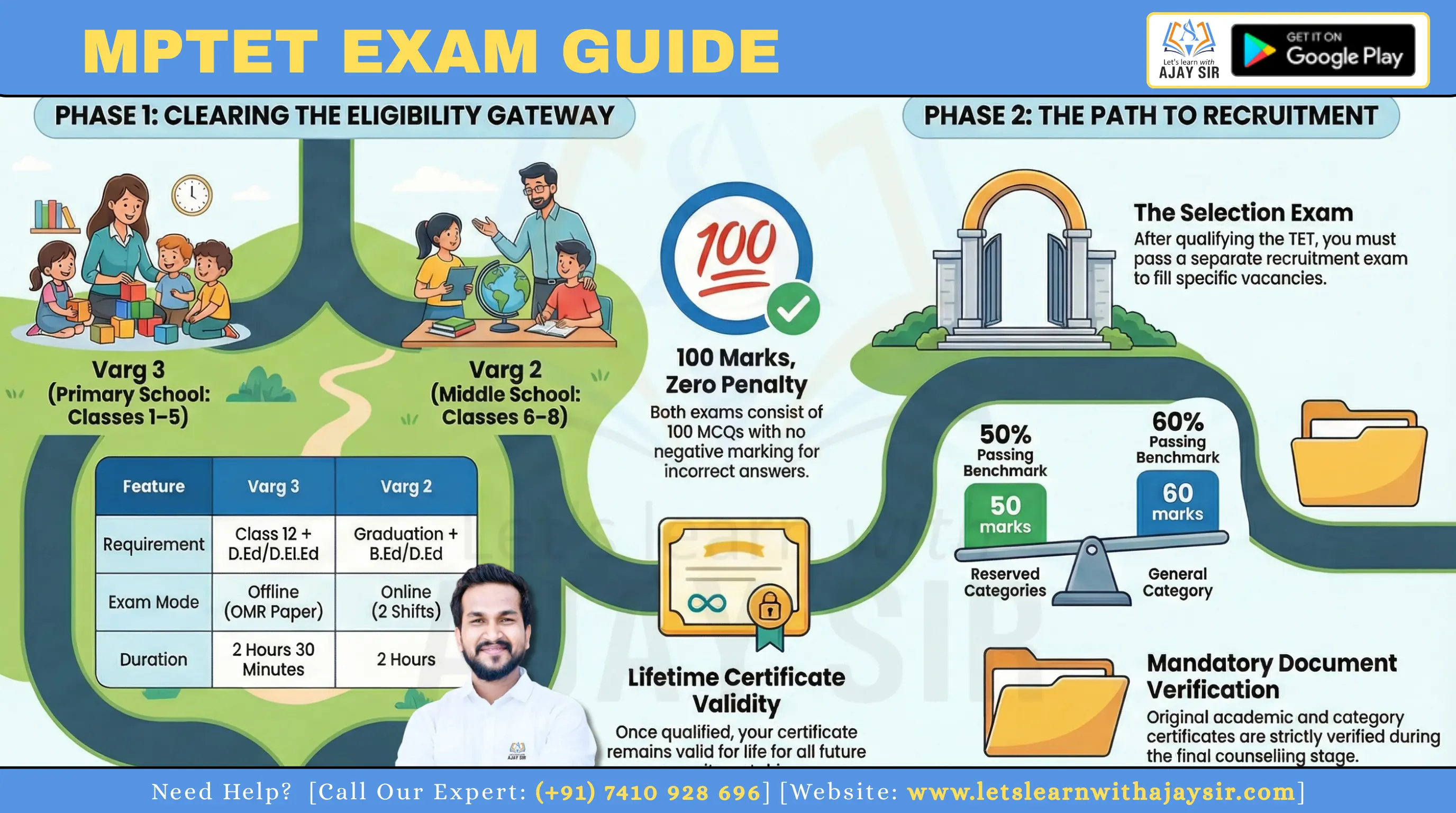
The pass percentage differs by category. For most reserved categories — SC, ST, OBC, EWS and PwD — the qualifying marks are 50%.
For General category candidates the threshold is 60%.
What lifetime validity means for you
Once you clear the test, the certificate is valid for life. That means you do not need to re‑sit the eligibility test before applying for government teaching vacancies later.
This gives you freedom to focus on subject depth and selection‑exam preparation instead of repeating the qualifying exam.
Set a safety margin: aim a few marks above the cut‑off to avoid calculation or answer‑key surprises.
Use mocks: compare your marks to the benchmarks and refine weaker topics.
Plan long term: clear the test early and then target recruitment notices when they appear.
Aspect | Reserved categories | General category |
Qualifying percentage | 50% | 60% |
How many marks (out of 100) | 50 marks | 60 marks |
Certificate validity | Lifetime — you can apply for future government recruitment without retaking the test |
|
MPTET: Exam mode and paper format
Understand how the exam mode affects your day‑of performance and practise in the same format you’ll face. The varg exam pattern differs by level: one is delivered on a screen, the other on paper, but both use objective MCQs and a 100 marks framework.
Varg 2 mode: online test structure
Varg 2 runs as an online test. You answer screen‑based MCQs with navigation tools to mark and review items.
Duration is two hours. Time management and using the review flag are key to handling the exam pattern and finishing all questions.
Varg 3 mode: offline objective paper format
Varg 3 is an offline, OMR‑style paper. You fill bubbles on a sheet for each question, so neat marking is essential.
Duration is two hours thirty minutes. Practise timed paper sessions to mirror the physical handling and avoid stray marks.
Common ground: both tests have 100 questions for 100 marks, objective answers, and no negative marking stated. Focus on accuracy rather than guessing.
Practice tip: use online mock interfaces for Varg 2 to build navigation speed.
Practice tip: do timed, 100‑question paper tests for Varg 3 to sharpen OMR technique.
Aspect | Varg 2 (online) | Varg 3 (offline) |
Format | Screen‑based MCQs | OMR objective paper |
Duration | 2 hours | 2 hours 30 minutes |
Total | 100 questions — 100 marks | 100 questions — 100 marks |
MPTET: Previous Year Question Paper
Use older question papers to spot patterns in topic weightage and common traps. Start with a calm, untimed pass to check concept gaps. Then move to timed attempts that mimic exam pressure.
Analyse past papers to find repeated topics
Mark each question by topic and note repeats across years. Tally high‑frequency items and focus weekly study on those high‑yield topics.
Quick check: sort questions into easy, moderate and tough to shape attempt order on test day.
Build an error log from practice sets and mock tests
"Track not just the wrong answer, but why it was wrong — careless error, concept gap or time pressure."
Create a simple table: question, error type, correction, and revision date. Convert this into a weekly revision list so your weakest areas improve fastest.
Use previous year resources as pattern‑finding tools, not one‑off trials.
Start untimed for clarity; shift to timed sets to match the real paper.
Review your error log after every mock and update your weekly plan.
Step | Action | Benefit |
Initial pass | Untimed analysis of a question paper | Identifies concept gaps |
Timed attempt | Mock under exam conditions | Builds speed and stamina |
Error log | Record mistakes and fixes | Focused weekly revision |
MPTET: Admit card, Exam Day Instructions
Downloading the admit card promptly is one small step that prevents big problems on exam day. Start with the official MPESB portal and use the candidate login to fetch your PDF as soon as it is published.
When to expect and how to download
The admit card usually appears 7–14 days before the examination. Log in with your application number and date of birth, download the file and save both a digital copy and a printed one.
Check these details: your name, photograph, centre address, shift timing and roll number. If anything is wrong, contact the helpdesk immediately.
Exam day checklist: what to carry and do
ID proof: original photo ID (Aadhaar, passport or driving licence) plus a photocopy.
Admit card: one printed copy and one phone copy as backup.
Reporting time: arrive at least 60–90 minutes early to clear security and verification.
Do’s and don’ts: carry only permitted items, switch off phones, avoid study notes inside the centre.
Practical tips: print the admit card on A4, use a clear folder and label backups. Plan your travel the day before and keep margin time for traffic or delays.
Item | Why it matters | Quick action |
Admit card | Entry pass with centre and timing | Download, verify, print |
ID proof | Identity verification for candidates | Carry original + copy |
Arrival time | Verification and seating | Reach 60–90 mins early |
On the examination day, keep a steady pace. Use time checkpoints—finish easy questions first and recheck flagged items—so you stay calm and make the best use of your time.
MPTET: Answer Key, Result process
The moment the provisional answer key appears, you gain a practical tool to tally your performance and estimate likely marks out of 100.
How to use the key
Match each response from your answer sheet to the official answer key carefully.
Count correct items; each correct item equals one mark. Avoid double‑counting or skipping questions.
Note uncertain answers separately so you can recheck once the final key or clarification arrives.
Post‑test actions to protect your case
Preserve your question recall notes and list any unclear items. Track the official portal for the key release and follow updates from the selection board.
Understanding the result process and what follows
The results are published after evaluation and any objection window closes. The process usually shows provisional scores, the final result and certificate details.
Once you qualify, shift focus to recruitment or selection exams. Strengthen weak areas, gather documents and stay ready for document verification and counselling stages.
Stage | What you do | Why it matters |
Key release | Match answers, tally marks | Estimate performance quickly |
Result publication | Check final score and certificate | Confirms eligibility for recruitment |
Next steps | Prepare for selection rounds, docs | Move from eligibility to job‑specific process |
Tip: your test certificate usually has lifetime validity, so once you clear the eligibility hurdle you can plan multiple recruitment attempts without repeating the qualifying test.
Conclusion
Close your preparation loop with simple steps that keep progress steady and confidence high as you approach the TET Varg.
Start with a one‑page action checklist: weekly topic targets, a mock test every month, and a focussed revision sprint three weeks before the exam. Keep one folder for scanned documents and a print of your admit card.
For candidates in Madhya Pradesh, track official updates, confirm eligibility, follow the right syllabus and practise in the correct mode for your varg exam. Use the 2025 exam syllabus as your study map and adapt it to your timetable.
Choose your pathway—primary or middle—then tailor daily drills and weekly full mocks to that TET Varg. Avoid distractions: only pursue other tests like UGC NET if they match your long‑term goal; otherwise focus here.
Simple commitment: set three weekly targets, one monthly revision cycle and regular mock analysis. Stay steady, revise smart and enter the test room calm and ready.