All Details
IBPS Clerk: Participating banks in recruitment
Knowing which banks participate helps you research before you lock preferences on your application.
List of participating public sector banks
Bank of Baroda
Canara Bank
Indian Overseas Bank
UCO Bank
Bank of India
Central Bank of India
Punjab National Bank
Union Bank of India
Bank of Maharashtra
Indian Bank
Punjab & Sind Bank
How preference affects posting and transfers
Preference order is not cosmetic. Merit rank, state choice and vacancies decide your allotment along with the bank list above.
Consider branch density, transfer patterns and language needs when ranking banks. Baseline pay is similar across public sector banks, but posting culture differs.
"Choose preferences based on where you can realistically work and grow, not on hearsay."
Factor | Why it matters | Action |
Branch network | Determines local posting likelihood | Prefer banks strong in your state |
Transfer policy | Impacts long‑term location | Research bank transfer norms |
Work culture | Daily experience differs by bank | Rank by career growth and comfort |
IBPS Clerk: Exam language and medium of examination
Language options exist to make the recruitment more accessible across diverse linguistic regions. Both prelims and mains are offered in English and Hindi, with an additional set of 13 regional languages available state‑wise.
English, Hindi and regional language choices
The purpose of multiple mediums is simple: to give local candidates a fair chance and to improve customer interaction at branches. Regional languages help you read questions faster and answer with more confidence.
How to pick the right medium
Choose the language that gives you the best comprehension speed under time pressure, not just comfort. If you read faster in a regional tongue, that may help for reasoning and numerical sections.
English often keeps technical terms consistent, which can help in data interpretation. Balance this trade‑off with your likely performance in timed practice.
Practical checks and next steps
Attempt a timed mock in both mediums where possible and compare accuracy and speed before you finalise your choice.
Cross‑check the state‑wise language table on the official website when the notification is live. Also ensure your selection matches any later language proficiency test requirements.
Prelims and mains: available in English, Hindi + regional languages as notified.
Pick the medium that boosts your speed and accuracy.
Confirm state-specific options on the official website before applying.
IBPS Clerk: Admit card, exam centres, and exam-day essentials
Downloading your call letter early removes last‑minute stress and lets you check centre details well ahead of the test. The admit card for prelims and mains is published separately on the official website and you must download it using your registration number and password or date of birth.
How to download your call letter
Visit the website link for call letters, enter credentials and click the download button. If you forget details, use the registered email or mobile recovery options immediately to retrieve them.
What the call letter shows
Your admit card lists the exact exam date, shift, venue address, reporting time, seat/roll number and centre instructions. Read these details carefully and check that names and ID fields match your documents.
Exam centre rules and selection
You select centre preferences while applying; allocation depends on centre capacity and your choices. Change requests are rarely allowed after allotment.
Checklist: printed admit card, valid photo ID, passport‑size photos, and permitted items like water (check centre rules).
Plan travel and arrive early; late entry rules are strict and can cost you the attempt.
Read instructions on the card about signature match, prohibited items and biometric formalities.
Item | Why it matters | Action for you |
Download timing | Avoid server overload | Save and print as soon as released |
Credentials | Required to access call letter | Use recovery options if lost |
Centre allocation | Final after allotment | Plan travel; do not expect changes |
On‑day rules | Non‑compliance may disqualify | Follow instructions on the admit card |
"Carry your printed admit card and ID; small checks now prevent last‑minute panic."
IBPS Clerk: Pre-exam training and support
A short, focused training programme can boost confidence and clarify the process before you sit the main papers. Pre-exam training is listed separately in the official notification and is offered only to eligible candidates.
Who can opt for training
The board decides eligibility. Typically, reserved-category or resource‑limited applicants are invited. Check the notification and the application portal to confirm if you qualify.
How to choose training during your application
During the online application you will see a training opt‑in option if it is available. Select it early in the application flow to secure a slot; places are limited and offered on a first‑come basis.
Downloading the training call letter
When the training schedule is published, the training call letter appears separately on the website. Download and print it just like your main admit card. Keep the receipt and proof of enrollment with your other documents.
What to expect at training centres
Sessions usually cover orientation, section-wise strategy, sample questions and time management tips. Trainers clear basic doubts and show centre procedures you will face on exam day.
Training is a supplement, not a substitute for daily mocks and focused study; treat it as a confidence booster.
Organise all documents from registration, training and the main application carefully. These papers help you follow the full process and avoid last‑minute issues on exam day.
Conclusion
Use this final note to convert information into a simple checklist that keeps you on track.
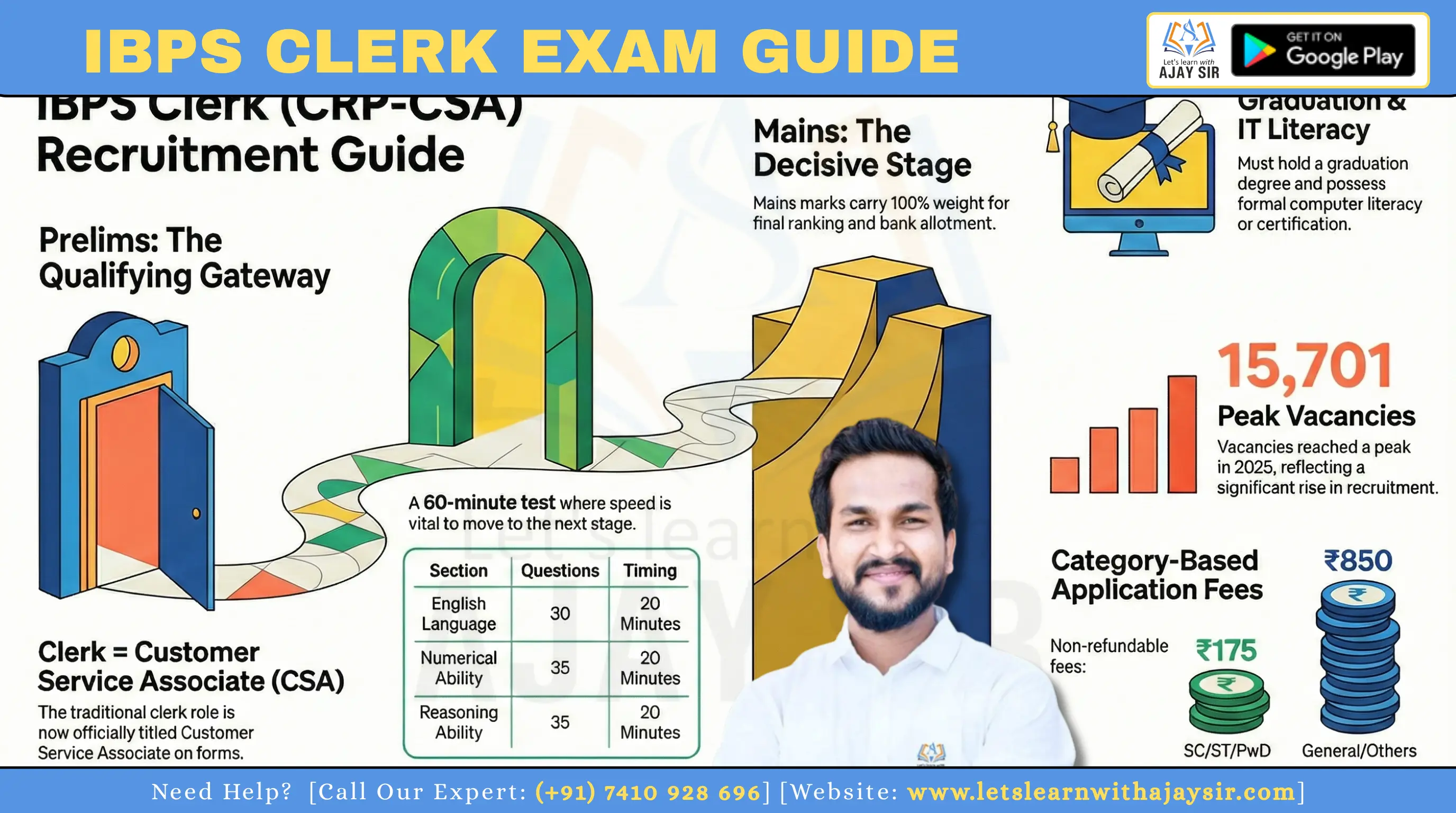
Recap: the ibps clerk route is a clear personnel selection path into public sector banks. Focus on dates, a flawless application and steady mock practice to build reliable marks.
Track the notification and updates on the official website; download the admit card promptly when released. Treat prelims as the gateway and the mains as the decisive stage for merit and allotment.
Three pillars that help most candidates are: a clean application process, regular timed mocks with deep analysis, and disciplined revision for GA and formulas. Check your eligibility criteria, keep documents ready and pay the correct application fee on time.
Next step: bookmark this guide, make your personal checklist (documents + dates) and start a weekly plan today so you avoid last‑minute rush.