• NEED HELP? TALK TO A COUNSELLOR: 7410928696

Delhi Police Head Constable

Category: SSC Exams

In this guide you’ll get a clear, end-to-end view of the Delhi police head constable journey. You’ll see how the SSC-run Computer-Based Examination sets the pace and how later stages are handled by local agencies.

You’ll learn what the exam day looks like, which marks affect merit, and what tests are merely qualifying. The content covers where to apply, what details to keep ready for your form, and how to avoid common delays.

Practical contrasts between Head Constable (Ministerial) and Head Constable (AWO/TPO) help you pick the right post. Key milestones — admit card, answer key, result and salary overview — are mapped so you can plan your preparation sensibly.

Key Takeaways

  • You’ll follow an end-to-end roadmap of the recruitment 2026 cycle, from notification to final selection.

  • The SSC-run CBT is the first major hurdle; later stages are managed by delhi police authorities.

  • Know which sections of the exam affect merit and which are qualifying only.

  • Prepare documents and form details in advance to avoid application errors.

  • Choose between ministerial and AWO/TPO posts based on your background and skills.

Quick Overview

Delhi Police Head Constable: Overview

Here’s a concise map of the recruitment: who manages each stage, which official sites to trust, and the two posts on offer.

Recruitment body and official websites you should use

The staff selection commission runs the Computer-Based Test (CBT). For CBT notifications, admit cards and answer keys, rely on https://ssc.gov.in/.

For post-CBT stages — physical tests, typing or trade tests, and final merit lists — use the delhipolice site at delhipolice.gov.in. Keep your contact and profile details consistent across both portals.

Posts covered: Head Constable (Ministerial) and Head Constable (AWO/TPO)

The drive covers two main posts. The Ministerial post focuses on clerical and office work; the AWO/TPO role maps to armoury, transport or technical duties.

How the selection stages are split between SSC and Delhi Police

Who does what: SSC conducts the CBT to filter candidates by knowledge and aptitude.

The local authority conducts PET/PMT, typing and trade tests, and document verification.

Stage

Conducted by

Purpose

Computer-Based Test

staff selection commission

Shortlist by merit and scores

Physical & Skill Tests

Delhi police

Assess fitness and job skills

Document Verification & Final Merit

Delhi police

Confirm eligibility and prepare final list

Eligibility Criteria

Delhi Police Head Constable: Eligibility criteria

Eligibility rules matter: read them before you apply so you avoid wasted effort. The SSC uses a fixed cut‑off date to calculate age. If you miss the band, your form will be rejected.

Age limit and who gets age relaxation

The basic age band for the Ministerial post is 18–25 years. Relaxations apply as per notification.

  • SC/ST: +5 years

  • OBC: +3 years

  • PwBD: up to +10–15 years depending on category

  • ESM and some departmental/women categories: as listed in the official table

Educational qualification options you can apply with

You are eligible if you hold Class 12 (10+2) or a recognised NTC in Mechanic‑cum‑Operator Electronic Communication System. Keep original certificates ready for verification.

Key disqualification risks to avoid

Common pitfalls: mismatched names, wrong certificate dates, improper category formats or unclear uploads.

During document verification, candidates must present valid proofs or face rejection. Also ensure your physical records match application details.

Vacancy Details

Delhi Police Head Constable: Vacancies 

Before you apply, get a clear snapshot of published vacancies and how those figures can change. The official notification frames the recruitment timeline and gives the first usable numbers. Use those figures to set realistic goals for study and counselling.

Vacancy snapshot from the latest released figures

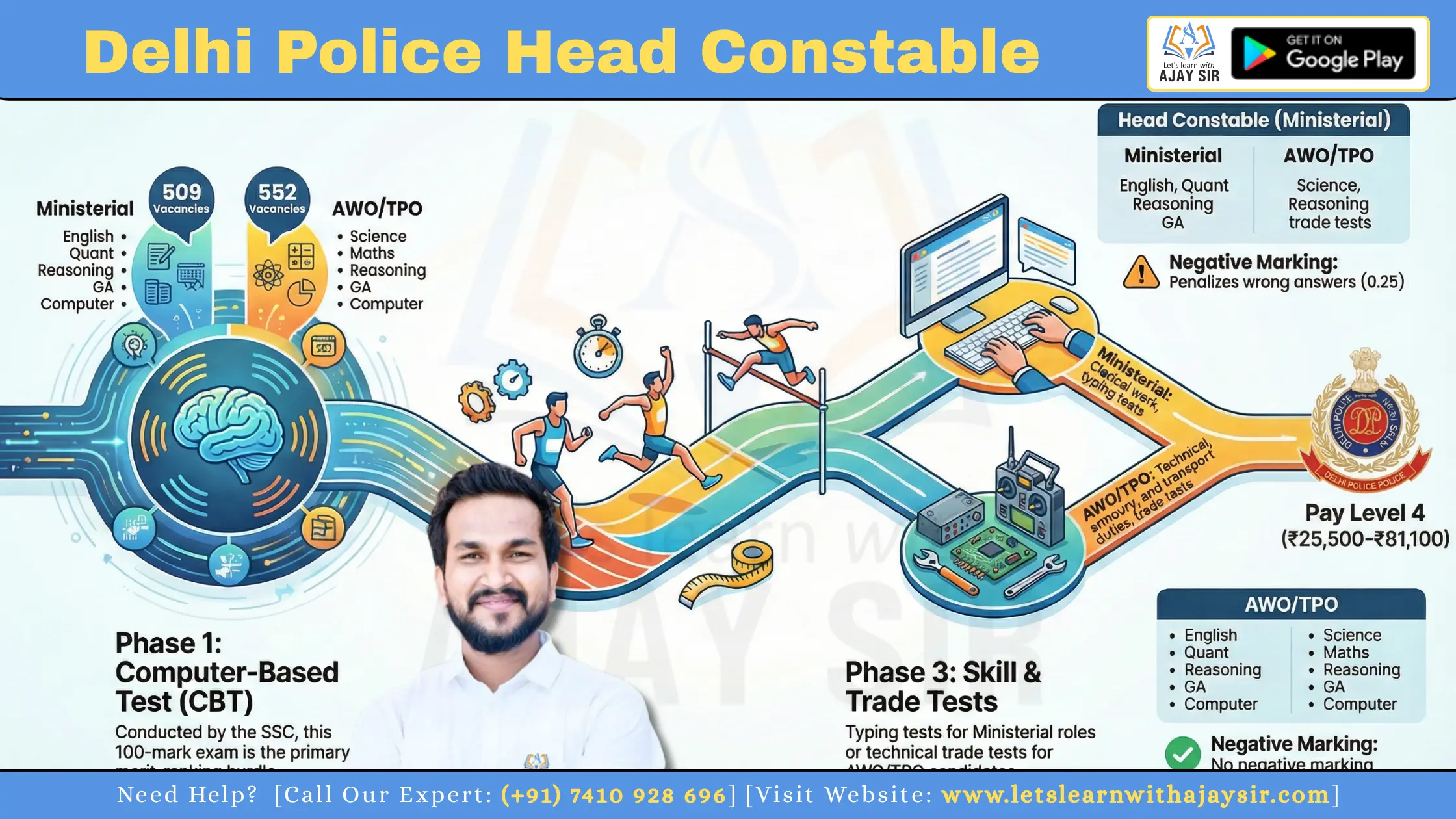
The most recent release shows 509 posts for head constable (Ministerial) and 552 vacancies for head constable (AWO/TPO). The Ministerial notification was issued on 29 September 2025.

Why vacancy numbers can change post-notification

Vacancy totals often shift after notification. Administrative needs, court orders or budget approvals can raise or reduce counts. Category-wise splits, ex‑servicemen allocations and reservation adjustments also alter cut-offs and selection outcomes.

  • Track official updates only on the SSC site and delhi police portal to avoid rumours.

  • If vacancies change, keep your exam plan; adjust counselling expectations instead.

  • Remember final selection depends on normalisation, qualifying stages and category distribution — not just the headline vacancies number.

Syllabus

Delhi Police Head Constable: Exam pattern (Ministerial) CBT

Understand the written test structure and use it to shape timed practice sessions that mirror exam day.

Sections, number of questions, marks and duration

The ministerial CBT has five sections totalling 100 questions for 100 marks. You get 90 minutes to finish the paper.

Section

Questions

Marks

General Awareness

20

20

Quantitative Aptitude

20

20

General Intelligence

25

25

English Language

25

25

Computer Fundamentals

10

10

Negative marking and attempt strategy

Each wrong answer costs 0.25 marks. That means random guessing erodes your score.

  • Attempt sure answers first; mark doubtful ones for review.

  • Use elimination to improve odds before attempting risky questions.

  • Set section time budgets so calculation-heavy items don't eat easy marks.

  • Focus on computer basics and English for quick gains; practise reasoning and quant for accuracy.

Tip: practice with full-length mocks under timed conditions to balance speed and precision and protect your merit in close cut-offs.

Delhi Police Head Constable: Exam pattern (AWO/TPO) CBT

You will find the exact section mix, total marks and timing for the AWO/TPO exam so your revision stays focused. The CBT has five sections and totals 100 questions for 100 marks. You get 90 minutes to complete the paper.

Sections tested and total questions / marks

The layout differs from the ministerial pattern by adding General Science and shifting weight to mathematics. Below is the clear split so you can tailor practice sessions.

Section

Questions

Marks

Focus

General Awareness

20

20

Current affairs & static GK

General Science

25

25

Basic physics & chemistry

Mathematics

25

25

Arithmetic & algebra

Reasoning

20

20

Logical problems & sequences

Computer Fundamentals

10

10

Basics, MS Office

No negative marking: what you should do differently

There is no negative marking in this constable exam. That means you should attempt every question and use educated guesses when unsure.

  • Start with high‑confidence areas to collect quick marks.

  • Use elimination to raise guess accuracy on tougher items.

  • Build speed in mathematics and accuracy in computer basics so you waste less time on low-value tasks.

Tip: simulate full 90‑minute tests and practise section timing. This trains your pace for the Delhi police AWO/TPO CBT and helps protect merit in close contests.

Delhi Police Head Constable: Syllabus (Ministerial)

This concise syllabus map helps you turn official topics into a weekly plan. Cover each subject, then lock your learning with timed practice and at least one full-length mock per week.

General Awareness

Focus on history, geography, economy, polity and the constitution. Balance static GK with recent current events so you stay current without over-studying headlines.

English Language

Work on grammar (error spotting, sentence correction), cloze tests and comprehension. Daily short passages and targeted grammar drills lift accuracy fast.

General Intelligence

Train analogy, series, coding‑decoding, Venn diagrams and visual reasoning. Timed sets build speed; review mistakes to spot recurring traps.

Quantitative Aptitude

Group topics: arithmetic (percentages, ratio, interest), algebra, geometry, mensuration, trigonometry and data interpretation. Use sectional timed practice to improve precision under pressure.

Computer Fundamentals

Cover MS Word and Excel basics, internet/WWW, e‑mail and communication fundamentals. These are often quick marks—practice common operations and shortcuts.

  • Study tip: make weekly targets by subject and tick topics off as you master them.

  • Practice: focus on past objective questions and revise weak areas with short, daily drills.

  • Final push: combine subject tests into full-length papers to simulate the exam.

Subject

Key topics

How to practise

Quick-win marks

General Awareness

History, Polity, Economy, Current events

Daily 20-minute summary + weekly revision

High

English

Grammar, Cloze, Comprehension

30 mins grammar drills + passage practice

Moderate

Quant & Reasoning

Arithmetic, Algebra, Series, Coding

Timed sectional sets; error log

High

Computer

MS Word/Excel, Internet, E-mail

Hands-on tasks and short tests

Low‑to‑Moderate

Delhi Police Head Constable: Syllabus(AWO/TPO)

Use this concise syllabus guide to identify high-frequency areas and fast wins. It lists core topics and quick practice tips so you can shape weekly goals and mock routines.

Reasoning

Focus: non‑verbal, analogy, series, input‑output, syllogism and data sufficiency.

Practice: timed sets and puzzles build speed. Work separate drills for data sufficiency as it needs a different approach.

General Science

Physics: motion, pressure, heat and basic units. Chemistry: everyday reactions, acids, bases and electrochemistry.

General Awareness

Study India and neighbouring countries, polity and constitution, economy and geography. Short daily notes and weekly revision help you retain facts for objective questions.

Mathematics & Computer Fundamentals

Maths: number system, percentage, SI/CI, algebra, geometry, mensuration, trigonometry and DI.

Computer: basics, MS Word shortcuts, MS Excel operations and communication fundamentals. Hands‑on practice yields quick marks.

Subject

Key topics

How to practise

Quick win

Reasoning

Non‑verbal, series, syllogism, data sufficiency

Daily 20‑minute puzzles + error log

High

General Science

Motion, heat, pressure; reactions, acids, electrochemistry

Concept notes + 10 MCQs/day

Moderate

GA / Maths / Computer

Polity, geography; arithmetic to trigonometry; MS Office basics

Mixed-topic mocks + hands‑on computer tasks

High

Salary

Delhi Police Head Constable: Salary Range [Pay Level 4]

The pay band for Pay Level 4 runs from ₹25,500–₹81,100. With standard allowances (HRA, DA and other perks), typical in‑hand pay for many candidates lands near ₹34,000–₹38,000.

Compared with other constable recruitment 2026 outcomes, roles under the local force offer similar stability and allowance structures. Use these figures to set realistic expectations when you plan post‑selection steps.

Selection Process

Delhi Police Head Constable: Selection process

This section breaks down every step you face after the written examination so you know which stages add to your merit and which are qualifying only.

Computer‑Based Objective Type Test

The CBT carries 100 marks and is the main score-bearing stage. SSC conducts this exam and your CBT marks form the backbone of the merit list.

Physical endurance and measurement test

The PET and PMT are qualifying. They occur after the written shortlisting and check fitness and body standards.

Train early: do not wait for results — physical preparation is essential.

Skill stages: typing, trade and computer checks

For the ministerial post a typing test (usually 25 marks) contributes to merit, while a computer formatting check remains qualifying.

For the AWO/TPO route, reading & dictation trade tests and computer proficiency are qualifying tests only.

Document verification and final merit list

After qualifying stages, originals are checked and discrepancies can cause rejection. Final selection merges CBT marks (and typing where applicable) with category rules to prepare the merit list.

Stage

Nature

Conducted by

CBT

Marks (100)

SSC

PET/PMT

Qualifying

delhi police

Typing / Trade / Computer

Mixed (marks/qualifying)

delhi police

How to Apply

Delhi Police Head Constable: How to apply online

Completing the online form is easier when you follow a step‑by‑step flow and prepare uploads in advance. Apply only via the official site: https://ssc.gov.in/. Keep your mobile number and email active; the staff selection commission will use them for all key recruitment alerts.

Step-by-step registration and submission flow

  • Register on the portal and note your registration ID.

  • Login, complete the application form and enter all personal and educational details.

  • Upload scanned photo, signature and certificates as per size and format rules.

  • Pay the fee online, submit the form and print the confirmation page.

Documents and uploads you should keep ready

Have a clear, legible photo and scanned signature. Keep category or disability certificates, Class 12 proof and any trade/skill certificates ready.

Image quality matters: low‑quality uploads cause rejections at admit card or document verification. Save each uploaded file name and copy of the confirmation PDF.

Application fee rules and exemptions

The fee for the Ministerial post was ₹100 for Gen/UR/OBC; other categories were exempt. Pay via the supported gateways and keep the e‑receipt safe.

Tip: Review every field before submission. Corrections may be allowed only during a limited correction window. Following this flow reduces errors for candidates in delhi police constable recruitment and for those applying to the head constable posts.

All Details

Delhi Police Head Constable: PET & PMT standards, typing and computer tests

Prepare to meet exact on‑ground standards: this part outlines running, jumping and skill criteria so you know what to train for.

Physical Endurance Test benchmarks

You must clear age‑banded runs and jumps. Male runs are 1600m; typical target times are 7 / 8 / 9 minutes by younger, middle and upper age bands respectively.

Long jump targets sit near 12½ / 11½ / 10½ ft; high jump targets are around 3½ / 3¼ / 3 ft. Female runs are 800m with goals of 5 / 6 / 7 minutes, long jump 9 / 8 / 7 ft and high jump 3 / 2½ / 2¼ ft.

Physical Measurement Test and relaxations

Height and chest standards vary; relaxations up to 5 cm are commonly allowed for reserved categories. You must check the specific notification for exact figures before planning.

Typing test: marks and what is evaluated

The typing test carries 25 marks for the ministerial post and affects merit. The board checks speed and accuracy; therefore, you should build steady WPM while reducing errors.

Computer formatting and proficiency

Computer checks are typically qualifying. Tasks cover MS Word, Excel and PowerPoint: saving, formatting, basic formulas and printing. Practise real files so you handle these operations confidently on test day.

  • Train early: endurance and jumps need weeks of progressive work to avoid injury.

  • Self‑check: verify PMT figures in your notification; do not assume standards are identical every cycle.

  • Skill tests: practice typing with accuracy and complete computer tasks hands‑on; these are qualifying but essential.

Test

Nature

Key metric

PET

Qualifying

Run time, long & high jump

PMT

Qualifying

Height / chest (relaxation possible)

Typing / Computer

Mixed (marks/qualifying)

WPM & accuracy; file tasks

Delhi Police Head Constable: Admit card, answer key, result

Downloading your admit card early avoids last‑minute surprises and gives you time to verify every exam detail. The SSC released the Ministerial admit card on 4 January for the CBT window scheduled 7–12 January. Check the file immediately for accuracy.

How to download and what to verify

Visit https://ssc.gov.in/, sign in with your registration ID and download the admit card PDF. Verify your name, photo, shift time, exam centre and instructions at once.

Carry the printed admit card, a valid photo ID, two passport photos and the prescribed stationery. Do not bring electronic gadgets or unauthorised material to the test centre.

Answer key and objections: typical process

SSC usually uploads a provisional answer key after the CBT. For example, a constable answer key was released on 13 January with an objections window until 16 January.

If you spot an error, submit a challenge within the deadline with supporting proof and the prescribed fee. The board reviews challenges before issuing a final answer key.

Interpreting result status across stages

Your CBT score decides initial shortlisting. A separate qualifying pass is needed for PET/PMT and skill tests. Final merit combines CBT marks and any specified skill test marks where applicable.

After results, maintain original documents for verification. Discrepancies found at that stage can lead to rejection, so keep everything ready.

Conclusion

Wrap up your prep with a clear plan that balances written study and physical training.

First, check the official notification, confirm eligibility and apply early to avoid portal delays. Keep documents ready and note the admit card release date so you do not miss any update.

Second, map the selection process and stages: know what adds marks and what is qualifying. Revise the exam pattern and the syllabus 2026 regularly, and run timed mocks to build speed and accuracy.

Train for the endurance measurement test alongside your written work; fitness is non‑negotiable at later stages. Track vacancies and updates only via the staff selection commission and the local official site to avoid rumours.

You’ll finish confident: pick your post, schedule study time, practise questions daily and stay consistent until results arrive.

FAQs

The Staff Selection Commission (SSC) conducts the recruitment for Head Constable posts while the local police department manages some stages such as physical tests. You should use the official SSC website for applications and notifications, and the police force’s official site for certain updates and local instructions.

The drive covers Ministerial posts and Arms Wing/Telecommunication posts. Each post has distinct test requirements: ministerial roles lean more on typing and clerical skills, while AWO/TPO roles test technical and trade-relevant abilities.

SSC organises the Computer-Based Test (CBT), initial document checks and issues provisional lists. The police department typically conducts the Physical Endurance and Measurement Test (PEMT) and final verification. Merit is prepared after all stages are cleared.

Vacancy numbers are published in the official notification on the SSC website. The notification includes a table of vacancies by category and post; check that document for the latest snapshot and reserve category breakdown.

Vacancies can change due to administrative revisions, court orders, department requisitions or cadre reallocations. The SSC will issue corrigenda or updates; always follow official notices rather than third‑party summaries.

Track the application opening and closing dates, correction window, CBT dates, PEMT schedule and document verification dates. SSC issues a calendar in the notification and later updates with exam windows and admit card release dates.

CBT windows are announced in the SSC calendar and your admit card will confirm your slot. For the current cycle, SSC has set CBT sessions in January; check your admit card for the exact date, shift and centre.

SSC opens the online application window for a fixed period, followed by a short correction window. You must apply within the initial dates and use the correction period only for permitted changes. Exact timelines appear in the notification.

The notification states the minimum and maximum age limits. Relaxation applies to reserved categories (SC/ST/OBC), ex‑servicemen, certain government employees and other statutory groups. Verify category‑wise relaxations in the official notice.

Minimum qualifications depend on the post: clerical/ministerial posts typically require a 12th class (or equivalent) pass and typing skills, while technical posts may need specific diplomas or ITI certificates. The notification lists the exact requirements for each post.

Common disqualifications include providing false information, failing to meet age or educational criteria, not meeting physical standards, past criminal convictions and not producing required documents at verification. Ensure your records match your application.

Register on the SSC portal with your details, generate an ID and password, fill the application form, upload scanned documents and photographs, pay the fee (if applicable) and submit. Save a copy of the submitted form and payment receipt for your records.

Keep your scanned photograph, signature, educational certificates, identity proof, category certificate (if applicable), and any trade or skill certificates ready in the prescribed format and size as per SSC instructions.

Fee rules are detailed in the notification. Typically, women, SC/ST, ex‑servicemen and certain other categories receive concessions or full exemptions. Payment methods include online options specified on the portal.

The CBT covers subjects listed for each post: general awareness, reasoning, numerical ability, English language and computer fundamentals for ministerial roles; AWO/TPO includes additional technical or science topics. Check the syllabus section in the notification.The CBT covers subjects listed for each post: general awareness, reasoning, numerical ability, English language and computer fundamentals for ministerial roles; AWO/TPO includes additional technical or science topics. Check the syllabus section in the notification.

The PEMT is generally qualifying in nature. You must meet the prescribed benchmarks (timings, distances, height and chest measurements where applicable) to progress. Failure to meet standards leads to disqualification regardless of CBT marks.

Skill tests include typing tests for ministerial posts, trade tests for technical roles and basic computer proficiency tests. These are scheduled after the CBT and PEMT for shortlisted candidates, and minimum standards are required to qualify.

After clearing CBT, PEMT and skill stages, you’ll be called for document verification. The final merit list is prepared based on CBT marks and fulfilment of other qualifying stages, with category‑wise allocation as per reservation rules.

The ministerial CBT typically includes sections on General Awareness, English Language, Quantitative Aptitude, General Intelligence and Computer Fundamentals. The notification specifies the number of questions, total marks and allotted time, so review it carefully.

Negative marking rules are given in the scheme of exam. If negative marking applies, avoid random guesses and focus on accuracy. The notification will state the exact penalty per wrong answer.

The AWO/TPO CBT focuses more on reasoning, general science, mathematics and computer fundamentals, with the exact number of questions and marks outlined in the notification. Some cycles may feature no negative marking for these posts—check the current scheme.

When there is no negative marking, attempt all questions after eliminating clearly wrong options. Time management becomes crucial, so practise full‑length mocks to build speed and stamina.

General Awareness covers static general knowledge, current affairs, basic polity, economy, geography and recent national events. Focus on national developments, government schemes and everyday science topics.

Study grammar rules, comprehension techniques, vocabulary, error spotting, sentence restructuring and basic writing skills. Practise past papers and mock tests to improve speed and accuracy.

General Intelligence includes analogy, series, coding‑decoding, syllogism, blood relations, direction sense and logical puzzles. Regular practice helps you identify common question patterns quickly.

Focus on arithmetic (percentages, profit & loss, ratio), algebra, geometry, mensuration and basic data interpretation. Learn shortcuts and practise calculations under timed conditions.

Learn basics of MS Word and Excel, internet fundamentals, email, operating systems and common shortcuts. Practical familiarity helps, especially for computer proficiency tests.

Reasoning covers non‑verbal reasoning, logical deductions and data sufficiency. General Science focuses on basic physics and chemistry concepts relevant to technical tasks and practical applications.

PET benchmarks vary by gender and age category. The notification specifies running times, race distances and other endurance criteria with age‑wise norms. Review the official standards carefully and prepare accordingly.

PMT lists minimum height and chest measurements with relaxations for certain categories and regions. These measurements are mandatory and recorded during the PEMT stage; ensure your documentation supports any claimed relaxation.

Typing tests assess speed and accuracy, usually measured in words per minute (WPM) on computers. The notification mentions required speed and the marking scheme; practise with online typing tests to meet the standard.

Tests evaluate document formatting, spreadsheet operations, presentation skills and basic troubleshooting. Practical tasks in MS Word, Excel and PowerPoint are common; hands‑on practice will help you clear these stages.

Download your admit card from the SSC portal using your registration details. Verify your name, photograph, exam date, shift, centre, roll number and instructions. Report discrepancies immediately through official channels.

SSC releases provisional answer keys after CBT. You can raise objections within the specified window by paying the prescribed fee per question. SSC reviews challenges and publishes a final answer key and result thereafter.

Appointed candidates are placed in Pay Level 4 as per the pay matrix, with basic pay and allowances varying by posting and city. The notification and official pay rules detail gross and in‑hand approximations.

Welcome to Let's Learn with Ajay Sir — Your trusted platform for mastering English Grammar and Literature. We are dedicated to providing high-quality educational content, insightful articles, interactive quizzes, and the latest exam updates to empower learners at every level. Join us on this enriching journey toward academic excellence and lifelong learning.