• NEED HELP? TALK TO A COUNSELLOR: 7410928696

Delhi Police Constable

Category: SSC Exams

You’ll get a clear snapshot of what the Delhi Police Constable drive is, who it suits, and how the recruitment process usually runs in India.

You’ll be guided on where to track official updates on ssc.gov.in and delhipolice.gov.in, and told which details are usually fixed (eligibility, measurements) and which often change from one cycle to the next.

Use this guide to jump to eligibility, physical standards, exam pattern or results, depending on what you need right now, and avoid wasting effort on paths you cannot pursue.

Key Takeaways

  • This page gives a concise overview to help you decide if you should apply.

  • It uses recent cycle dates as a planning reference, not final future dates.

  • You will see the full application-to-appointment journey at a glance.

  • Track official notices on ssc.gov.in and delhipolice.gov.in for reliable updates.

  • Know the non-negotiables early—eligibility and physical standards—so you save time.

Quick Overview

Delhi Police Constable: Overview

This short guide explains who runs the exam, which post is central, and why vacancy figures matter for your preparation. Read it so you can follow official notices and focus on the correct role.

Who conducts the recruitment and where updates are published

The exam is organised by the staff selection commission. Treat ssc.gov.in and delhipolice.gov.in as your primary sources for authentic notices, corrigenda and result PDFs.

Check those sites regularly. A notice, corrigendum or result PDF can change your eligibility window or test dates, and missing one may cost you the opportunity.

Post focus: Constable (Executive) male and female

This guide targets the Constable (Executive) post for both male female applicants. Your training and document list differ from SI or Inspector tracks, so align study and fitness routines to this post.

Vacancies snapshot and what it means for competition

In a recent cycle there were 7,565 openings for Constable (Executive). That number affects how many candidates are called to PET/PMT and the likely cut-offs.

Vacancy totals are useful, but not decisive. Applicant volume and exam difficulty also change the qualifying bar. Use vacancy data alongside past cut-offs to set realistic targets.

Quick tip: Learn to read a notice vs corrigendum vs result PDF so you never miss a crucial change.

Eligibility Criteria

Delhi Police Constable: Eligibility Criteria

Before you apply, confirm that you meet each eligibility rule to avoid wasted fees and time.

Age limits and category-wise relaxations

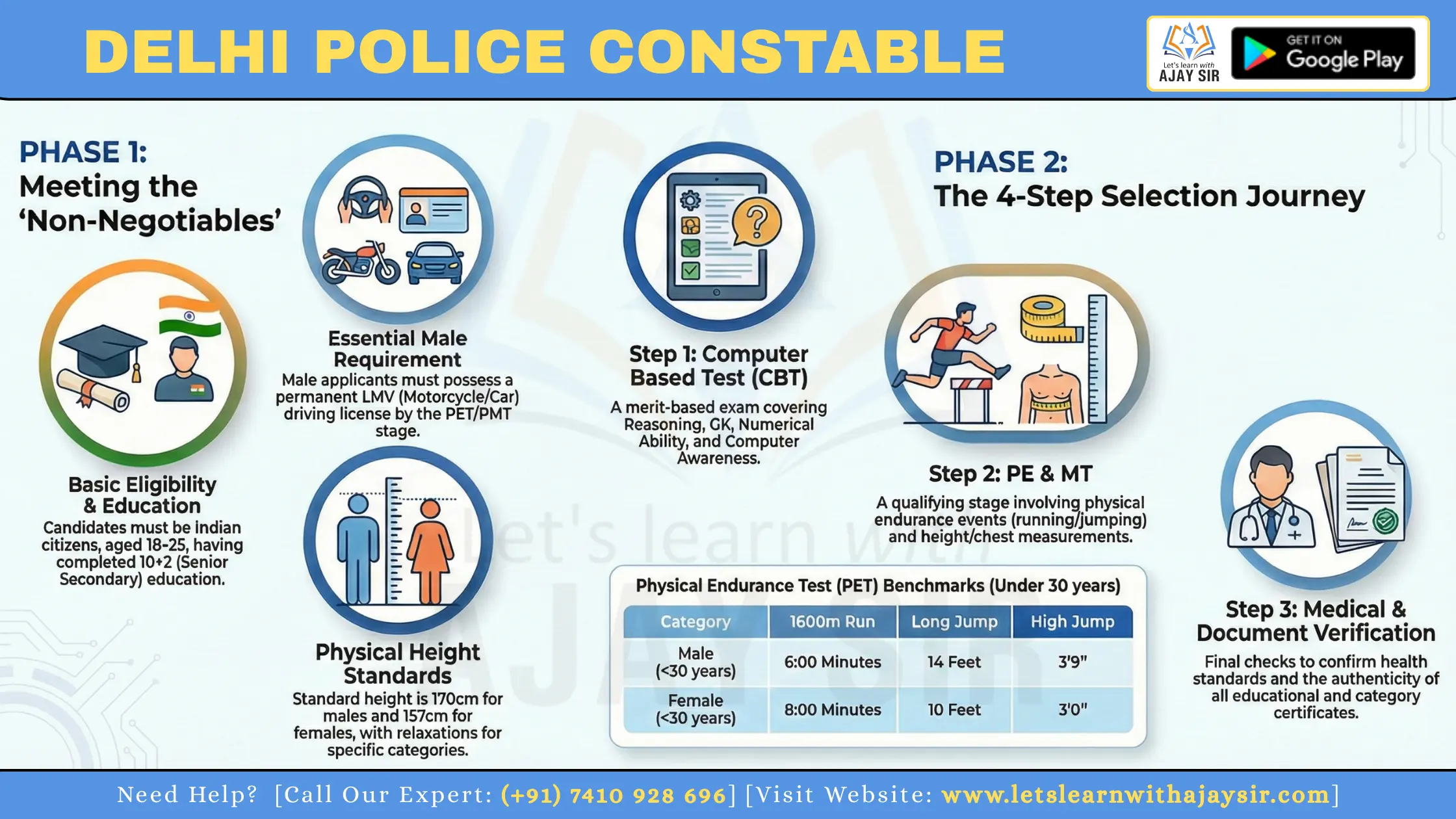
The standard age range is 18 to 25 years. This age limit is verified at the application stage and again at document check.

Relaxations follow central government norms: OBC +3 years, SC/ST +5 years. Certain groups — state-level sportspersons, and widowed or divorced women — get +5 years. Children of serving or former force members may be eligible up to 29 years. Departmental upper caps differ by category (General 40, OBC 43, SC/ST 45).

Educational qualification and recognised boards

The minimum qualification is completion of 10+2 (Senior Secondary) from a recognised board or university. Some post-specific rules may permit 11th standard in notified cases, so check the official notice before applying.

Nationality requirement

You must be an Indian citizen; this is strictly checked during verification.

Driving licence rule for male candidates

Male candidates need a valid, permanent LMV licence (motorcycle/car) by the PET/PMT stage. Learner permits are not accepted, so secure a full licence early.

Requirement

What is needed

Notes

Age limit

18–25 years

Category relaxations apply as per rules

Qualification

10+2 from recognised board university

Some roles allow 11th-standard relaxation if notified

Nationality

Indian citizen

Checked at document verification

Driving licence (male)

Permanent LMV licence

Must hold by PET/PMT; learner not accepted

Keep these documents safe: educational certificates, caste/category proof, sports certificates, and any divorce or widow proof you may need to claim relaxations. Confirm eligibility criteria early to avoid issues while applying to Delhi police or later stages.

Delhi Police Constable: PST/PMT

This section explains the physical thresholds you must meet during the PST/PMT and why they matter for selection.

Male height and chest requirements

The standard male height is 170 cm for the General category. Certain groups — Garhwalis, Kumaonis, Gorkhas, Dogras, Marathas, North‑East areas, Kashmir/Leh‑Ladakh, ST and Ex‑Servicemen — have 165 cm as the baseline.

Chest for General males: 81 cm unexpanded to 85 cm expanded, with a minimum 4 cm expansion. Specified groups may use 76–80 cm with the same expansion rule.

Note a further 5 cm relaxation in height for residents of hilly areas, ST candidates and ex‑servicemen.

Female height requirements

Female candidates must meet a height of 157 cm (General). There is a 5 cm relaxation for hill areas, SC/ST and daughters of serving, retired or deceased force personnel.

What the measurement test checks and how to prepare

The measurement stage checks height and chest (unexpanded versus expanded). The measurement test is straightforward: officials measure standing height and chest expansion using standard tools.

Prepare with good posture, steady hydration and sensible weight management. Avoid risky "height hacks" on the day. Focus on consistent physical fitness and practice standing and breathing calmly for the chest check.

Tip: cross‑check the final PST/PMT table in the official notice, as category rules may be updated.

Delhi Police Constable Exam 2026: Physical Endurance Test

You must train for a mix of timed runs and explosive jumps if you want to clear the physical endurance stage. The PET checks speed, power and recovery across four core events: a 1600 m run, long jump, high jump and a 6 kg shot put.

PET events you will face

Expect the 1600 m to be the key stamina check. The jumping events assess technique and leg power. Shot put measures upper‑body strength. Practise each event under timed conditions and on similar surfaces to the test.

Benchmarks: male by age bracket

Age bracket

1600 m (target)

Long jump

High jump

Up to 30 years

6:00 minutes

14 ft

3'9"

30–40 years

7:00 minutes

13 ft

3'6"

Above 40

8:00 minutes

12 ft

3'3"

Benchmarks: female by age bracket

Age bracket

1600 m (target)

Long jump

High jump

Up to 30 years

8:00 minutes

10 ft

3'

30–40 years

9:00 minutes

9 ft

2'9"

Above 40

10:00 minutes

8 ft

2'6"

Convert these numbers into a weekly plan: build pace for the run, add plyometrics for the long jump, practised approach for the high jump, and throws for shot put. Prioritise recovery to avoid injury.

Remember the PET is qualifying. Passing this endurance test lets you move forward in the wider selection process towards medical and document stages.

Syllabus

Delhi Police Constable: Exam pattern and syllabus

Knowing the syllabus and how marks are allocated helps you shape a smart revision timetable. The standard CBT covers four core subjects so you can allocate time by return on effort.

Subjects to focus on

The paper includes: Reasoning Ability, General Knowledge/Current Affairs, Numerical Ability and Computer Awareness. Practise short, timed sets for each subject to build speed and accuracy.

How this differs by post

Post

Core subjects

Additional focus

Constable level

Reasoning, GK, Numerical, Computer

Speed and basic computer concepts

SI / Inspector

Same core subjects

English comprehension and higher-level reasoning

Strategy change

Practice same format

Adjust mocks to include English for officer posts

Using past trends and weightage to plan revision

Analyse previous papers to spot recurring topics and question weightage based on previous year trends. Prioritise those topics first; they yield the quickest gains for your study hours.

  1. Make daily GK notes and review weekly.

  2. Split numerical practice into short timed drills to raise speed.

  3. Do focused computer sessions of 20–30 minutes rather than long textbook study.

Tip: align mock tests to the exact post you are applying for so score analysis tells you where to improve.

Selection Process

Delhi Police Constable: Selection Process

A clear stage map stops surprises and keeps your effort focused on the right deadlines and tests. Follow each step in order so you balance revision and physical training without burning out.

Typical stages you will go through

The usual route is: Written exam (CBT) → PE & MT → Medical exam → Document verification → Final merit list. For some roles an interview may be added.

What each stage checks and why it matters

CBT (examination) is merit‑based and decides who moves to the physical round. Treat it as high‑weight: practise papers and time management.

PE & MT is qualifying — endurance events plus measurements. Your training must split time between books and fitness to avoid elimination here.

Medical and document verification confirm fitness and identity. Missing or incorrect papers are a common, avoidable cause of rejection.

When interviews apply

Interviews are role‑dependent. For most constable posts you will not face one, so do not over‑prepare for interviews at the expense of CBT and PE & MT.

  1. Plan study blocks for the CBT first.

  2. Schedule weekly fitness sessions for PE & MT.

  3. Keep originals and photocopies of all documents ready from day one.

Stage

Nature

Typical outcome

Action for you

CBT

Merit‑based written test

Shortlisted for PE & MT

Practice papers, time strategy

PE & MT

Qualifying physical tests

Pass/fail to medical

Balanced fitness and technique

Medical

Health and fitness check

Cleared for DV

Maintain records, follow rest

Document verification

Identity/eligibility checks

Final merit and appointment

Organise originals, certificates


How to Apply

Delhi Police Constable: How to apply online

Start your application at the SSC portal; this is the official website where forms are published and fees are collected. Always cross‑verify any notice on the force’s official website to avoid fake links and last‑minute surprises.

Where you will apply and how to verify notices

Use ssc.gov.in as the primary platform for applying for Delhi police posts. After you submit, check the force’s official website to confirm timelines and corrigenda.

Documents and details to keep ready

  • Personal details and recent passport photograph and signature.

  • 10+2 qualification certificate and board name from a recognised board or university.

  • Category certificates for reservations and ID/address proofs (Aadhaar, passport, etc.).

  • Male candidates: permanent LMV driving licence (required by PET/PMT).

Common form‑filling mistakes to avoid

Check spellings against your matriculation certificate, choose the correct category, and follow photo/signature size rules. Save the fee receipt, submitted PDF and screenshots of the successful submission.

Step

Action

Why it matters

Visit SSC portal

Fill form and upload documents

Primary submission point; keeps record

Verify

Cross‑check on official website

Avoid fake notices and last‑minute changes

Save proofs

Download PDF and take screenshots

Needed for queries and document verification


All Details

Delhi Police Constable: Answer key, result, merit list, and cut-off

Knowing how to use the answer key and the result PDF helps you act fast. When the official answer key is released, you can estimate your score and decide whether to file an objection within the short window.

How to check the answer key and submit objections

Visit the SSC website and open the notification for the Constable (Executive) exam. The last cycle's answer key was published on 13 January 2026, with objections accepted until 16 January 2026.

Compare your responses with the official key, calculate your tentative score, and prepare evidence if you plan to object. Objection windows close quickly, so act the same day you spot an error.

How to download the result PDF and find your roll number

SSC posts the delhi police constable result 2026 as a downloadable PDF under the Results tab.

  1. Go to the SSC site → Results → locate the Constable (Executive) result.

  2. Download the PDF and use Ctrl+F to search your roll number or name.

The result PDF lists candidates shortlisted for PE & MT and the provisional merit list for the stage that follows.

What cut-off marks depend on and how to interpret them

Cut-off marks change each cycle. Key drivers are the number of candidates, difficulty of the paper, vacancy count (7,565 in the referenced cycle) and category-wise reservations.

Interpret cut-offs calmly: a lower cut-off doesn’t mean lower standards — it often reflects tougher papers or more applicants. Use past cut-offs as a guide, not a rule.

What happens after the result: PE & MT call-up and next-stage readiness

If your name or roll number appears, you move to PE & MT, then medical and document verification. This is still part of the wider selection process, not the final appointment.

  • Keep the result PDF and print extra copies for document checks.

  • Start focused PET practice immediately and confirm your measurement documents.

  • Track official notices to avoid missing call‑up dates or venue changes.

Tip: always download and archive the SSC PDFs and related notices; they are needed at verification and for any future queries.

Item

Where to find

Action

Answer key

SSC website – notifications

Estimate score, file objections fast

Result PDF

SSC → Results tab

Download & search with Ctrl+F

Cut-off

Result document / notice

Compare by category and vacancy to gauge chances

Conclusion

Close your preparation gap by tracking official dates, confirming eligibility criteria and training in parallel for the written test and physical stages. Use the official website ecosystem (SSC and the force portal) for every notice, corrigendum and result PDF.

Keep a short checklist: confirm age limit and category proofs, ensure 10+2 qualification is ready, and (for male candidates) secure a valid LMV driving licence before the PET/PMT. Treat physical fitness and physical endurance as daily habits, not last‑minute sprints.

When the answer key and result PDFs appear, act fast: calculate scores, save documents and shift into the next stage if shortlisted. Follow the recruitment process with accurate form filling, consistent practice and organised paperwork to reduce avoidable mistakes and stay in contention.

FAQs

Welcome to Let's Learn with Ajay Sir — Your trusted platform for mastering English Grammar and Literature. We are dedicated to providing high-quality educational content, insightful articles, interactive quizzes, and the latest exam updates to empower learners at every level. Join us on this enriching journey toward academic excellence and lifelong learning.