Syllabus
Delhi Police AWO TPO: Exam Pattern
Know the exact CBT layout so you can divide time and target high‑value topics on test day.
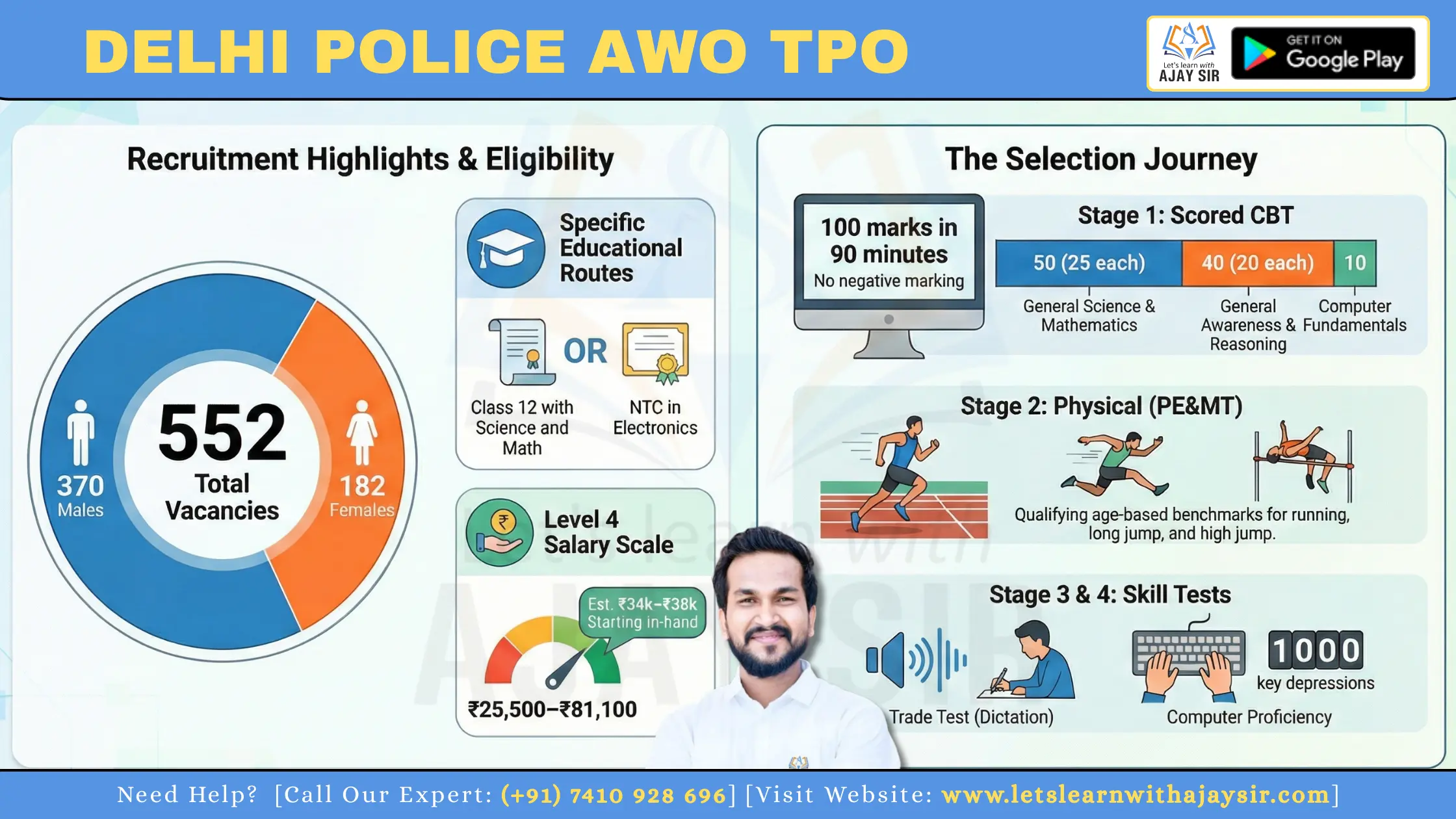
The computer‑based test has 100 questions for 100 marks to be completed in 90 minutes. Each question carries one mark and you will not lose marks for incorrect answers.
Total questions, marks, and duration
This means you get roughly 54 seconds per question if you try to answer all. Plan time per section based on difficulty rather than equal splits.
Section-wise weightage
Section | Questions | Marks |
General Awareness | 20 | 20 |
General Science | 25 | 25 |
Mathematics | 25 | 25 |
Reasoning | 20 | 20 |
Computer Fundamentals | 10 | 10 |
Negative marking rule and strategy
The official position: no negative marking for this CBT. That reduces the penalty for educated guesses but does not replace smart time use.
Prioritize Mathematics and General Science — together they form half the paper.
Answer quick General Awareness and Reasoning items early to build confidence and bank marks.
Skip time‑consuming problems on first pass; mark and return if time allows.
Since each question = one mark, focus on accuracy and speed to raise your cutoff chances.
Suggested section order: Reasoning → GA → Math → Science → Computer, or adjust to your strengths.
Practical tip: practice full 90‑minute mocks to learn pacing. That beats theoretical plans on test day.
Delhi Police AWO TPO: Syllabus
This syllabus breakdown shows the exact topics that regularly appear in the exam. Use it to build weekly targets and timed practice sessions.
General Awareness
Focus areas: India and neighbouring countries, polity and constitution, economy, geography, history, culture, environment, and current affairs. Cover recent national events and basics of governance.
General Science
Physics: thermodynamics, Newton’s laws, gravity and motion, pressure and units, sound, heat & temperature, basic electronics, magnetism, Ohm’s law, fibre optics and modes of communication.
Chemistry: everyday chemicals, catalysts and reactions, chemical vs physical change, common acids (H2SO4, HCl), atomic numbers, element symbols, and basics of electrochemistry.
Mathematics
Number systems, percentage, SI/CI, profit & loss, discount, ratio, averages, algebra, geometry, mensuration, time-distance-work, trigonometry, data interpretation, series, permutation & combination, and simplification.
Reasoning
Non‑verbal reasoning, analogies, series, coding‑decoding, input‑output, blood relations, directions, Venn diagrams, seating arrangements, syllogism, inequalities, and data sufficiency.
Computer Fundamentals
Basic computer knowledge plus MS Word and Excel tasks, email and communication, and internet fundamentals. Practice practical typing and formatting to help both objective questions and the qualifying skill test.
"Convert this checklist into weekly modules — consistent practice beats last‑minute cramming."
Subject | Typical CBT weight (approx) | Study tip |
General Awareness | 20 marks | Daily current affairs + static GK |
General Science | 25 marks | Concepts + formula revision |
Mathematics | 25 marks | Timed problem sets |
Reasoning & Computer | 30 marks | Practice puzzles + MS Office drills |
Delhi Police AWO TPO: PE&MT standards
This section gives exact physical benchmarks so you can train with purpose for the PE&MT. Treat this as a qualifying stage: even top CBT scores won’t help if you fail these checks. Below are the run and jump requirements by age and the measurement norms you must meet.
Male PET requirements by age group
Up to 30 years: 1600 m in 7 minutes; long jump 12½ ft; high jump 3½ ft.
30–40 years: 1600 m in 8 minutes; long jump 11½ ft; high jump 3¼ ft.
40+ years: 1600 m in 9 minutes; long jump 10½ ft; high jump 3 ft.
Female PET requirements by age group
Up to 30 years: 800 m in 5 minutes; long jump 9 ft; high jump 3 ft.
30–40 years: 800 m in 6 minutes; long jump 8 ft; high jump 2½ ft.
40+ years: 800 m in 7 minutes; long jump 7 ft; high jump 2¼ ft.
PMT height and chest standards (including relaxations)
Male height: 170 cm, relaxable by 5 cm in certain categories. Chest: 81–85 cm with minimum 4 cm expansion on respiration.
Female height: 157 cm, relaxable by 5 cm in allowable cases. There is no chest requirement for female candidates.
Parameter | Male | Female |
Height | 170 cm (relaxable by 5 cm) | 157 cm (relaxable by 5 cm) |
Chest | 81–85 cm; min 4 cm expansion | Not required |
Practical tip: Practice timed runs, drills for jump technique, and measure chest expansion periodically. Many candidates fail on avoidable details like footwear, warm-up, or incorrect measurement posture.
Delhi Police AWO TPO: Trade test and Computer Proficiency Test
Before you sit any practical checks, you should know exactly what the trade and computer tests will ask you to do. This section explains the formats, measurable targets, and simple practice routines so you enter the room calm and prepared.
Trade test (reading & dictation) overview and evaluation
The trade test is qualifying in nature and focuses on reading clarity and dictation accuracy. Examiners look for neat handwriting, correct spelling, and timely completion.
During dictation, you must capture spoken lines with minimal errors. Accuracy matters more than speed; make legible corrections when needed.
English word processing: speed, accuracy, and disqualification rules
The English word processing benchmark is precise: 1000 key depressions in 15 minutes. If you make 25 or more mistakes, you face disqualification.
Practice with a timer and focus on reducing error types like transposed letters, omitted words, and incorrect punctuation.
Basic computer functions checklist
Expect short practical tasks that mirror daily office work. You should be able to:
Start and shut down a PC and log in safely.
Open, edit, save, and print documents in MS Office.
Format paragraphs, apply numbering, and modify text as instructed.
Set up a simple daily practice environment: a laptop or desktop with MS Word, a basic timer app, and short drills that combine typing with formatting tasks.
Tip: Treat these as job‑related checks. Focus on controlled accuracy, not frantic speed. That approach wins for candidates preparing for the tpo / awo tpo qualifying stages.