CTET: Exam centres and city preference
Choosing exam cities wisely reduces travel stress and keeps you focused on preparation. During the application form you must pick test cities carefully to avoid last‑minute problems. The city intimation slip, released on 23 January 2026, gives early notice of your allotted city so you can plan before the admit card arrives.
How many test-city choices you can select and how allotment works
You may select up to four test‑city preferences in the CTET application. Allotment is based on centre capacity, availability and seat distribution.
CBSE can allot a different centre if your chosen cities are full or unavailable. That is why strategic choices matter; random, distant picks increase the chance of an inconvenient allotment.
Planning travel using your city intimation slip
The city intimation slip tells you the city well ahead of the exam so you can book travel and lodging early. Treat it as a planning tool rather than waiting for the admit card.
Use this travel‑planning checklist:
Confirm route options (train/flight/bus) and realistic travel time.
Allow buffer time—arrive a day earlier where possible to avoid same‑day risks.
Prepare fallback plans if the allotted city differs from your first choice.
Keep scanned copies of your application form, fee receipt and ID ready for verification.
Regularly check the official website for updates and download the slip and admit card early to avoid technical delays on exam day.
CTET: Admit card
Download your admit card as soon as it is live on the official website. The city intimation slip is due on 23 January 2026 and the admit card is expected about two days before the exam date (expected 6 February 2026).
How to download and what to check
Log in with your application ID and password, choose the admit card link and save both a PDF and a printed copy. Do this early to avoid site congestion.
Verify immediately: your name, photo, roll number, paper(s), language choice, exam city/centre address, exam date and reporting time. Check the reporting time against the city slip.
If you spot an error
Contact the helpdesk listed in the information bulletin and use the portal contact form without delay. Keep screenshots of the admit card and your application for proof.
Exam‑day checklist and arrival plan
Printed admit card and a valid photo ID (original).
Black/blue ballpoint pen and permitted stationery for the OMR sheet.
Arrive early — allow time for security and locating the centre entrance.
A small bottle of water and face mask if required by centre rules.
Key exam hall instructions
Follow seating directions, mark the OMR carefully, manage time per section and avoid prohibited items such as phones or smartwatches. Stay calm, read questions fully, and attempt all items strategically to make the most of the ctet exam window.
CTET: Answer key, response sheet and objections process
After the exam, the board posts a provisional answer key and your response sheet so you can cross-check answers and estimate your score before the result is declared. This is the first formal chance to verify how you performed and to spot any discrepancies.
Where to check and download the provisional key
Find the provisional answer key and response sheet on the official website. Log in with your application credentials, locate the answer‑key / challenge portal and download the PDF versions. Rely only on the portal copies—third‑party uploads may be incomplete or altered.
How the objection facility works
Identify the question number and the option you wish to challenge after comparing the key with your response sheet.
Prepare a short justification and cite authoritative sources or syllabus excerpts to support your claim.
Submit the objection through the portal and pay the objection fee of ₹1000 per question (non‑refundable).
Track your submission status on the portal; keep PDFs or screenshots of the submission and payment receipt.
Final answer key release and effect on results
CBSE reviews all valid challenges, revises the provisional key if needed and releases a final answer key. The final key is the basis for result calculation. If an answer is changed, marks are adjusted accordingly and the revised key stands for all candidates.
Use the provisional key to estimate score and plan next steps, but wait for the final key before making decisions.
Only raise objections when you have strong documentary support, since the fee is non‑refundable.
Keep records: screenshots/PDFs of your objection and payment for future reference.
CTET: Question papers and previous year papers
Working through past papers is the fastest way to mirror real exam conditions and spot weak areas. Use official question papers released by CBSE on the board's portal to practise exact MCQ formats.
How practising previous year papers improves speed and accuracy
Begin by timing each full paper to match the exam pattern: 150 questions in 150 minutes. This builds stamina and helps you find a steady pace.
Regular practice trains you to distinguish similar options in pedagogy and language items. As accuracy rises, you gain confidence for the real ctet exam.
Turning question papers into a weekly mock-test routine
Create a simple weekly plan: one full-length timed mock, one analysis session and one targeted revision. Repeat this cycle to turn mistakes into improvements.
Mock: simulate exam day with strict timing and no interruptions.
Analyse: mark wrong answers, note why you missed them and reference syllabus lines.
Revise: focus on weak topics shown in your error log.
"Convert each paper into an error log: concept gaps, silly mistakes and time sinks."
Routine | Action | Frequency | Benefit |
Full mock | 150 Qs in 150 mins under exam conditions | Weekly | Builds pacing and stamina |
Deep analysis | Review each wrong answer with source notes | Weekly | Improves accuracy and concept clarity |
Targeted revision | Short sessions on error-log topics | 2–3 times a week | Eliminates repeated mistakes |
Section tracking | Record scores for CDP, languages, maths, EVS/SS | After every mock | Prioress high-impact improvements |
Practical tip: keep a running count of time spent per 10‑question block to learn where you lose time. Track section-wise trends so you prioritise study where it returns the most marks.
CTET: Result, cut-off and qualifying marks
When results appear online, a clear process helps you interpret your performance and move forward. Results are expected by the end of March (roughly 15–20 days after the exam window). You should check your result from the official portal using your login credentials as soon as the board publishes it.
How to check your result and what to save
Log in with your application ID and password, open the result link and download the scorecard PDF. Save a digital copy and print one for verification during recruitment.
Download: scorecard, provisional certificate (if issued) and the detailed marksheet.
Verify: your name, roll number, paper(s) and total marks immediately.
Store: keep copies in email and cloud storage for quick access during applications to central government schools or other employers.
Qualifying marks vs recruitment cut-offs
The exam uses a qualifying benchmark — typically 60% — to award the teacher eligibility certificate. That is different from recruitment cut-offs.
Recruitment cut-offs vary widely by state, district and school. A high qualifying score helps, but individual hiring panels set their own thresholds when they advertise vacancies.
Category relaxations and what they mean
Some categories receive relaxations in the qualifying percentage. These relaxations differ by category and are listed in the official notification.
Tip: always verify the exact relaxation rules for your category in the information bulletin before you act on assumptions.
What clearing the exam does — and does not — guarantee
Clearing the paper confirms your teacher eligibility and makes you eligible to apply for jobs in central government and other schools that require the certificate.
It does not guarantee a job. You must still apply to recruitment drives, meet other selection criteria and pass any local selection stages.
Practical post-result plan
Organise documents: scorecard, ID, training certificates and mark sheets.
Shortlist target schools, including central government institutions and private options.
Set a calendar for upcoming recruitment notifications and application deadlines.
Prepare for interviews or additional selection tests as required by hiring bodies.
Item | Action | Why it matters |
Scorecard | Download & print | Required for verification during applications |
Qualifying mark | Check percentage | Determines teacher eligibility certificate |
Recruitment | Apply to vacancies | Hiring decisions are separate from the eligibility test |
Conclusion
Use this short wrap-up to lock in the dates, documents and study moves that matter most for the ctet exam.
Recap: from the CTET 2026 notification and the online application form to the exam pattern, syllabus and final preparation, follow a simple timeline. Note the notification, application deadline, correction window, city slip, admit card timing, exam date and the tentative result month.
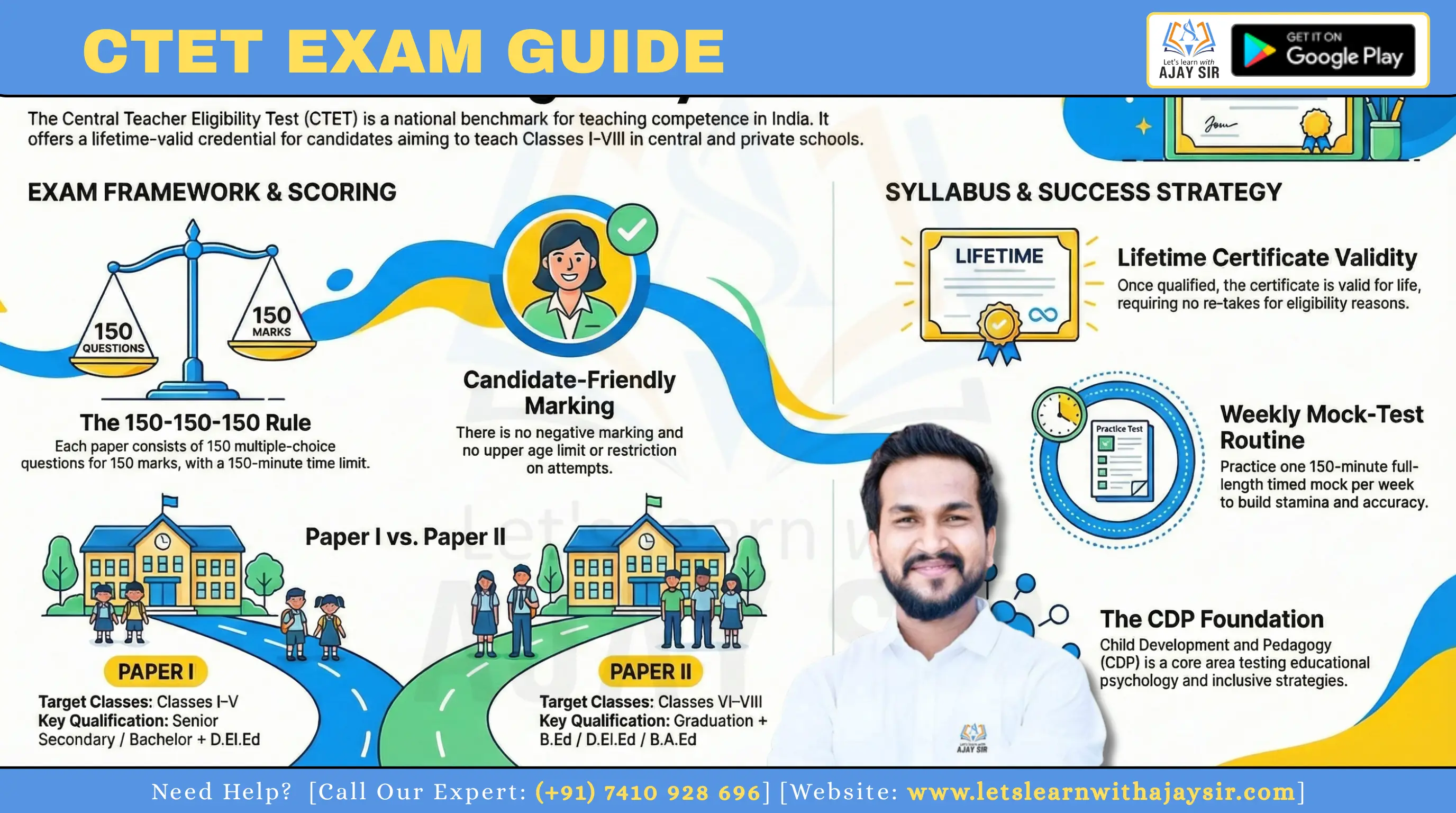
Before you apply, double‑check your eligibility criteria, paper choice, language options and form details. Remember the basics: offline OMR, two papers, 150 questions/150 marks/150 minutes and no negative marking.
Qualifying earns a ctet certificate with lifetime validity and opens doors to central government schools and other employers that require this teacher eligibility test.